Law Enforcement and Justice
Understanding how AI is changing policing and security, and the growing need to safeguard individual rights.

Building an AI pipeline to comb through millions of local statutes, researchers at Stanford Law School turn a spotlight on unsavory laws still on the books in communities across the country.
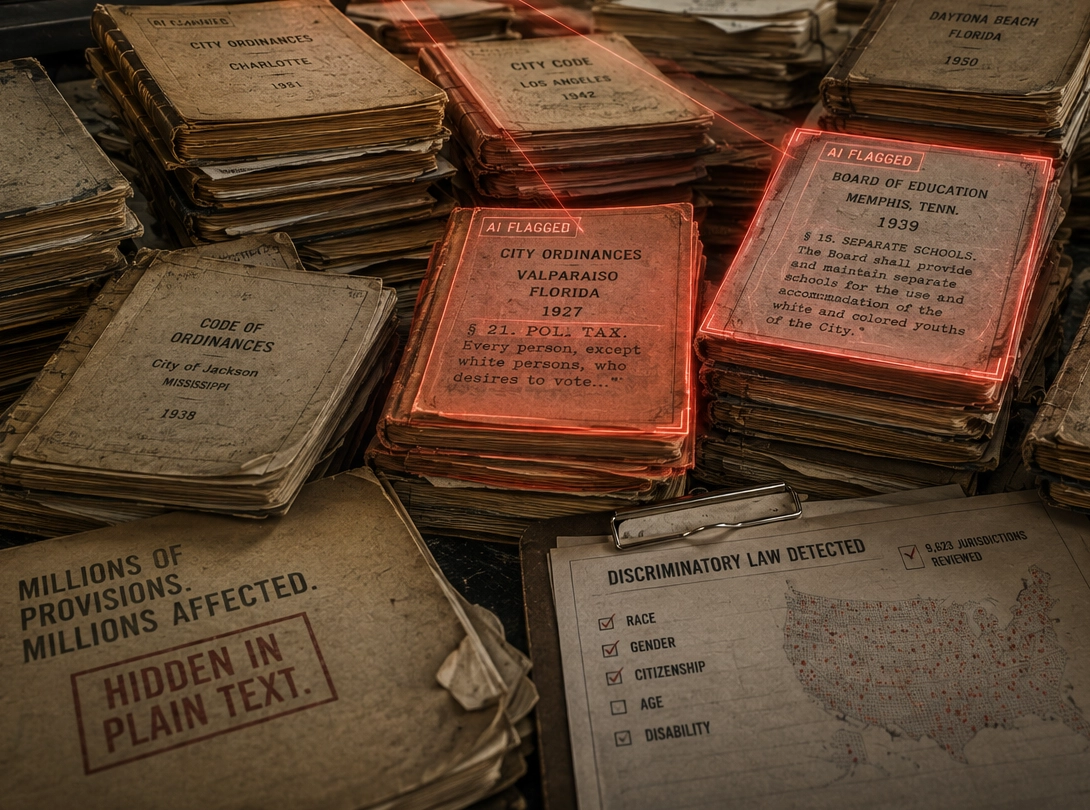
Building an AI pipeline to comb through millions of local statutes, researchers at Stanford Law School turn a spotlight on unsavory laws still on the books in communities across the country.
A New Direction for Machine Learning in Criminal Law
This brief proposes a machine learning approach to studying decision-making in the criminal legal system as a way to identify and reduce systemic inequalities.
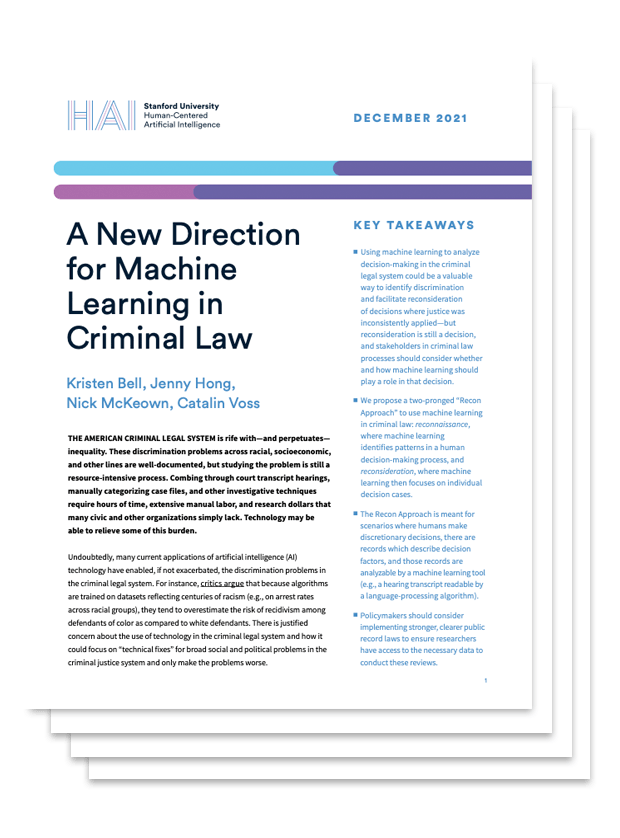
This brief proposes a machine learning approach to studying decision-making in the criminal legal system as a way to identify and reduce systemic inequalities.



Increasing reliance on language models for legal tasks have led to calls for more information about the likelihood and severity of potential errors. Realizing useful and robust transparency requires an institutional perspective, say the editors of a new special section in PNAS.

Increasing reliance on language models for legal tasks have led to calls for more information about the likelihood and severity of potential errors. Realizing useful and robust transparency requires an institutional perspective, say the editors of a new special section in PNAS.
As AI-hallucinated case citations flood the courts, judges have increased fines for attorneys who have cited fake cases. HAI Policy Fellow Riana Pfefferkorn hopes this will "make the firm sit up and pay better attention."
As AI-hallucinated case citations flood the courts, judges have increased fines for attorneys who have cited fake cases. HAI Policy Fellow Riana Pfefferkorn hopes this will "make the firm sit up and pay better attention."
Jennifer King, Policy Fellow at the Stanford HAI who specializes in privacy, discusses vagueness in the TSA’s public communications about what they are doing with facial recognition data.
Jennifer King, Policy Fellow at the Stanford HAI who specializes in privacy, discusses vagueness in the TSA’s public communications about what they are doing with facial recognition data.
All Work Published on Law Enforcement and Justice
“It connects back to my fear that the people with the fewest resources will be most affected by the downsides of AI,” says HAI Policy Fellow Riana Pfefferkorn in response to a viral AI-generated deepfake video.
“It connects back to my fear that the people with the fewest resources will be most affected by the downsides of AI,” says HAI Policy Fellow Riana Pfefferkorn in response to a viral AI-generated deepfake video.
"The biggest difference between 23andMe and other breaches is that sequenced DNA is 'irreplaceable and immutable,' said Jennifer King," a Stanford HAI Policy Fellow.
"The biggest difference between 23andMe and other breaches is that sequenced DNA is 'irreplaceable and immutable,' said Jennifer King," a Stanford HAI Policy Fellow.

Stanford law professor advocates for public-sector AI tools to support self-represented litigants in civil cases.
Stanford law professor advocates for public-sector AI tools to support self-represented litigants in civil cases.


At a recent Stanford-MIT-Princeton workshop, experts highlight the need for legal protections, standardized evaluation practices, and better terminology to support third-party AI evaluations.
At a recent Stanford-MIT-Princeton workshop, experts highlight the need for legal protections, standardized evaluation practices, and better terminology to support third-party AI evaluations.

Stanford's RegLab, directed by HAI Senior Fellow Daniel E. Ho, developed an AI model that helped Santa Clara accelerate the process of flagging and mapping restrictive covenants.
Stanford's RegLab, directed by HAI Senior Fellow Daniel E. Ho, developed an AI model that helped Santa Clara accelerate the process of flagging and mapping restrictive covenants.
Dan Ho, HAI Senior Fellow and director of the Stanford RegLab, discusses RegLab's AI model that analyzes decades of property records, helping to identify illegal racially restrictive language in housing documents.
Dan Ho, HAI Senior Fellow and director of the Stanford RegLab, discusses RegLab's AI model that analyzes decades of property records, helping to identify illegal racially restrictive language in housing documents.