Stanford
University
  • Stanford Home
  • Maps & Directions
  • Search Stanford
  • Emergency Info
  • Terms of Use
  • Privacy
  • Copyright
  • Trademarks
  • Non-Discrimination
  • Accessibility
© Stanford University.  Stanford, California 94305.
My Summer of Learning: Inside Stanford HAI’s AI4ALL Program | Stanford HAI

Stay Up To Date

Get the latest news, advances in research, policy work, and education program updates from HAI in your inbox weekly.

Sign Up For Latest News

Navigate
  • About
  • Events
  • Careers
  • Search
Participate
  • Get Involved
  • Support HAI
  • Contact Us
Skip to content
  • About

    • About
    • People
    • Get Involved with HAI
    • Support HAI
    • Subscribe to Email
  • Research

    • Research
    • Fellowship Programs
    • Grants
    • Student Affinity Groups
    • Centers & Labs
    • Research Publications
    • Research Partners
  • Education

    • Education
    • Executive and Professional Education
    • Government and Policymakers
    • K-12
    • Stanford Students
  • Policy

    • Policy
    • Policy Publications
    • Policymaker Education
    • Student Opportunities
  • AI Index

    • AI Index
    • AI Index Report
    • Global Vibrancy Tool
    • People
  • News
  • Events
  • Industry
  • Centers & Labs

My Summer of Learning: Inside Stanford HAI’s AI4ALL Program

AI4All participant Anandita Mukherjee shares her experience in an immersive two-week AI learning experience.

Anandita Mukherjee took part in this year's AI4All program through Stanford HAI. The program offers high school students a chance to learn about artificial intelligence, how to build it, and its impact. | Jeanina Matias

Anandita Mukherjee
Link copied to clipboard!
August 06, 2025
Anandita Mukherjee
August 06, 2025
Education, Skills
Share:
Link copied to clipboard!

Related News

Stanford HAI and Swiss National AI Institute Form Alliance to Advance Open, Human-Centered AI
Jan 22, 2026
Announcement
Your browser does not support the video tag.

Stanford, ETH Zurich, and EPFL will develop open-source foundation models that prioritize societal values over commercial interests, strengthening academia's role in shaping AI's future.

Announcement
Your browser does not support the video tag.

Stanford HAI and Swiss National AI Institute Form Alliance to Advance Open, Human-Centered AI

Education, SkillsJan 22

Stanford, ETH Zurich, and EPFL will develop open-source foundation models that prioritize societal values over commercial interests, strengthening academia's role in shaping AI's future.

What Parents Need to Know About AI in the Classroom
Nikki Goth Itoi
Sep 29, 2025
News

From immersive learning and personalized tutors to lesson plans and grading, AI is everywhere in K-12 education.

News

What Parents Need to Know About AI in the Classroom

Nikki Goth Itoi
Education, SkillsSep 29

From immersive learning and personalized tutors to lesson plans and grading, AI is everywhere in K-12 education.

How Math Teachers Are Making Decisions About Using AI
Christopher Mah, Dora Demszky, Helen Higgins
Sep 15, 2025
News

A Stanford summit explored how K-12 educators are selecting, adapting, and critiquing AI tools for effective learning.

News

How Math Teachers Are Making Decisions About Using AI

Christopher Mah, Dora Demszky, Helen Higgins
Education, SkillsSep 15

A Stanford summit explored how K-12 educators are selecting, adapting, and critiquing AI tools for effective learning.

This summer, 86 students took part in AI4All, a two-week program run by the Stanford Institute for Human-Centered AI designed to increase inclusion in the field of artificial intelligence by immersing high school students in AI. The students engaged in daily lectures from Stanford scholars, exciting hands-on research projects, and mentoring activities from experts in medicine, robotics, autonomous vehicles, and more.

Anandita Mukherjee, a 15 year old rising 10th grade student from Palo Alto, California, participated in this year’s cohort. She kept a daily journal of her experiences in the program. A condensed version is shared here.


The first day of Stanford AI4ALL left me both inspired and eager for what’s to come. We began the morning with a talk from HAI Distinguished Fellow Peter Norvig, whose work has shaped modern AI. He placed AI within the broader story of intelligence, not only in machines but in the natural world, and explained the difference between traditional software and AI. With code, you tell the computer exactly what to do. With AI, you show it examples, and it learns from them. This changes how we interact with these systems and how they learn to solve problems.

What made his talk especially meaningful to me was his focus on AI’s potential to improve education by making it more equitable, effective, and accessible, something I care about deeply. 

Later in the morning, we gathered with our Medical AI cohort — bringing together students across Canada, China, and different corners of the U.S.

Our mentors guided us through the evolving landscape of Medical AI. We explored how AI is already transforming medicine, from clinical decision support tools that assist healthcare providers to models that predict patient outcomes or accelerate drug discovery. But alongside these advancements, we were encouraged to think critically about issues around data quality, algorithmic bias, patient privacy, and the ethical implications of AI in the medical workforce. 

Our upcoming project will give us the opportunity to engage directly with these challenges as we adapt a vision-language model for biomedical image analysis. Through this, we’ll explore how generalist AI models can be carefully tailored to the specific, high-stakes world of healthcare.


Our first speaker of the day was Stanford PhD candidate Chaitanya Patel, who gave an engaging and approachable introduction to machine learning. His talk covered core concepts like supervised, unsupervised, and reinforcement learning, and he emphasized how modern AI models learn not through hand-coded rules, but by extracting patterns from data.

In the afternoon, we had a thought-provoking faculty talk from Ge Wang, Associate Professor at Stanford’s Center for Computer Research in Music and Acoustics. But this wasn’t a technical lecture—it was an invitation to reflect on what we really want from AI.

He urged us to think beyond efficiency and problem-solving, and consider how technology—especially AI—can be designed to reflect human values, creativity, and even struggle.

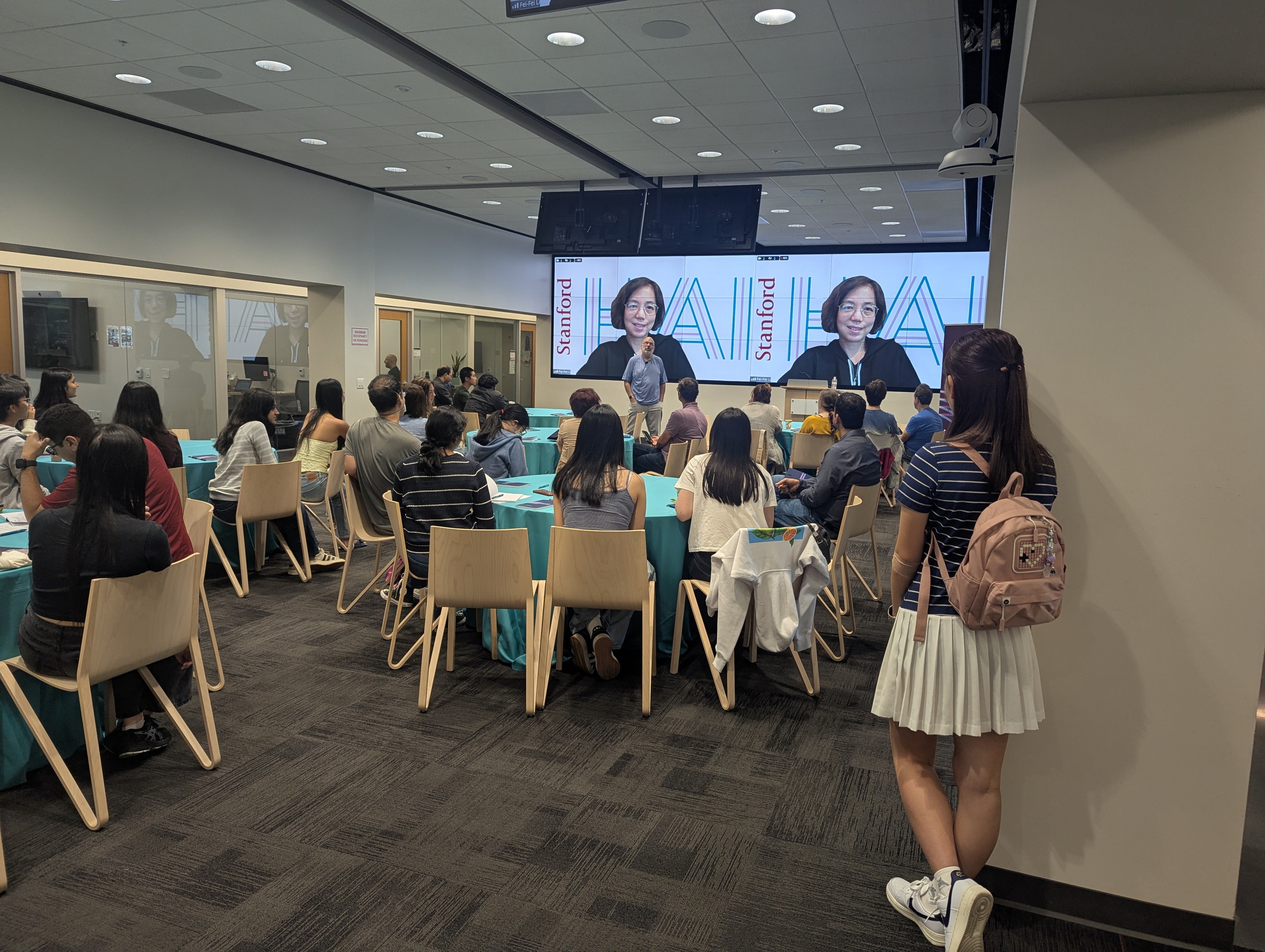
HAI Co-Director Fei-Fei Li shares her insights with students at a recent AI4All event. | Shana Lynch


Today, our Medical AI group took a deeper dive into the complexities of applying artificial intelligence to healthcare through a mix of technical lectures, discussions, and an engaging faculty talk from Dr. Roxana Daneshjou.

Our group sessions walked us through the full lifecycle of building medical AI tools — from collecting and preparing data to training models and evaluating their performance. One of the key takeaways was understanding the role of a validation set. Without it, a model might seem to perform well on test data, but you have no real way of knowing if it’s learning meaningful patterns or simply memorizing the answers. At the same time, especially in healthcare, it’s not always easy to split your data into training, validation, and test sets — high-quality data is hard to come by, and making those trade-offs is often part of the process.

Dr. Daneshjou’s talk highlighted the risks that come with medical AI. Her lab has done important work showing how even advanced models can reflect harmful biases, often inherited from flawed training data. Her team also stress-tests these models through a process called “red teaming,” intentionally pushing AI systems to reveal hidden flaws that even experts might otherwise miss.

One of her key messages was the danger of “automation bias” — the human tendency to place too much trust in AI systems, especially when they sound confident. In healthcare, that overconfidence can lead to severe harm if models are used uncritically.


We started the morning by diving deeper into the technical side of building AI models, jumping into the foundations of linear algebra and probability. It’s easy to get caught up in the excitement of chatbots and generative models, but at its core, AI still depends on the fundamentals—numbers, vectors, and matrices quietly doing the work in the background.

Behind every AI application—whether it’s diagnosing medical images or translating languages—there’s a layer of math making it possible.
— Anandita Mukherjee
AI4All participant

As someone who enjoys math, this part of the lecture was one of my favorites. It was a good reminder that behind every AI application—whether it’s diagnosing medical images or translating languages—there’s a layer of math making it possible. I especially liked revisiting matrix operations, transposes, and norms. Seeing how chest X-ray images are stored as grids of numbers and understanding how those numbers guide AI predictions helped connect the dots between abstract math and real-world applications.

Later in the morning, we put those ideas into practice using Google Colab and the MedMNIST dataset. We loaded medical images, explored the data, and visualized how AI models represent and process information. It definitely made the concepts feel less abstract. It was also satisfying to get some coding time after focusing so much on theory. 


Today we split into smaller groups to start thinking through the problems our work could help address. My group is working with the ChestMNIST dataset, which contains labeled chest X-ray images for detecting a variety of lung conditions. During our breakout room discussion, we focused on two major challenges AI could help tackle: improving healthcare access in under-resourced areas, and reducing the backlog of medical scans that can slow down diagnosis even in well-equipped hospitals. It also gave us a chance to get to know each other better, and it turns out several people in our group share an interest in music—whether that’s singing or playing instruments—so the conversation was a fun mix of AI and shared interests.

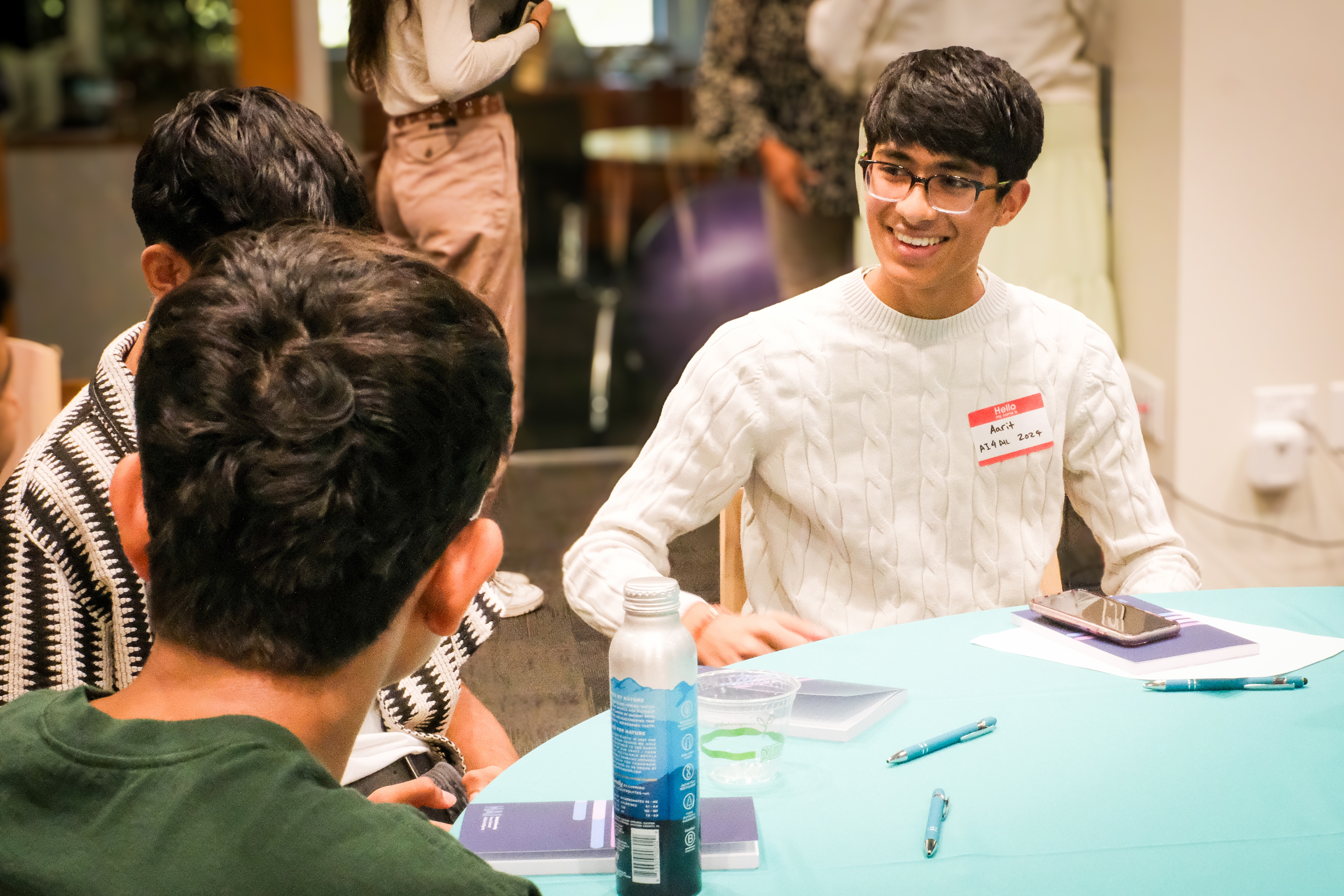
Students connect after a lecture at a recent AI4All event. | Jeanina Matias


Our AI4All task is to build AI models for zero-shot classification on the ChestMNIST and PneumoniaMNIST datasets. That means the models have to predict disease categories without being explicitly trained on those specific tasks. We’ll be working with models like BioMedCLIP and SmolVLM, and experimenting with prompt engineering to improve their accuracy. The project definitely feels ambitious, but having seen the structure and resources laid out, it feels manageable as long as we work together.

We also learned more about prompt engineering—the idea that carefully designing the language prompts we feed into the models can significantly impact performance. It’s a space where medical knowledge, language, and AI all come together, and there’s a lot of room to be creative with how we approach it.


Today felt like a real turning point – we made solid progress on our final projects and explored some of the broader ways AI is being applied.

The morning began with a focused session reviewing the tools we’re using in our projects. Our mentors clarified key concepts like the distinction between classical machine learning and deep learning, particularly how deep learning models can automatically extract features from data and perform classification end-to-end. This is exactly what makes them so powerful for complex tasks like medical image analysis.

We also revisited supervised and unsupervised learning. This naturally led to a deeper discussion of CLIP (Contrastive Language-Image Pre-Training), the vision-language model from OpenAI that plays a big role in our project. CLIP learns to associate images and text using contrastive learning, bringing correct image-caption pairs closer together in feature space. Once trained, it enables zero-shot classification, meaning the model can predict labels for images it hasn’t explicitly seen, simply by comparing the image to textual prompts. This is especially valuable in medical AI, where new, unfamiliar cases often arise.

My group made the decision to switch from ChestMNIST to BloodMNIST, a smaller and more manageable dataset. Running the larger dataset on Google Colab had been challenging, and the switch will make it much easier to collaborate and test our models without worrying about technical limitations.

In the afternoon, we had a faculty talk from Joon Park, whose research on generative agents was one of the most engaging sessions so far. His project, Smallville, uses AI-driven agents that simulate believable human behavior in a sandbox environment. The agents can plan their days, have conversations, remember interactions, and even reflect on their experiences. 

The whole system runs inside a pixelated, game-like interface that immediately reminded me of cozy games like Animal Crossing. It was really fun and charming to watch these little AI agents going about their lives — socializing, making plans, and adapting to their environment — all powered by language models, memory systems, and higher-level reflections that shape their behavior in realistic ways. It was impressive to see how emergent, believable social behaviors could arise from this combination of language models and memory architecture.

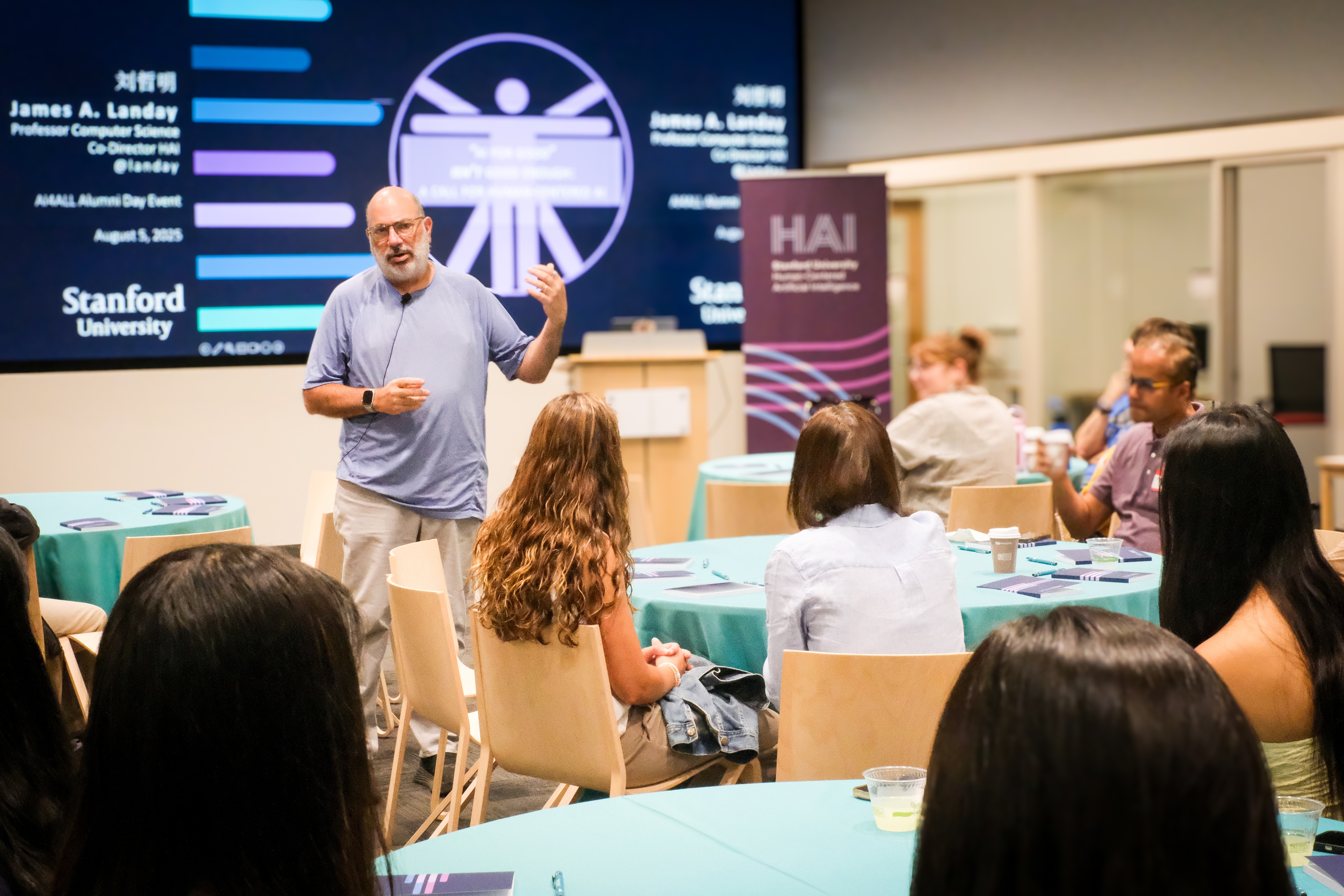
HAI Co-Director James Landay explains human-centered AI at a recent AI4All event. | Jeanina Matias


After working through the technical setup, our group finally got our initial model running — but the results weren’t exactly what we hoped for. With eight possible blood cell classes, random guessing should give us around 12.5% accuracy. Surprisingly, our model performed even worse, with an accuracy of just 11%. It was a good reminder that even with large pre-trained models like BiomedCLIP, applying AI to specialized medical tasks isn’t as straightforward as it sounds. Achieving meaningful performance takes careful design, experimentation, and troubleshooting.

In the afternoon, we shifted gears and got to see AI applied to an entirely different field: self-driving cars. Aurora, a company building autonomous vehicle technology, gave a fascinating demo that broke down how their system works and the challenges that come with making self-driving cars safe and reliable.

We ended the day with team updates. The robotics group has been working on simulating a robotic arm that can sort trash, using AI to tackle sustainability challenges. The computer vision group is applying satellite imagery to predict poverty-stricken areas in Uganda, showing how AI can support global development. And the NLP team is using natural language processing to analyze tweets during disaster scenarios, with the goal of identifying what resources or assistance people need most in real time.

It was exciting to see how, even though our projects are all so different, they each show a unique way AI can be used to address real-world challenges.

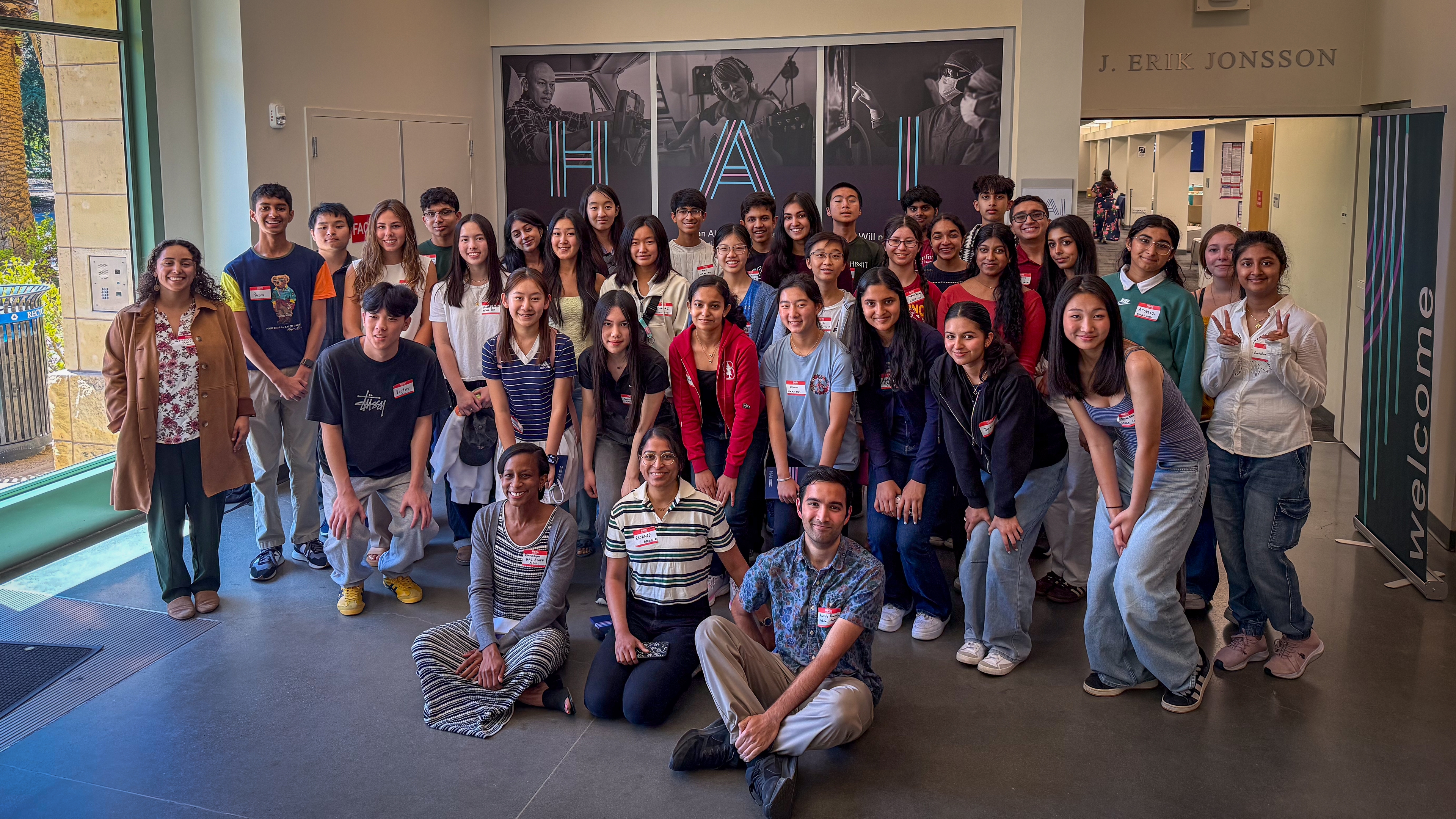
AI4All alumni students met at HAI for a day of lectures, hands-on experiences, and more. | Jeanina Matias


Today we heard from Priya Sundaresan, a fourth-year PhD student at Stanford, who shared a fascinating overview of how robots learn — and why it’s so challenging to make them operate safely in real-world environments.

Priya introduced several approaches to robot learning, starting with Imitation Learning, where robots observe humans to learn tasks, and Reinforcement Learning, where robots learn through trial and error. More recently, robotics has drawn inspiration from large-scale internet data, similar to vision-language models, to help robots generalize beyond narrow, hardcoded tasks. 

After the session, I went back to thinking about our project, and I was still frustrated by how low the model accuracy was. I decided to explore linear probing, a lightweight but powerful method for adapting pre-trained models to new tasks.

With linear probing, you freeze the image encoder of BiomedCLIP, meaning its internal parameters don’t change, and extract the learned image embeddings for all the blood smear images. These embeddings represent high-level features that the model has already learned from its large-scale pretraining. Instead of retraining the whole model, I trained a simple linear classifier (essentially a single-layer neural network) on top of these fixed embeddings to map them to our specific blood cell classes.

The results were incredible. Our model accuracy jumped to 83%, a massive improvement over both the single-prompt and prompt ensemble approaches.
— Anandita Mukherjee
AI4All participant

This approach is much more efficient than full fine-tuning, and it focuses only on adapting the final decision layer without altering the pre-trained model itself. The results were incredible. After applying linear probing, our model accuracy jumped to 83%, a massive improvement over both the single-prompt and prompt ensemble approaches.

It was exciting to see how such a simple, well-understood technique could unlock so much performance. It also reinforced how important it is to experiment with different tools — and not assume that one method alone will be enough to solve complex AI tasks.


The final day of Stanford AI4ALL brought everything full circle. After two packed weeks of learning, coding, and collaboration, each team had the opportunity to present their work to a panel of Stanford experts and reflect on what we’d accomplished.

Stanford AI4ALL has been more than just a summer program. Over the past two weeks, we explored AI from multiple perspectives: technical concepts, real-world applications, and the ethical questions that shape how this technology impacts people’s lives. Whether we were working on medical diagnostics, robotics, satellite analysis, or natural language processing, we saw how much thought and care goes into building responsible AI. But more than anything, we found a community — one that was curious, supportive, and deeply committed to using AI thoughtfully. We’re leaving with new skills, new friendships, and a clearer sense of the questions we want to keep exploring. Thank you, AI4ALL!!