Modeling Effective Regulation of Facebook
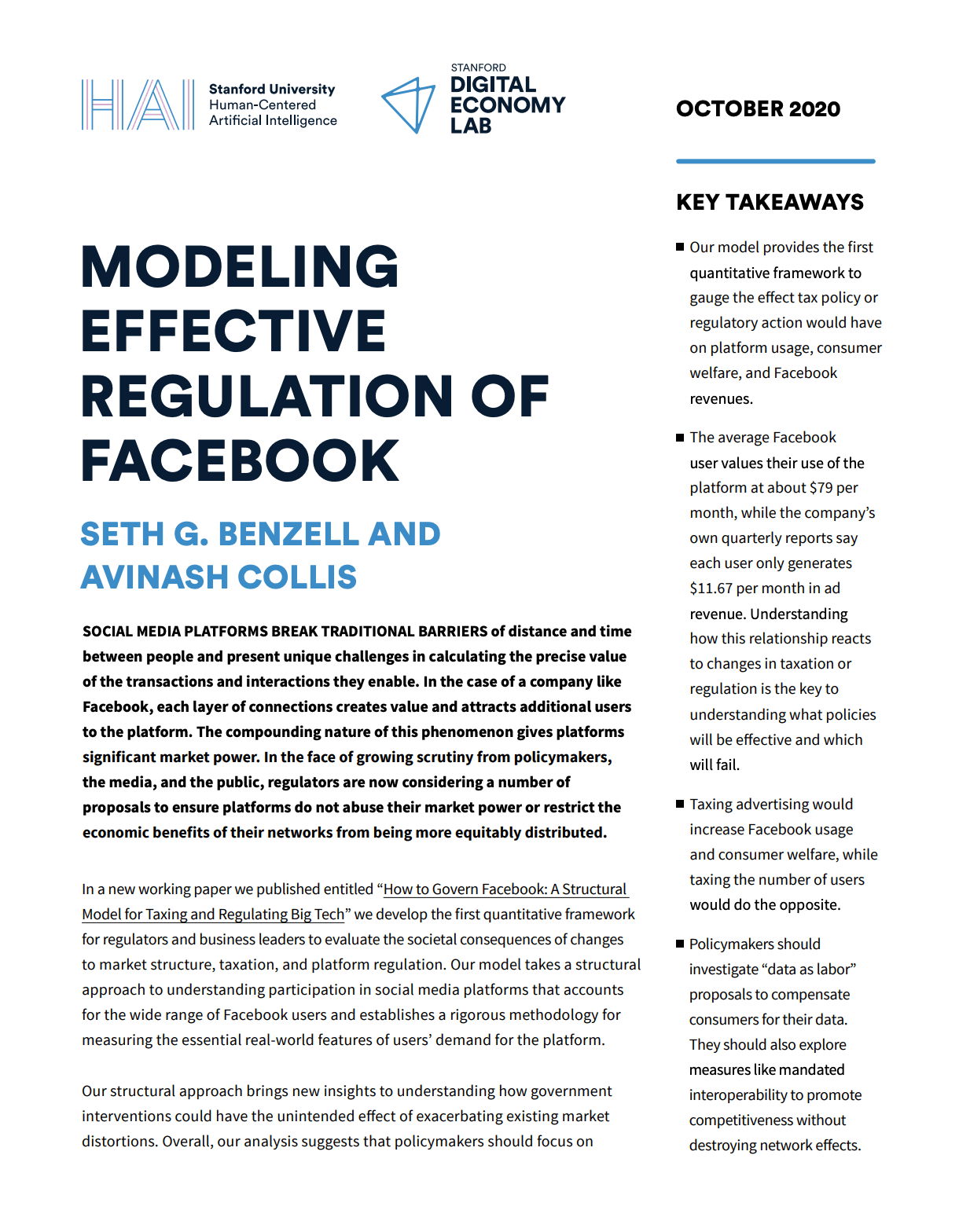
This brief introduces a quantitative framework to gauge the effect tax policy or regulatory action would have on Facebook’s platform usage, consumer welfare, and revenues.
In collaboration with

Key Takeaways
Our model provides the first quantitative framework to gauge the effect tax policy or regulatory action would have on platform usage, consumer welfare, and Facebook revenues.
The average Facebook user values their use of the platform at about $79 per month, while the company’s own quarterly reports say each user only generates $11.67 per month in ad revenue. Understanding how this relationship reacts to changes in taxation or regulation is the key to understanding what policies will be effective and which will fail.
Taxing advertising would increase Facebook usage and consumer welfare, while taxing the number of users would do the opposite.
Executive Summary
Social media platforms break traditional barriers of distance and time between people and present unique challenges in calculating the precise value of the transactions and interactions they enable. In the case of a company like Facebook, each layer of connections creates value and attracts additional users to the platform. The compounding nature of this phenomenon gives platforms significant market power. In the face of growing scrutiny from policymakers, the media, and the public, regulators are now considering a number of proposals to ensure platforms do not abuse their market power or restrict the economic benefits of their networks from being more equitably distributed.
In a new working paper we published entitled “How to Govern Facebook: A Structural Model for Taxing and Regulating Big Tech” we develop the first quantitative framework for regulators and business leaders to evaluate the societal consequences of changes to market structure, taxation, and platform regulation. Our model takes a structural approach to understanding participation in social media platforms that accounts for the wide range of Facebook users and establishes a rigorous methodology for measuring the essential real-world features of users’ demand for the platform.
Our structural approach brings new insights to understanding how government interventions could have the unintended effect of exacerbating existing market distortions. Overall, our analysis suggests that policymakers should focus on redistributive rather than trust-busting tools for dealing with Facebook. A tax on targeted advertisements, or a more ambitious proposal to compensate users for watching ads and providing their data, deserve policymakers’ close attention. Policymakers should also investigate measures to encourage greater platform competition by mandating greater interoperability between social media companies. These measures would ensure more gains were passed along to consumers and would also allow Facebook to continue selling advertisements in a manner productive to all parties.
Related Publications
Response to FDA’s Request for Feedback on Considerations for the Regulation of GenAI-Enabled Medical Devices
Stanford scholars respond to a federal request for feedback, offering policy recommendations for the regulation of generative AI-enabled medical devices.
Stanford scholars respond to a federal request for feedback, offering policy recommendations for the regulation of generative AI-enabled medical devices.
Implementing the Transparency in Frontier AI Act Report for the California Department of Technology Multistakeholder Workshops
In this paper, HAI Associate Director and Senior Fellow Rob Reich and UC Berkeley School of Information Professor Deirdre K. Mulligan provide concrete recommendations to the California Department of Technology on the implementation of its frontier AI transparency requirements.
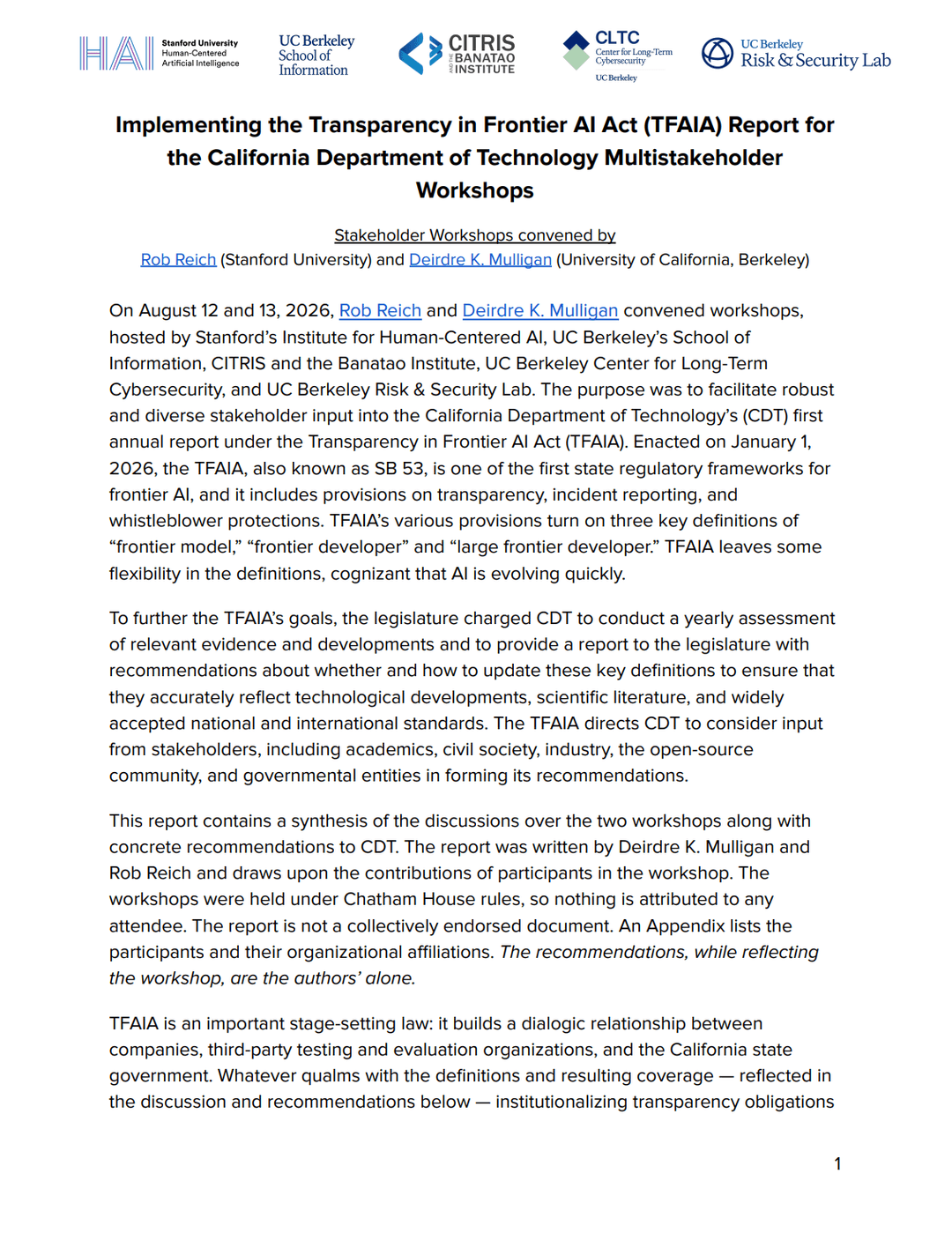
In this paper, HAI Associate Director and Senior Fellow Rob Reich and UC Berkeley School of Information Professor Deirdre K. Mulligan provide concrete recommendations to the California Department of Technology on the implementation of its frontier AI transparency requirements.
Designing Loyalty: AI Agents and Conflicts of Interest

This brief examines the conflict-of-interest risks posed by AI agents and calls for imposing a duty of loyalty on developers and deployers.
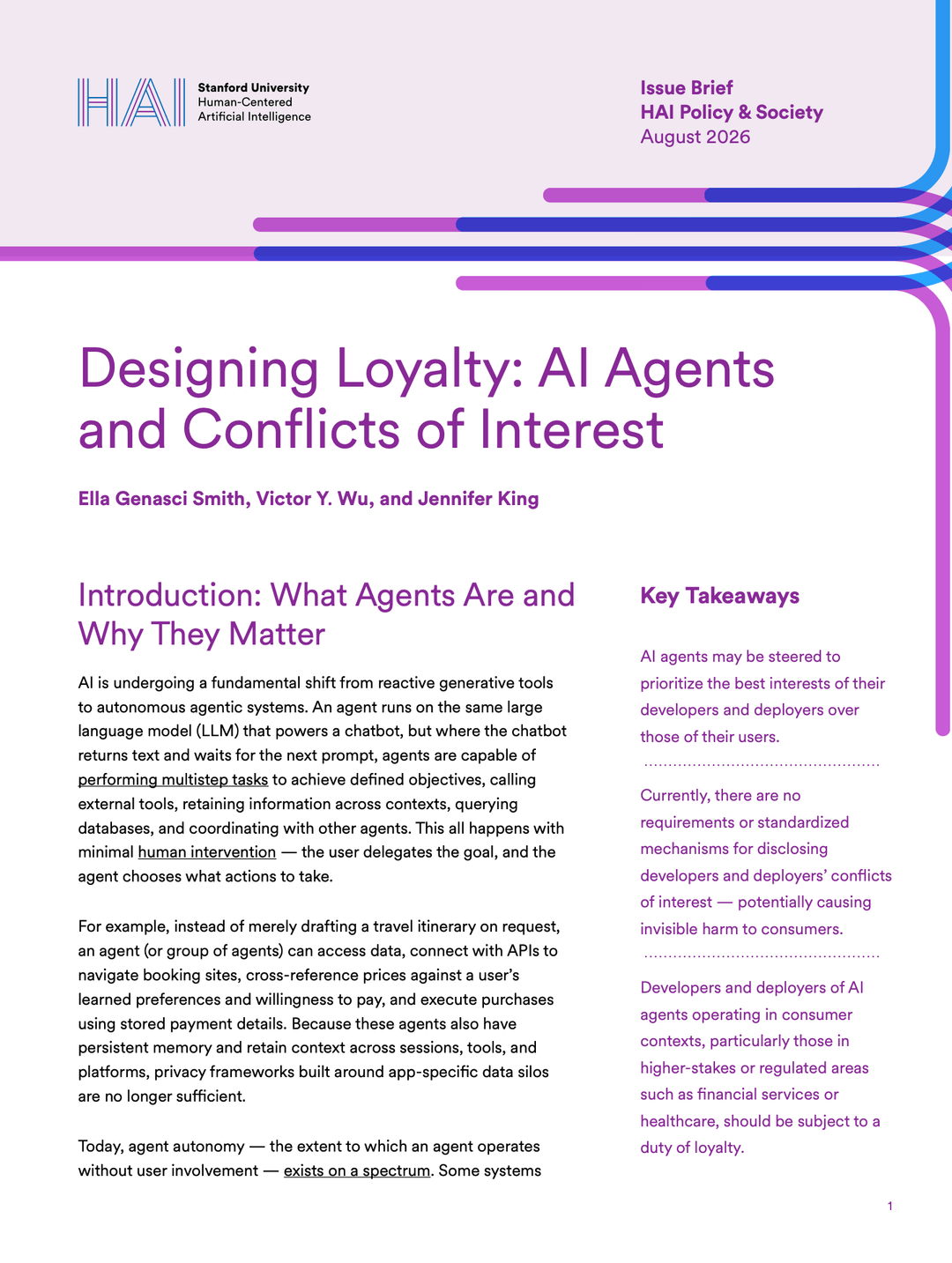
This brief examines the conflict-of-interest risks posed by AI agents and calls for imposing a duty of loyalty on developers and deployers.
Regulating Data Brokers in the Age of AI: A California Case Study
This brief assesses data broker compliance with California privacy laws and calls for more stringent consumer protections.
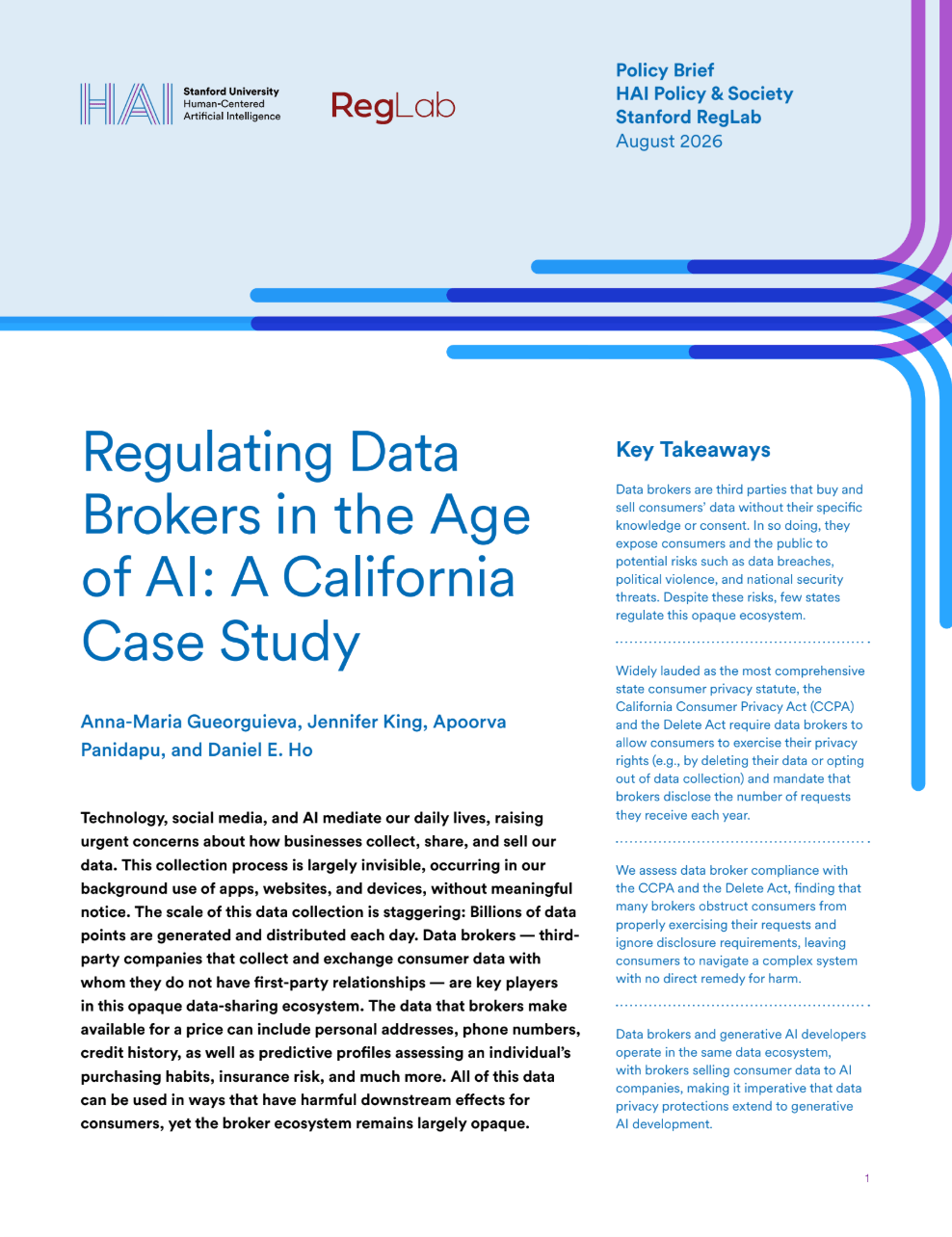
This brief assesses data broker compliance with California privacy laws and calls for more stringent consumer protections.