Stanford
University
  • Stanford Home
  • Maps & Directions
  • Search Stanford
  • Emergency Info
  • Terms of Use
  • Privacy
  • Copyright
  • Trademarks
  • Non-Discrimination
  • Accessibility
© Stanford University.  Stanford, California 94305.
Response to OSTP's Request for Information on Accelerating the American Scientific Enterprise | Stanford HAI

Stay Up To Date

Get the latest news, advances in research, policy work, and education program updates from HAI in your inbox weekly.

Sign Up For Latest News

Navigate
  • About
  • Events
  • Careers
  • Search
Participate
  • Get Involved
  • Support HAI
  • Contact Us
Skip to content
  • About

    • About
    • People
    • Get Involved with HAI
    • Support HAI
    • Subscribe to Email
  • Research

    • Research
    • Fellowship Programs
    • Grants
    • Student Affinity Groups
    • Centers & Labs
    • Research Publications
    • Research Partners
  • Education

    • Education
    • Executive and Professional Education
    • Government and Policymakers
    • K-12
    • Stanford Students
  • Policy

    • Policy
    • Policy Publications
    • Policymaker Education
    • Student Opportunities
  • AI Index

    • AI Index
    • AI Index Report
    • Global Vibrancy Tool
    • People
  • News
  • Events
  • Industry
  • Centers & Labs
policyResponse to Request

Response to OSTP's Request for Information on Accelerating the American Scientific Enterprise
Date
December 26, 2025
Topics
Sciences (Social, Health, Biological, Physical)
Regulation, Policy, Governance
Read Paper
abstract

Stanford scholars respond to a federal RFI on scientific discovery, calling for the government to support a new “team science” academic research model for AI-enabled discovery.

In collaboration with

Executive Summary

In this response to a request for information issued by the White House Office of Science and Technology Policy (OSTP) on how the federal government can strengthen the American scientific enterprise, scholars from Stanford HAI and Stanford Data Science share their vision for how academic institutions can write the chapter of scientific discovery by drawing upon the curiosity-driven approach to research that has historically led to profound technological breakthroughs. They identify two areas the federal government should pay attention to when crafting policies to support the scientific enterprise:

  1. Support a new academic research model focused on team science for AI-enabled discovery and organize these efforts through an interdisciplinary consortium of academic, government, and industry experts.

  2. Invest in and support the open-source research ecosystem, for example by ensuring that federal funding and infrastructure for AI includes a requirement that software and datasets be made openly available.

Read Paper
Share
Link copied to clipboard!
Authors
  • Rishi Bommasani
    Rishi Bommasani
  • John Etchemendy
    John Etchemendy
  • Surya Ganguli headshot
    Surya Ganguli
  • Dan Ho headshot
    Daniel E. Ho
  • Guido Imbens
    Guido Imbens
  • James Landay
    James Landay
  • fei fei li headshot
    Fei-Fei Li
  • Russell Wald headshot
    Russell Wald
Related
  • Expanding Academia’s Role in Public Sector AI
    Kevin Klyman, Aaron Bao, Caroline Meinhardt, Daniel Zhang, Elena Cryst, Russell Wald
    Quick ReadDec 04
    issue brief
    Expanding Academias role in public sector ai

    This brief analyzes the disparity between academia and industry in frontier AI research and presents policy recommendations for ensuring a stronger role for academia in public sector AI.

Related Publications

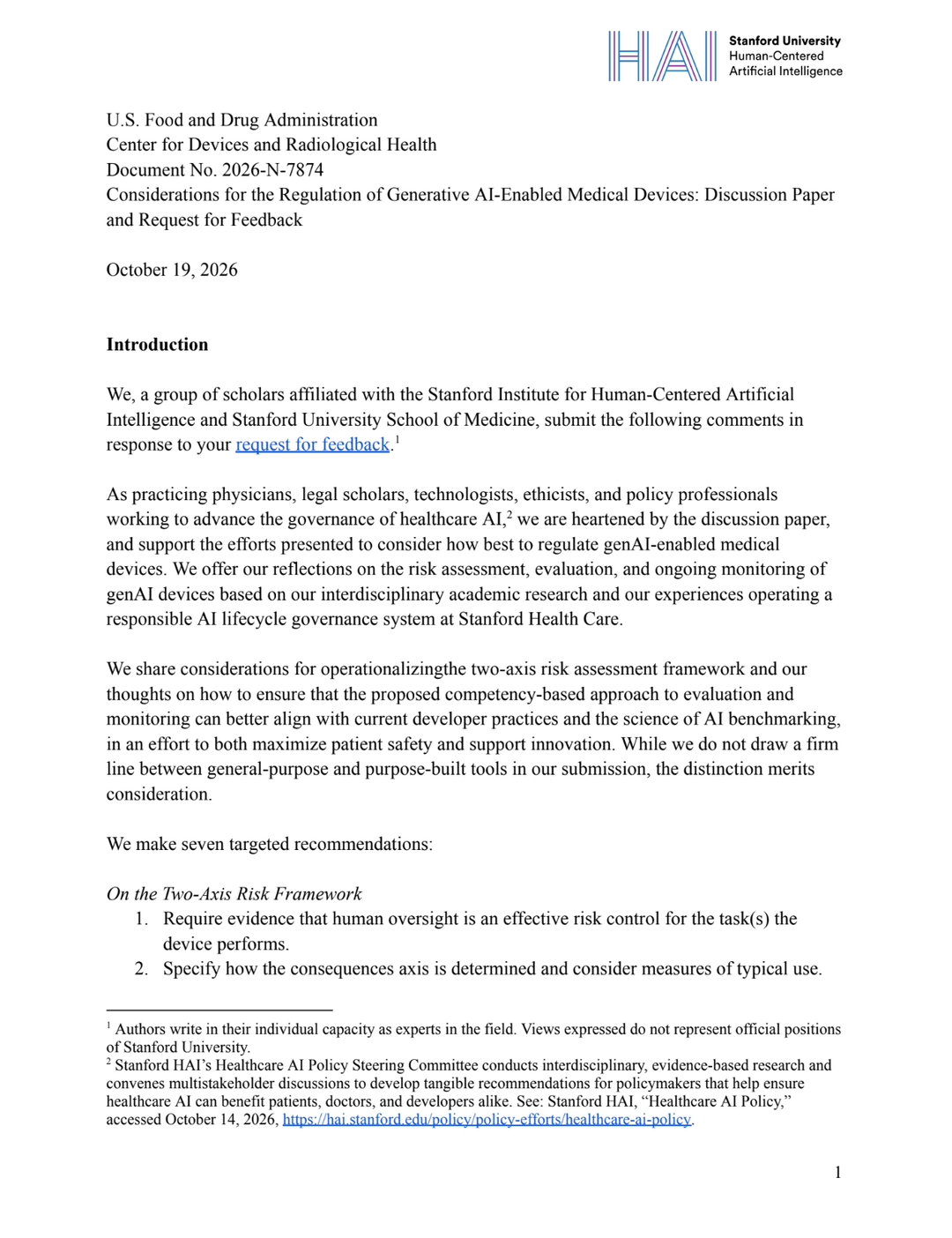
Response to FDA's Request for Comment on AI-Enabled Medical Devices
Desmond C. Ong, Jared Moore, Nicole Martinez-Martin, Caroline Meinhardt, Eric Lin, William Agnew
Quick ReadDec 02, 2025
Response to Request

Stanford scholars respond to a federal RFC on evaluating AI-enabled medical devices, recommending policy interventions to help mitigate the harms of AI-powered chatbots used as therapists.

Response to Request

Response to FDA's Request for Comment on AI-Enabled Medical Devices

Desmond C. Ong, Jared Moore, Nicole Martinez-Martin, Caroline Meinhardt, Eric Lin, William Agnew
HealthcareRegulation, Policy, GovernanceQuick ReadDec 02

Stanford scholars respond to a federal RFC on evaluating AI-enabled medical devices, recommending policy interventions to help mitigate the harms of AI-powered chatbots used as therapists.

Russ Altman’s Testimony Before the U.S. Senate Committee on Health, Education, Labor, and Pensions
Russ Altman
Quick ReadOct 09, 2025
Testimony

In this testimony presented to the U.S. Senate Committee on Health, Education, Labor, and Pensions hearing titled “AI’s Potential to Support Patients, Workers, Children, and Families,” Russ Altman highlights opportunities for congressional support to make AI applications for patient care and drug discovery stronger, safer, and human-centered.

Testimony

Russ Altman’s Testimony Before the U.S. Senate Committee on Health, Education, Labor, and Pensions

Russ Altman
HealthcareRegulation, Policy, GovernanceSciences (Social, Health, Biological, Physical)Quick ReadOct 09

In this testimony presented to the U.S. Senate Committee on Health, Education, Labor, and Pensions hearing titled “AI’s Potential to Support Patients, Workers, Children, and Families,” Russ Altman highlights opportunities for congressional support to make AI applications for patient care and drug discovery stronger, safer, and human-centered.

Michelle M. Mello's Testimony Before the U.S. House Committee on Energy and Commerce Health Subcommittee
Michelle Mello
Quick ReadSep 02, 2025
Testimony

In this testimony presented to the U.S. House Committee on Energy and Commerce’s Subcommittee on Health hearing titled “Examining Opportunities to Advance American Health Care through the Use of Artificial Intelligence Technologies,” Michelle M. Mello calls for policy changes that will promote effective integration of AI tools into healthcare by strengthening trust.

Testimony

Michelle M. Mello's Testimony Before the U.S. House Committee on Energy and Commerce Health Subcommittee

Michelle Mello
HealthcareRegulation, Policy, GovernanceQuick ReadSep 02

In this testimony presented to the U.S. House Committee on Energy and Commerce’s Subcommittee on Health hearing titled “Examining Opportunities to Advance American Health Care through the Use of Artificial Intelligence Technologies,” Michelle M. Mello calls for policy changes that will promote effective integration of AI tools into healthcare by strengthening trust.

Response to the Department of Education’s Request for Information on AI in Education
Victor R. Lee, Vanessa Parli, Isabelle Hau, Patrick Hynes, Daniel Zhang
Quick ReadAug 20, 2025
Response to Request

Stanford scholars respond to a federal RFI on advancing AI in education, urging policymakers to anchor their approach in proven research.

Response to Request

Response to the Department of Education’s Request for Information on AI in Education

Victor R. Lee, Vanessa Parli, Isabelle Hau, Patrick Hynes, Daniel Zhang
Education, SkillsRegulation, Policy, GovernanceQuick ReadAug 20

Stanford scholars respond to a federal RFI on advancing AI in education, urging policymakers to anchor their approach in proven research.