Responses to NTIA's Request for Comment on AI Accountability Policy
Stanford scholars respond to a federal RFC on AI accountability policy issued by the National Telecommunications and Information Administration (NTIA).
In collaboration with


Response on behalf of Stanford HAI, CRFM, and Princeton CITP
Rishi Bommasani, Sayash Kapoor, Daniel Zhang, Arvind Narayanan, Percy Liang
This response centers on foundation models (FMs), which constitute a broad paradigm shift in AI. Foundation models require substantial data and compute to provide striking capabilities that power countless downstream products and services. Researchers argue that pervasive opacity compromises accountability for foundation models. Foundation models and the surrounding ecosystem are insufficiently transparent, with recent evidence showing this transparency is deteriorating further. Without sufficient transparency, the federal government and industry cannot implement meaningful accountability mechanisms as we cannot govern what we cannot see. The submission recommends the federal government:
Invest in digital supply chain monitoring for foundation models
Invest in public evaluations of foundation models
Incentivize research on guardrails for open-source models
Read full response
Response on behalf of Stanford HAI
Jennifer King
This response focuses on data protection, data accountability, and privacy mechanisms to ensure AI accountability. The researcher argues that there is an urgent need for comprehensive federal privacy legislation and regulation of AI and data practices. Individual privacy rights and sectoral approaches are insufficient to restrain the large-scale data collection required for AI. Accountability mechanisms focused on data provenance, quality, consent, and transparency are needed to address concerns with AI datasets. Greater public access to models, data, and computing resources would enable researchers and advocates to develop and test such mechanisms. Without legal guardrails and accountability, the expansion of data collection for AI threatens to intensify privacy harms and erosion of consumer trust.
Read full response
Related Publications
Response to FDA’s Request for Feedback on Considerations for the Regulation of GenAI-Enabled Medical Devices
Stanford scholars respond to a federal request for feedback, offering policy recommendations for the regulation of generative AI-enabled medical devices.
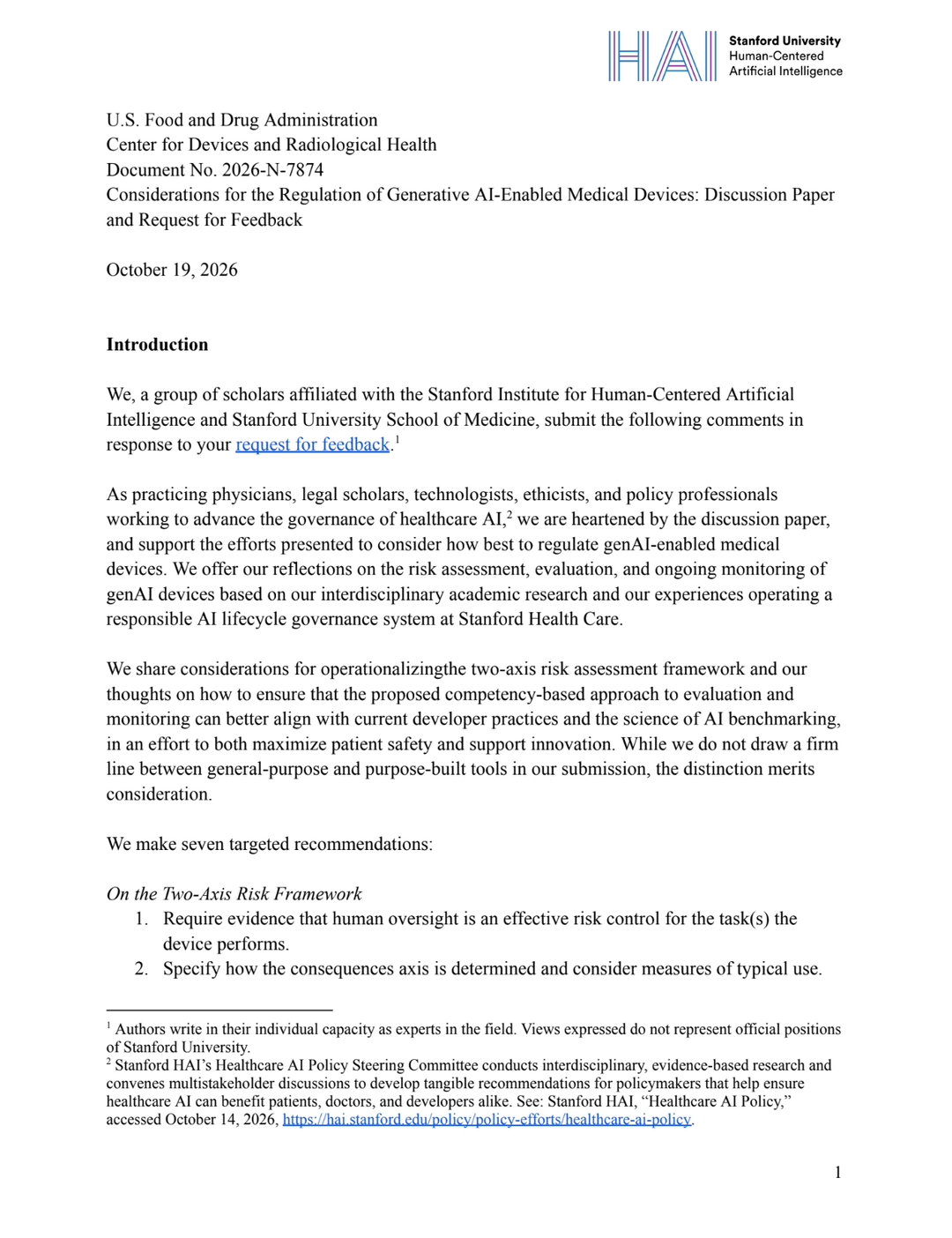
Stanford scholars respond to a federal request for feedback, offering policy recommendations for the regulation of generative AI-enabled medical devices.
Implementing the Transparency in Frontier AI Act Report for the California Department of Technology Multistakeholder Workshops
In this paper, HAI Associate Director and Senior Fellow Rob Reich and UC Berkeley School of Information Professor Deirdre K. Mulligan provide concrete recommendations to the California Department of Technology on the implementation of its frontier AI transparency requirements.
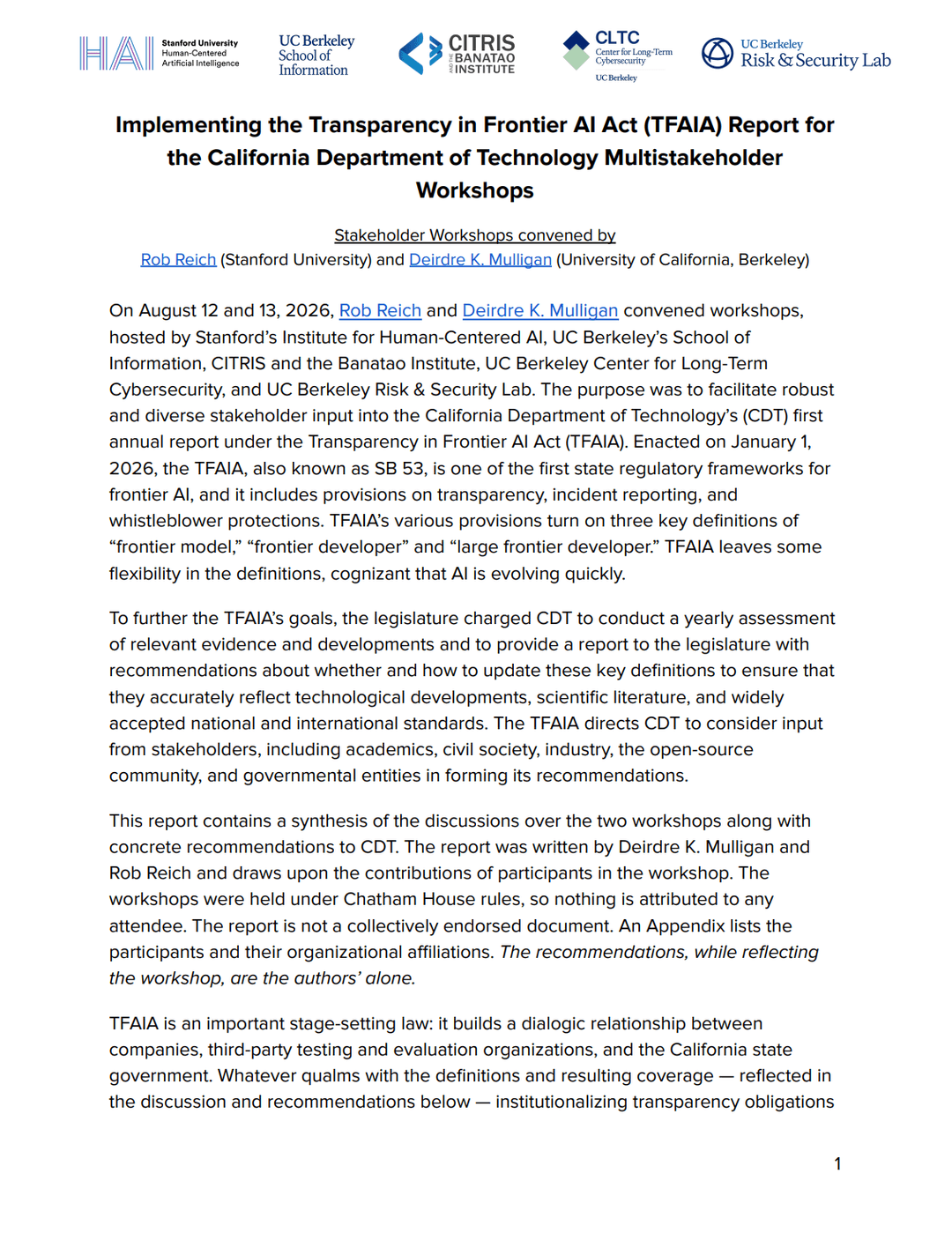
In this paper, HAI Associate Director and Senior Fellow Rob Reich and UC Berkeley School of Information Professor Deirdre K. Mulligan provide concrete recommendations to the California Department of Technology on the implementation of its frontier AI transparency requirements.
Designing Loyalty: AI Agents and Conflicts of Interest
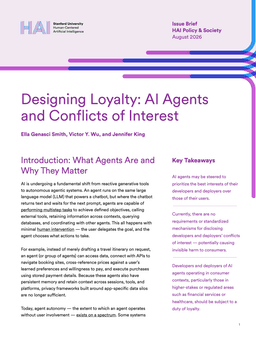
This brief examines the conflict-of-interest risks posed by AI agents and calls for imposing a duty of loyalty on developers and deployers.
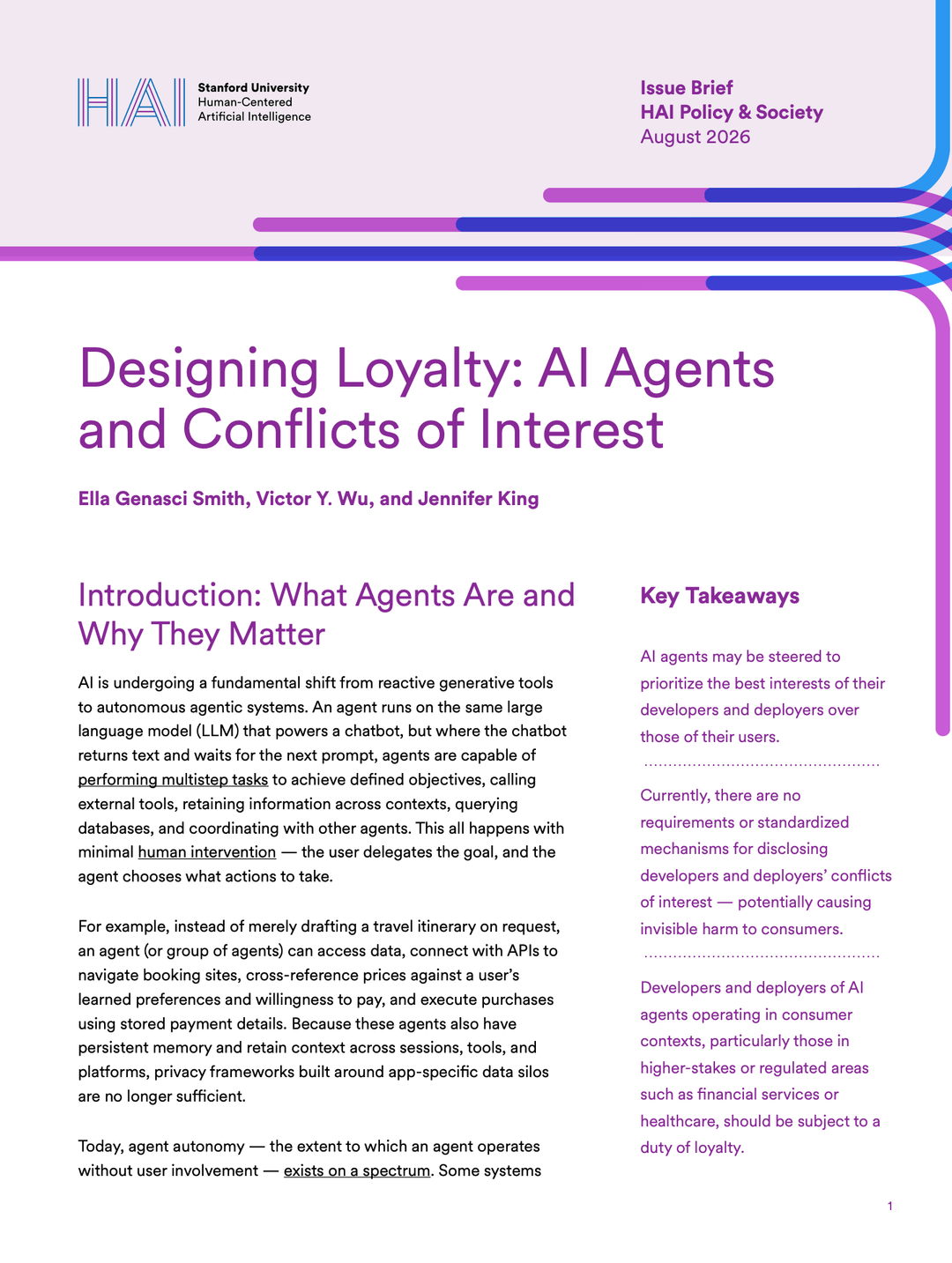
This brief examines the conflict-of-interest risks posed by AI agents and calls for imposing a duty of loyalty on developers and deployers.
Regulating Data Brokers in the Age of AI: A California Case Study
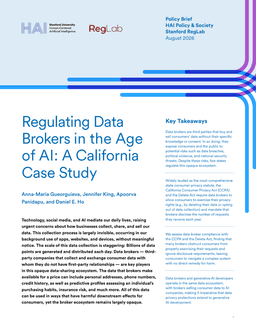
This brief assesses data broker compliance with California privacy laws and calls for more stringent consumer protections.
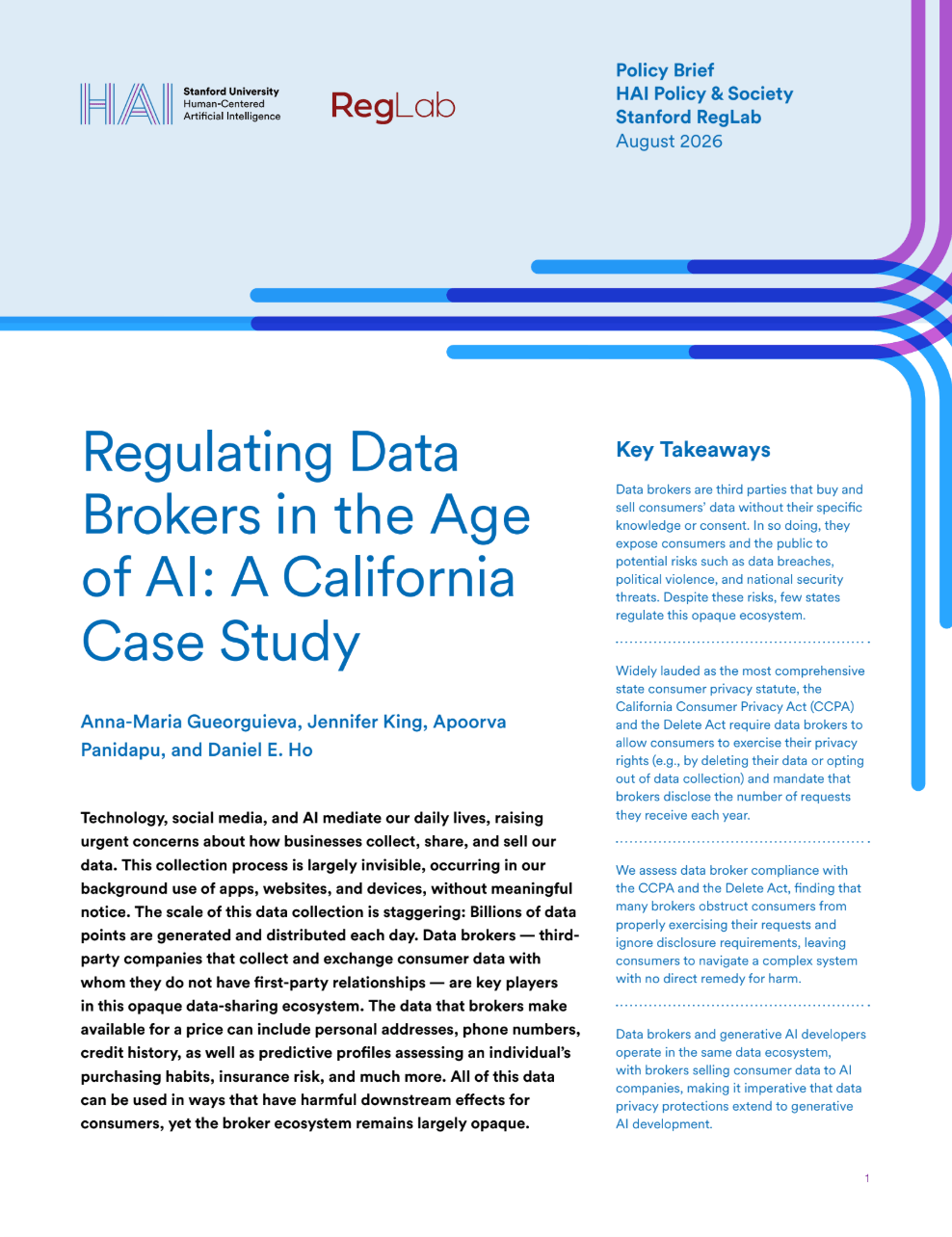
This brief assesses data broker compliance with California privacy laws and calls for more stringent consumer protections.