Technology and Election 2020 Issue Brief Series
This issue brief series examines how technology will impact public debate, affect the electoral process, and may even determine the election outcome.
Election 2020: Technology’s Role in Administering Democratic Elections
The 2020 Election in the United States will take place on November 3 in the midst of a global pandemic, economic downturn, social unrest, political polarization, and a sudden shift in the balance of power in the U.S Supreme Court. On top of these issues, the technological layer impacting the public debate, as well as the electoral process itself, may well determine the election outcome.
Election 2020: Social Media and Political Polarization
The emergence of a digital sphere where public debate takes place raises profound questions about the connection between online information and polarization, echo chambers, and filter bubbles. Does the information ecosystem created by social media companies support the conditions necessary for a healthy democracy? Is it different from other media? These are particularly urgent questions as the United States approaches a contentious 2020 election during the COVID-19 pandemic.
Election 2020: Content Moderation and Accountability
As we approach the 2020 Election in the United States content moderation on social media platforms is taking center stage. From speech issues on Facebook and Twitter to YouTube videos and TikTok brigands, the current election season is being reshaped by curation concerns about what’s allowed online, what’s not, upranking and downranking, and who’s deciding.
Election 2020: Political Advertising and Social Media
Voters are being inundated with political advertising on social media and online platforms during the 2020 election season. Campaigns, PACs and third parties have added new tools and tactics for gathering data on voters and targeting them with advertising, and now they can pinpoint niches of potential voters on social media in ways unknown in prior election cycles.
Election 2020: Foreign Interference and Domestic Manipulations Aimed at Voters and Electoral Outcomes
In 2016 we learned about efforts by foreign actors to interfere in the U.S. election by injecting misinformation and disinformation into public discourse on social media. False events and personas added to the polarization and manipulation of voters. The 2020 election is marked by similar efforts, though this time the actors are domestic as well as foreign.
Election 2020: Antitrust and Privacy in the Age of Big Tech
Antitrust and privacy concerns are two of the most high-profile topics on the tech policy agenda. Checks and balances to counteract the power of companies such as Google, Amazon, and Facebook are under consideration in Congress, though a polarized political environment is a hindrance. But a domestic approach to tech policy will be insufficient, as the users of the large American tech companies are predominantly outside the United States. We need to point the way toward a transnational policy effort that puts democratic principles and basic human rights above the commercial interests of these private companies.
Election 2020: Election Results, the Aftermath, and Tech Agendas
The immediate aftermath of Election Day 2020 offers lessons about the state of American democracy as well as technology’s influence on voters, the voting process, and democratic institutions. Whatever the outcome of an election, and despite a polarized society, it is clear that all Americans share a common stake in protecting the integrity and independence of the administration of elections, the declaration of winners and losers, and a peaceful transition of power. Yet other questions persist: How have disinformation campaigns, whether domestic or foreign, affected the electoral process? And what does the future hold in terms of a tech agenda?
Election 2020: Technology, Democracy, and the Path Forward
The complicated relationship between technology and democracy is abundantly clear in the wake of the 2020 election. When tech companies proudly aspire to disrupt the conventional way of doing business in the marketplace, we can celebrate innovation and competition. But what happens when the same efforts disrupt democracy itself? Our task then is to examine questions about the business models of social media companies, technology policy, and the relationship between technological disruption and democratic rights.
On October 20, 2020, HAI held a special public event to discuss the first two issue briefs in this series with their lead authors. You can watch the full recording on YouTube.
Related Publications
Response to FDA’s Request for Feedback on Considerations for the Regulation of GenAI-Enabled Medical Devices
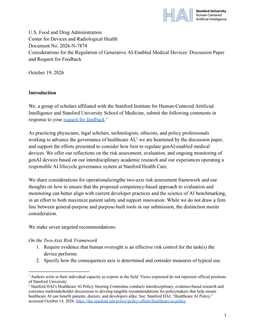
Stanford scholars respond to a federal request for feedback, offering policy recommendations for the regulation of generative AI-enabled medical devices.
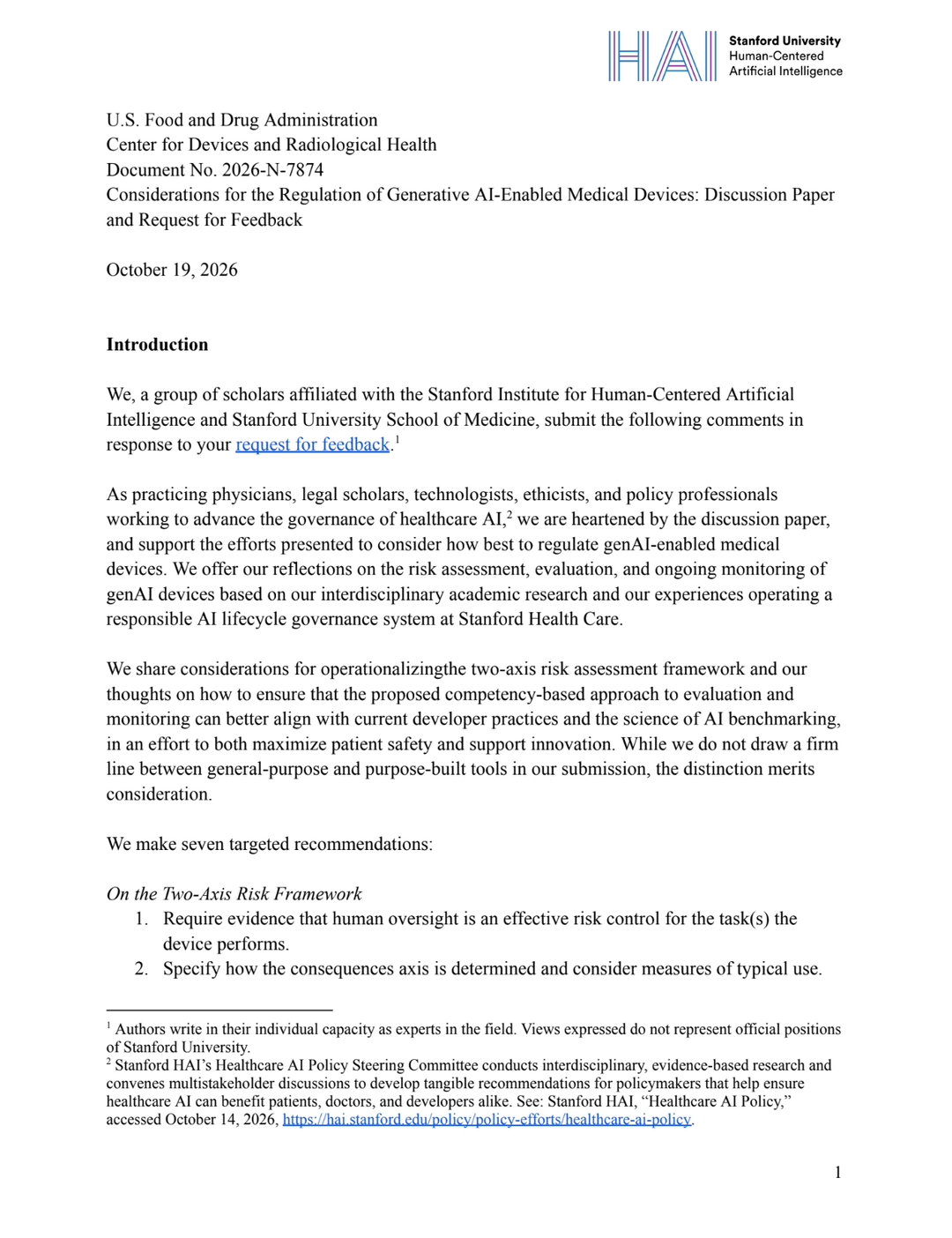
Stanford scholars respond to a federal request for feedback, offering policy recommendations for the regulation of generative AI-enabled medical devices.
Implementing the Transparency in Frontier AI Act Report for the California Department of Technology Multistakeholder Workshops
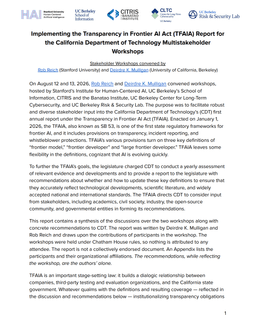
In this paper, HAI Associate Director and Senior Fellow Rob Reich and UC Berkeley School of Information Professor Deirdre K. Mulligan provide concrete recommendations to the California Department of Technology on the implementation of its frontier AI transparency requirements.
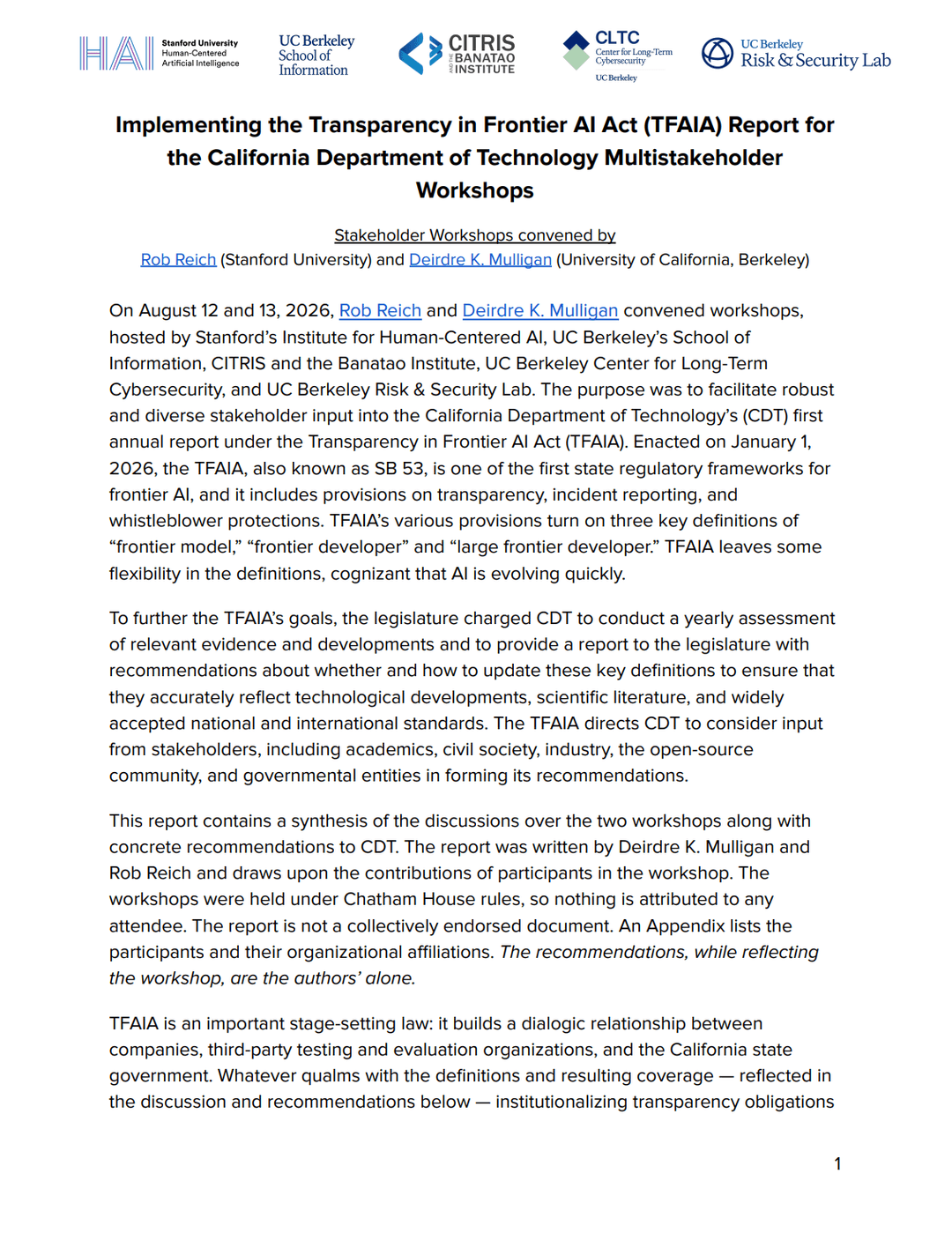
In this paper, HAI Associate Director and Senior Fellow Rob Reich and UC Berkeley School of Information Professor Deirdre K. Mulligan provide concrete recommendations to the California Department of Technology on the implementation of its frontier AI transparency requirements.
Designing Loyalty: AI Agents and Conflicts of Interest
This brief examines the conflict-of-interest risks posed by AI agents and calls for imposing a duty of loyalty on developers and deployers.
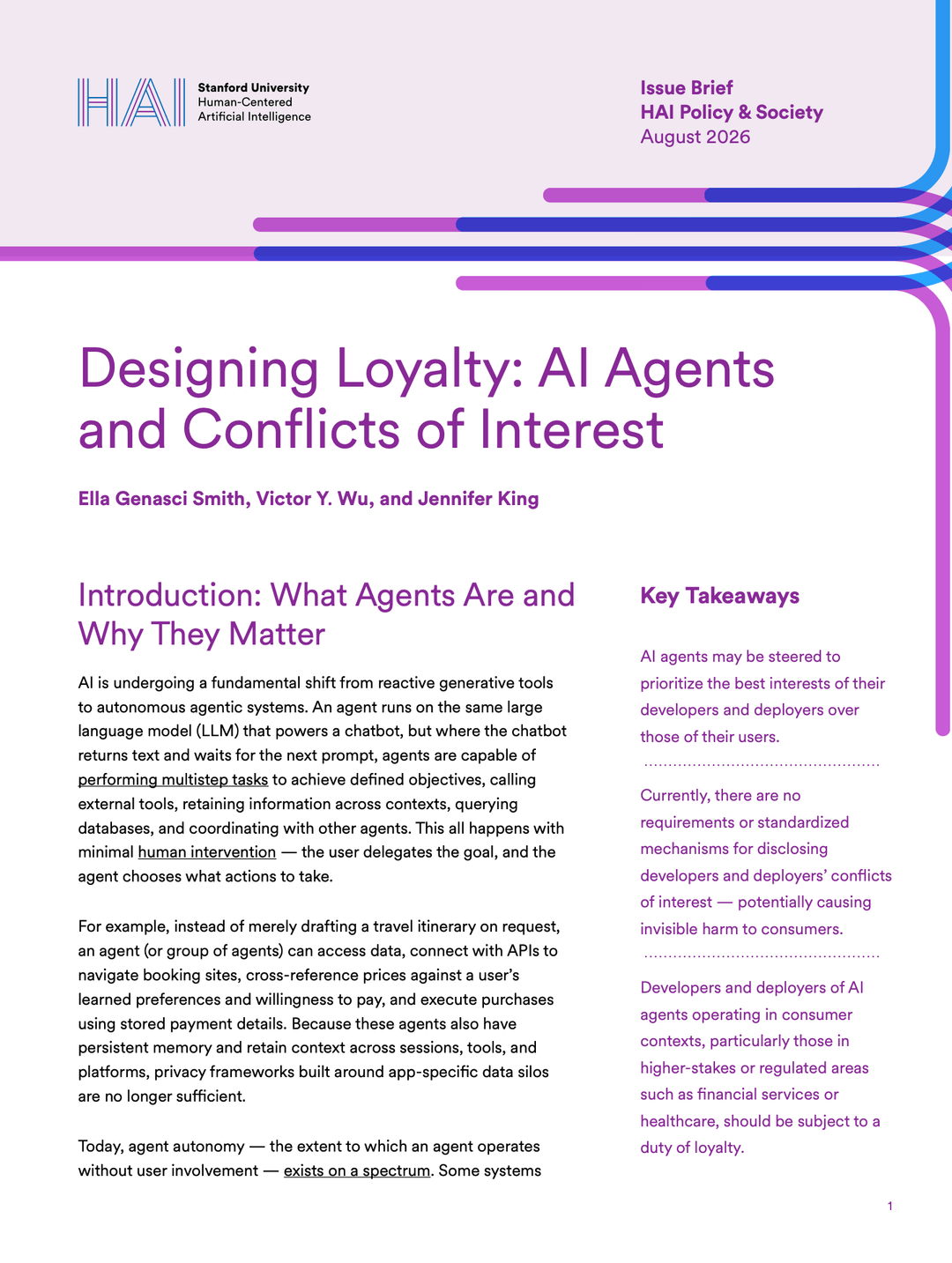
This brief examines the conflict-of-interest risks posed by AI agents and calls for imposing a duty of loyalty on developers and deployers.
Regulating Data Brokers in the Age of AI: A California Case Study
This brief assesses data broker compliance with California privacy laws and calls for more stringent consumer protections.
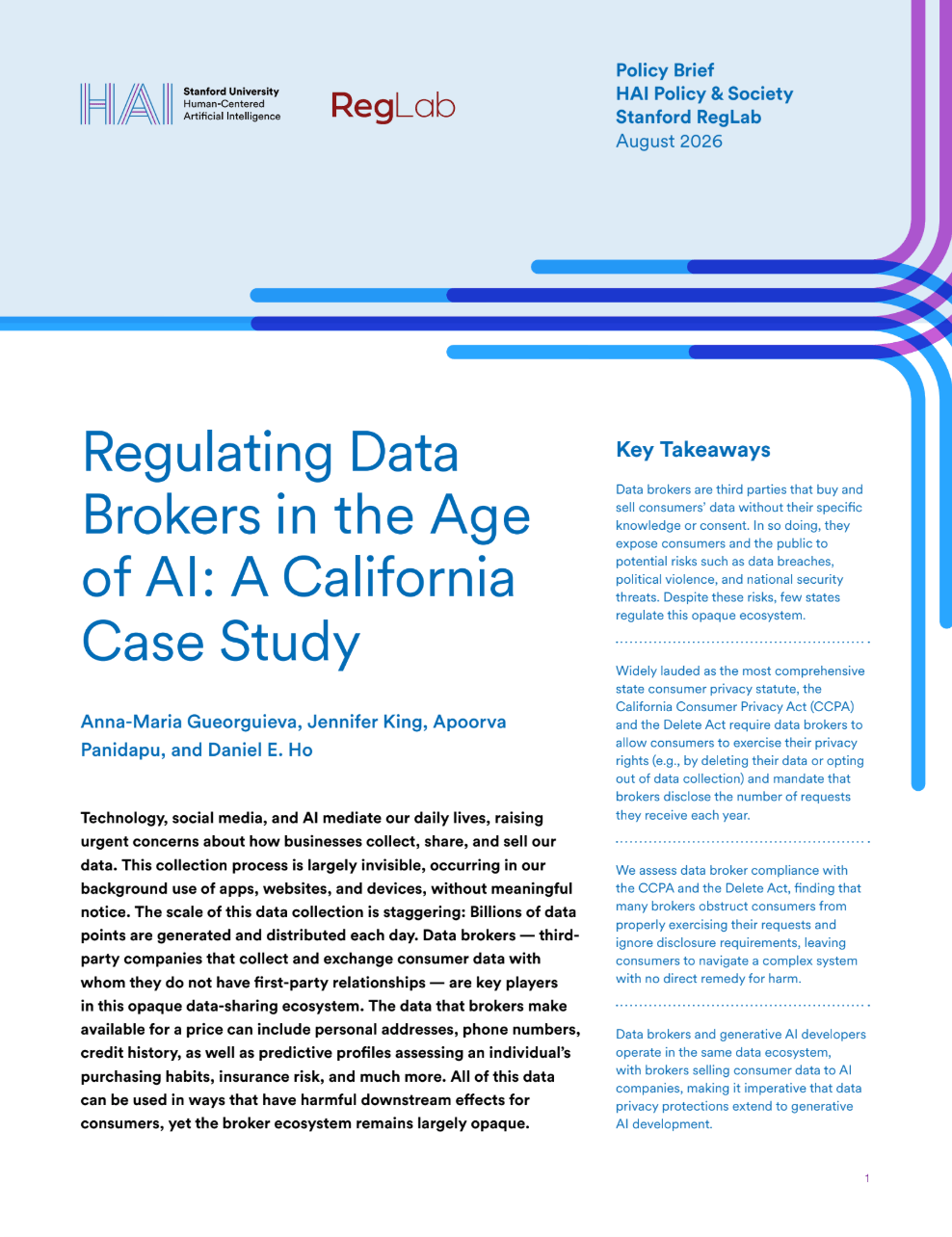
This brief assesses data broker compliance with California privacy laws and calls for more stringent consumer protections.