Implementation Challenges to Three Pillars of America’s AI Strategy

This white paper assesses the implementation status of three U.S. executive and legal actions related to AI innovation and trustworthy AI, calling for improvements in reporting and tracking key requirements.
In collaboration with

Executive Summary
This White Paper assesses the progress of three pillars of U.S. leadership in AI innovation and trustworthy AI that carry the force of law: (i) the AI in Government Act of 2020; (ii) the Executive Order on “AI Leadership”; and (iii) the Executive Order on “AI in Government.” Collectively, these Executive Orders and the AI in Government Act have been critical to defining the U.S. national strategy on AI and envisioning an ecosystem where the U.S. government leads in AI and promotes trustworthy AI. We systematically examined the implementation status of each requirement and performed a comprehensive search across 200+ federal agencies to assess implementation of key requirements to identify regulatory authorities pertaining to AI and to enumerate AI use cases.
While much progress has been made, our findings are sobering. America’s AI innovation ecosystem is threatened by weak and inconsistent implementation of these legal requirements. First, less than 40% of all requirements could be publicly verified as having been implemented. Second, 88% of examined agencies have failed to provide AI plans that identify regulatory authorities pertaining to AI. Third, roughly half or more of agencies have failed to file an inventory of AI use cases, as required under the AI in Government Order. Difficulties in verifying implementation strongly suggests that improvements must be made on reporting and tracking of requirements that the President or Congress deemed necessary for public disclosure. Fulfilling mandated transparency requirements strengthens external stakeholders’ ability to provide meaningful, informed advice to the federal government. The high prevalence of non-implementation suggests a leadership vacuum and capacity gap at the agency and national level. Agencies require leadership and resources and to meaningfully advance the objectives of these legal mandates. Checking these boxes is not the end itself, but is a mechanism for the ultimate goal of U.S. leadership and responsibility in AI development and trustworthy adoption, both for the public and private sector. Overall, implementation has been lacking.
Related Publications
Response to FDA’s Request for Feedback on Considerations for the Regulation of GenAI-Enabled Medical Devices
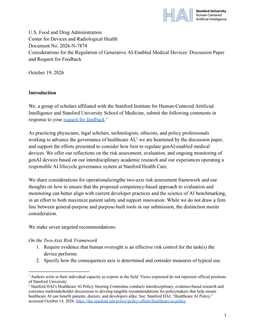
Stanford scholars respond to a federal request for feedback, offering policy recommendations for the regulation of generative AI-enabled medical devices.
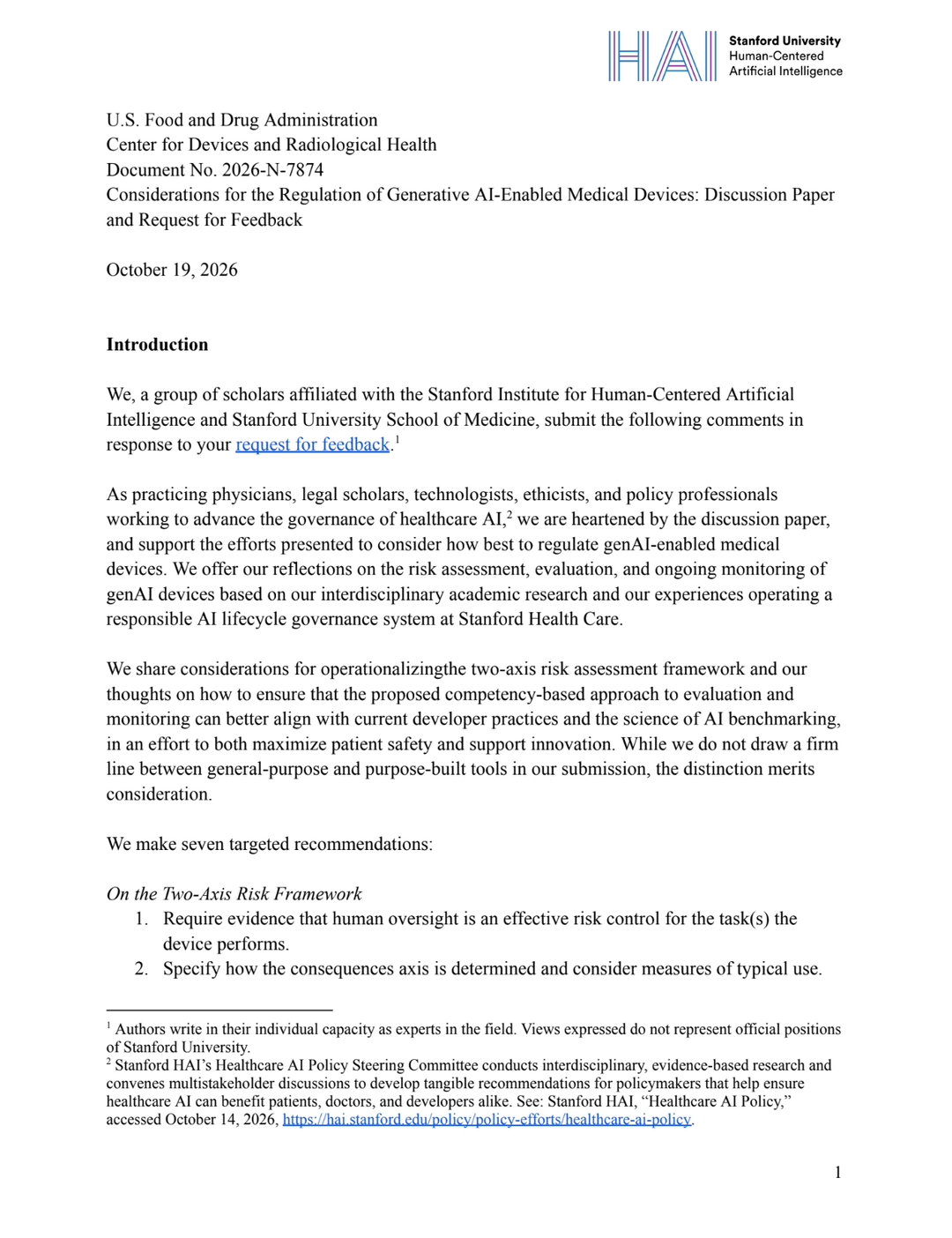
Stanford scholars respond to a federal request for feedback, offering policy recommendations for the regulation of generative AI-enabled medical devices.
Implementing the Transparency in Frontier AI Act Report for the California Department of Technology Multistakeholder Workshops
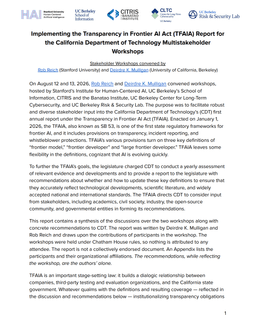
In this paper, HAI Associate Director and Senior Fellow Rob Reich and UC Berkeley School of Information Professor Deirdre K. Mulligan provide concrete recommendations to the California Department of Technology on the implementation of its frontier AI transparency requirements.
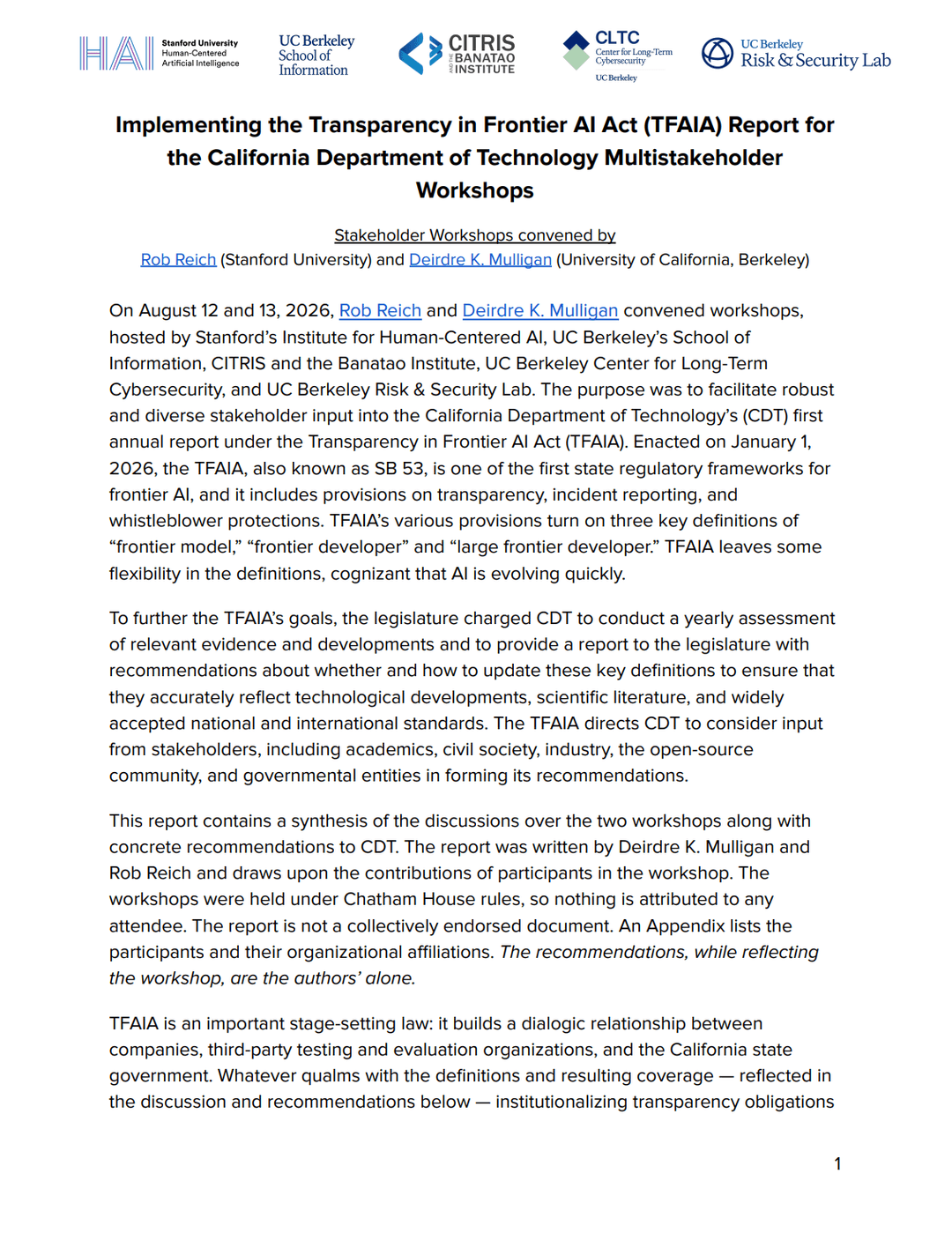
In this paper, HAI Associate Director and Senior Fellow Rob Reich and UC Berkeley School of Information Professor Deirdre K. Mulligan provide concrete recommendations to the California Department of Technology on the implementation of its frontier AI transparency requirements.
Making Local Law Legible: LLM-Assisted Detection of Discrimination
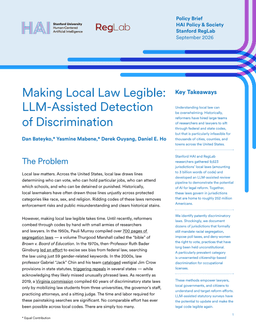
This brief demonstrates the potential of LLM-assisted review to accelerate legal reform.
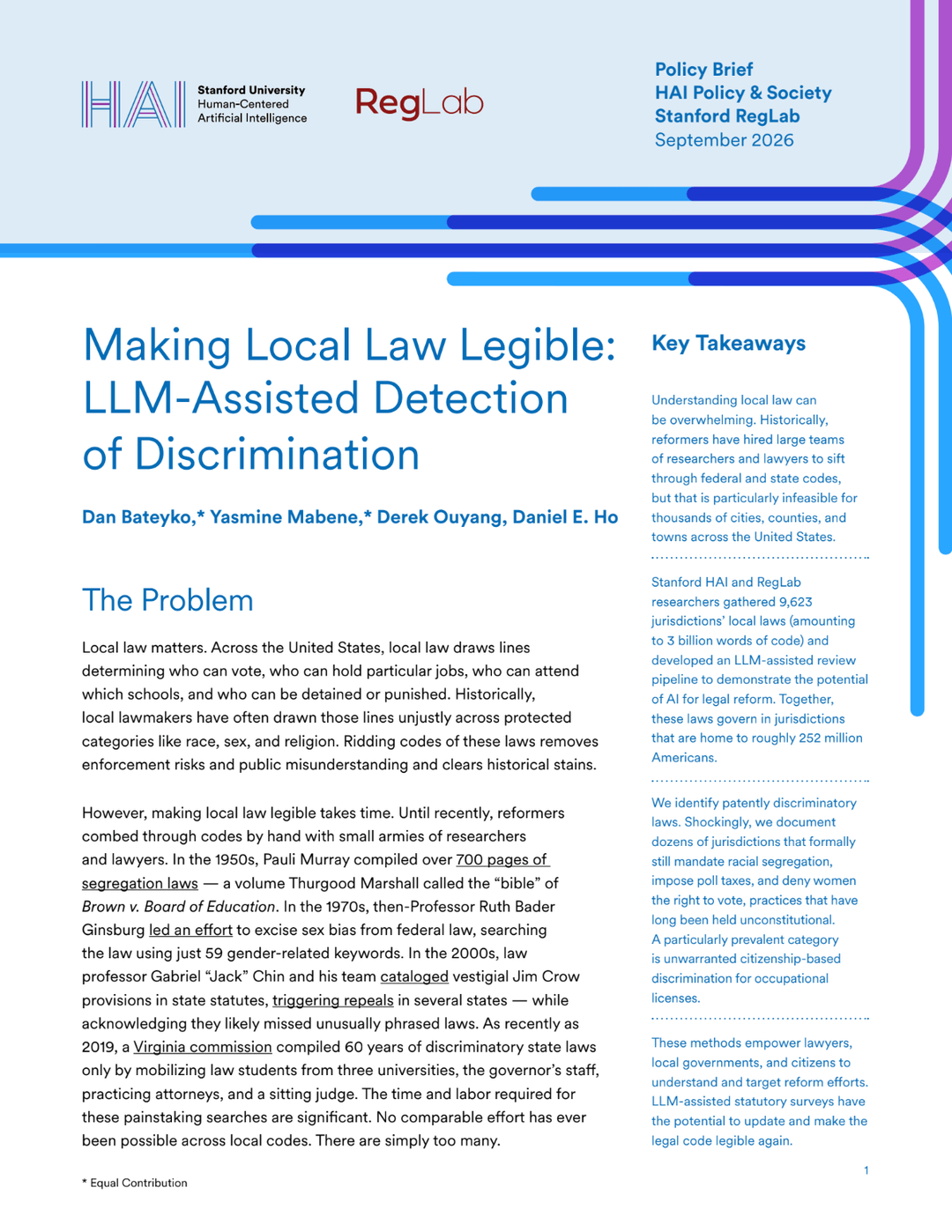
This brief demonstrates the potential of LLM-assisted review to accelerate legal reform.
Designing Loyalty: AI Agents and Conflicts of Interest

This brief examines the conflict-of-interest risks posed by AI agents and calls for imposing a duty of loyalty on developers and deployers.

This brief examines the conflict-of-interest risks posed by AI agents and calls for imposing a duty of loyalty on developers and deployers.