Stanford
University
  • Stanford Home
  • Maps & Directions
  • Search Stanford
  • Emergency Info
  • Terms of Use
  • Privacy
  • Copyright
  • Trademarks
  • Non-Discrimination
  • Accessibility
© Stanford University.  Stanford, California 94305.
Recommendations on Updating the National Artificial Intelligence Research and Development Strategic Plan | Stanford HAI

Stay Up To Date

Get the latest news, advances in research, policy work, and education program updates from HAI in your inbox weekly.

Sign Up For Latest News

Navigate
  • About
  • Events
  • Careers
  • Search
Participate
  • Get Involved
  • Support HAI
  • Contact Us
Skip to content
  • About

    • About
    • People
    • Get Involved with HAI
    • Support HAI
    • Subscribe to Email
  • Research

    • Research
    • Fellowship Programs
    • Grants
    • Student Affinity Groups
    • Centers & Labs
    • Research Publications
    • Research Partners
  • Education

    • Education
    • Executive and Professional Education
    • Government and Policymakers
    • K-12
    • Stanford Students
  • Policy

    • Policy
    • Policy Publications
    • Policymaker Education
    • Student Opportunities
  • AI Index

    • AI Index
    • AI Index Report
    • Global Vibrancy Tool
    • People
  • News
  • Events
  • Industry
  • Centers & Labs
policyResponse to Request

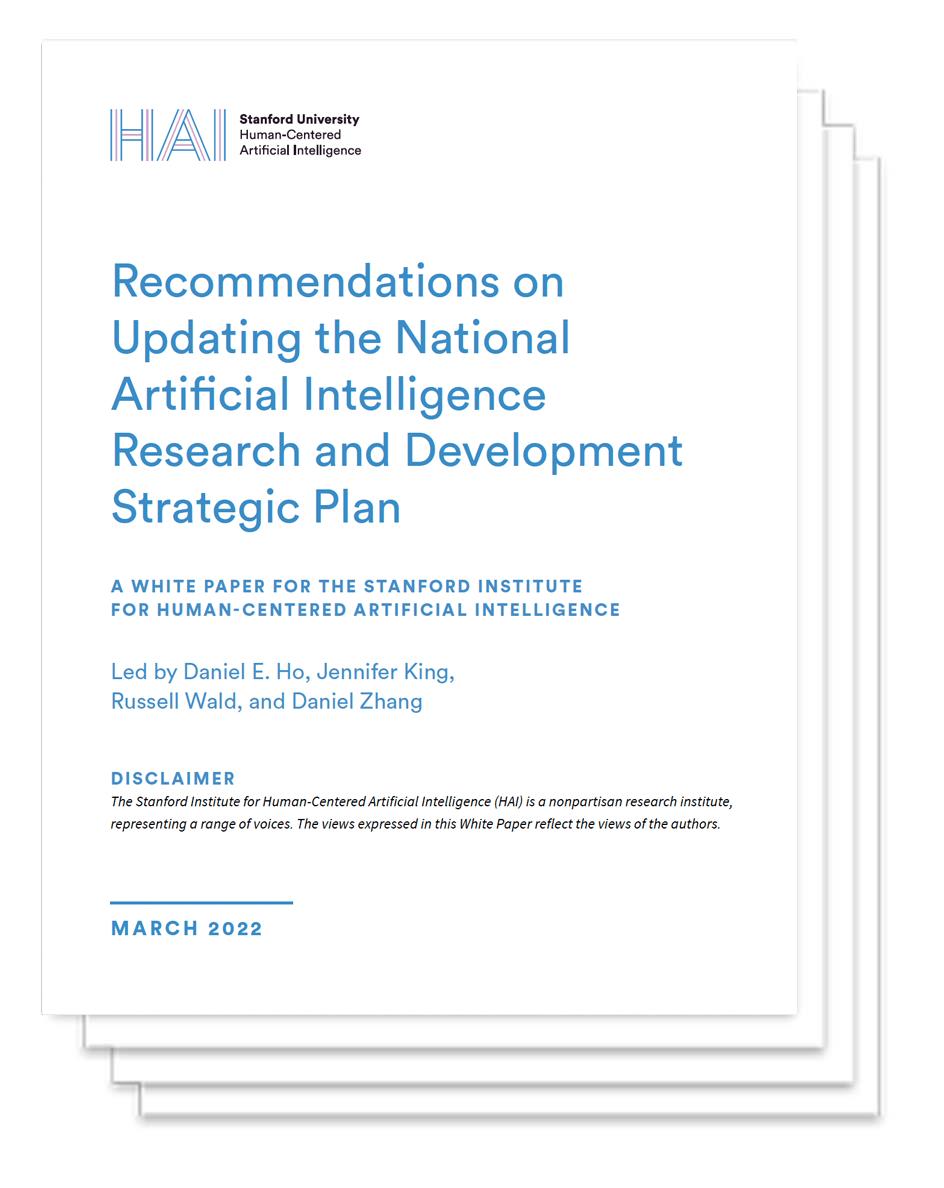
Recommendations on Updating the National Artificial Intelligence Research and Development Strategic Plan
Date
March 09, 2022
Topics
Regulation, Policy, Governance
Read Paper
abstract

Stanford HAI scholars respond to a federal RFI on updating the National AI R&D Strategic Plan, offering eight strategies for driving AI development forward.

Executive Summary

In this response to a request for information by the White House Office of Science and Technology (OSTP) regarding the Update of the National Artificial Intelligence Research and Development Strategic Plan, Stanford HAI scholars present eight strategies for driving AI development forward:

  1. Boost non-defense AI R&D budgets, particularly on AI-related infrastructure, to support long-term investments.

  2. Increase support for interdisciplinary and multidisciplinary AI research on human-AI collaboration that expands beyond exclusively technical research.

  3. Understand and Address the Ethical, Legal, and Societal Implications of AI.

  4. Develop appropriate acquisition strategies and update existing procurement regulations to respond to AI procurement and acquisition challenges in the federal government.

  5. Expand government data access to academic researchers to train AI models and develop frameworks for government agencies to evaluate such datasets and their applications in tandem.

  6. Establish a mechanism to evaluate AI models within the exact context of their intended use to ensure safe deployment as well as designate NIST in collaboration with other federal agencies to benchmark AI models in institutional contexts.

  7. Update immigration policies to attract talent in AI and other technical fields as well as develop federal programs to hire AI talent and re-skill civil servants with both technical capacity and institutional knowledge.

  8. Strengthen partnerships with academic institutions and build a framework for a public-university-industry AI R&D ecosystem to drive AI development forward. 

Read Paper
Share
Link copied to clipboard!
Authors
  • Dan Ho headshot
    Daniel E. Ho
  • Jennifer King
    Jennifer King
  • Russell Wald headshot
    Russell Wald
  • Daniel Zhang
    Daniel Zhang

Related Publications

Response to OSTP's Request for Information on Accelerating the American Scientific Enterprise
Rishi Bommasani, John Etchemendy, Surya Ganguli, Daniel E. Ho, Guido Imbens, James Landay, Fei-Fei Li, Russell Wald
Quick ReadDec 26, 2025
Response to Request

Stanford scholars respond to a federal RFI on scientific discovery, calling for the government to support a new “team science” academic research model for AI-enabled discovery.

Response to Request

Response to OSTP's Request for Information on Accelerating the American Scientific Enterprise

Rishi Bommasani, John Etchemendy, Surya Ganguli, Daniel E. Ho, Guido Imbens, James Landay, Fei-Fei Li, Russell Wald
Sciences (Social, Health, Biological, Physical)Regulation, Policy, GovernanceQuick ReadDec 26

Stanford scholars respond to a federal RFI on scientific discovery, calling for the government to support a new “team science” academic research model for AI-enabled discovery.

Response to FDA's Request for Comment on AI-Enabled Medical Devices
Desmond C. Ong, Jared Moore, Nicole Martinez-Martin, Caroline Meinhardt, Eric Lin, William Agnew
Quick ReadDec 02, 2025
Response to Request

Stanford scholars respond to a federal RFC on evaluating AI-enabled medical devices, recommending policy interventions to help mitigate the harms of AI-powered chatbots used as therapists.

Response to Request

Response to FDA's Request for Comment on AI-Enabled Medical Devices

Desmond C. Ong, Jared Moore, Nicole Martinez-Martin, Caroline Meinhardt, Eric Lin, William Agnew
HealthcareRegulation, Policy, GovernanceQuick ReadDec 02

Stanford scholars respond to a federal RFC on evaluating AI-enabled medical devices, recommending policy interventions to help mitigate the harms of AI-powered chatbots used as therapists.

Russ Altman’s Testimony Before the U.S. Senate Committee on Health, Education, Labor, and Pensions
Russ Altman
Quick ReadOct 09, 2025
Testimony

In this testimony presented to the U.S. Senate Committee on Health, Education, Labor, and Pensions hearing titled “AI’s Potential to Support Patients, Workers, Children, and Families,” Russ Altman highlights opportunities for congressional support to make AI applications for patient care and drug discovery stronger, safer, and human-centered.

Testimony

Russ Altman’s Testimony Before the U.S. Senate Committee on Health, Education, Labor, and Pensions

Russ Altman
HealthcareRegulation, Policy, GovernanceSciences (Social, Health, Biological, Physical)Quick ReadOct 09

In this testimony presented to the U.S. Senate Committee on Health, Education, Labor, and Pensions hearing titled “AI’s Potential to Support Patients, Workers, Children, and Families,” Russ Altman highlights opportunities for congressional support to make AI applications for patient care and drug discovery stronger, safer, and human-centered.

Michelle M. Mello's Testimony Before the U.S. House Committee on Energy and Commerce Health Subcommittee
Michelle Mello
Quick ReadSep 02, 2025
Testimony

In this testimony presented to the U.S. House Committee on Energy and Commerce’s Subcommittee on Health hearing titled “Examining Opportunities to Advance American Health Care through the Use of Artificial Intelligence Technologies,” Michelle M. Mello calls for policy changes that will promote effective integration of AI tools into healthcare by strengthening trust.

Testimony

Michelle M. Mello's Testimony Before the U.S. House Committee on Energy and Commerce Health Subcommittee

Michelle Mello
HealthcareRegulation, Policy, GovernanceQuick ReadSep 02

In this testimony presented to the U.S. House Committee on Energy and Commerce’s Subcommittee on Health hearing titled “Examining Opportunities to Advance American Health Care through the Use of Artificial Intelligence Technologies,” Michelle M. Mello calls for policy changes that will promote effective integration of AI tools into healthcare by strengthening trust.