Economy, Markets
How AI is driving economic growth and creating new markets.
Richard Socher | The Eureka Machine: Why AI is the Key to Unlocking a New Era of Scientific Discoveries
The next, maybe final, frontier of AI research is automating the process of knowledge discovery. By pointing AI first at itself and then at the R&D process of all scientific domains, we can far exceed where human-led research can take us. Richard Socher argues the current pace of scientific discovery has slowed significantly over the past several decades as the fields of science fragment and the number of researchers focused on any one continues to shrink.
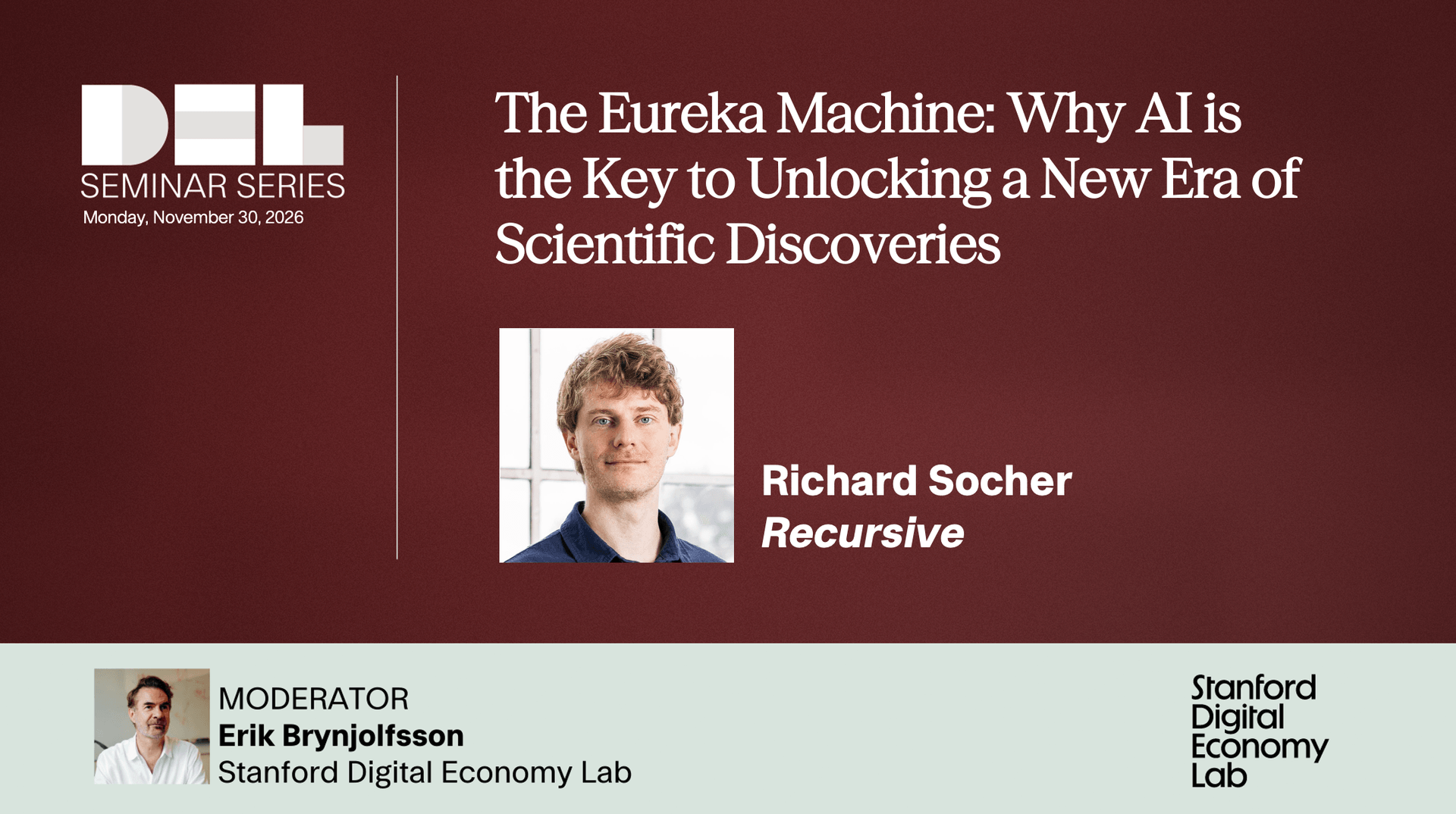
The next, maybe final, frontier of AI research is automating the process of knowledge discovery. By pointing AI first at itself and then at the R&D process of all scientific domains, we can far exceed where human-led research can take us. Richard Socher argues the current pace of scientific discovery has slowed significantly over the past several decades as the fields of science fragment and the number of researchers focused on any one continues to shrink.
Seven interdisciplinary research teams win a total of $3.5 million to pursue bold human-centered approaches to AI across medicine, science, law and education.
Seven interdisciplinary research teams win a total of $3.5 million to pursue bold human-centered approaches to AI across medicine, science, law and education.

AI will have a profound impact on work, business, and the economy. In this industry brief, we provide a sampling of key research both at HAI and more broadly at Stanford that can help inform the future of work. You will find researchers studying how AI can be used to help teams collaborate, improve workplace culture, promote employee well-being, assist humans in dangerous environments, and more.

AI will have a profound impact on work, business, and the economy. In this industry brief, we provide a sampling of key research both at HAI and more broadly at Stanford that can help inform the future of work. You will find researchers studying how AI can be used to help teams collaborate, improve workplace culture, promote employee well-being, assist humans in dangerous environments, and more.

Stanford scholars respond to a federal RFI regarding a study to advance a more productive tech economy, highlighting why productivity has not been sufficiently understood or measured, especially from AI.

Stanford scholars respond to a federal RFI regarding a study to advance a more productive tech economy, highlighting why productivity has not been sufficiently understood or measured, especially from AI.


New findings from the Stanford AI Index reveal a more uneven picture of public sentiment and labor market outcomes than previously thought, as AI investment surpasses $1 trillion.
New findings from the Stanford AI Index reveal a more uneven picture of public sentiment and labor market outcomes than previously thought, as AI investment surpasses $1 trillion.
All Work Published on Economy, Markets

From battlefield targeting to synthetic media, the third AI100 report finds a technology that has outrun both expectations and governance.
From battlefield targeting to synthetic media, the third AI100 report finds a technology that has outrun both expectations and governance.

Policy Strategies for Harnessing Productivity Potential of AI in the U.S.

This brief outlines a set of policy recommendations that could increase productivity growth, make the U.S. more competitive, and reduce income inequality.
This brief outlines a set of policy recommendations that could increase productivity growth, make the U.S. more competitive, and reduce income inequality.

Erik Brynjolfsson



Dashboards created by Stanford HAI’s Digital Economy Lab measure how AI adoption is altering employment trends and job growth, along with broader economic indicators.
Dashboards created by Stanford HAI’s Digital Economy Lab measure how AI adoption is altering employment trends and job growth, along with broader economic indicators.


In this testimony to the House Committee on the Budget’s hearing on “Machines, Artificial Intelligence, & the Workforce,” Susan Athey highlights AI’s vast promise and calls for continuous worker reskilling to ensure the technology tackles looming economic and societal challenges.
In this testimony to the House Committee on the Budget’s hearing on “Machines, Artificial Intelligence, & the Workforce,” Susan Athey highlights AI’s vast promise and calls for continuous worker reskilling to ensure the technology tackles looming economic and societal challenges.

HAI Director James Landay discusses historical technological impacts on productivity growth.
HAI Director James Landay discusses historical technological impacts on productivity growth.