Policy Strategies for Harnessing Productivity Potential of AI in the U.S.
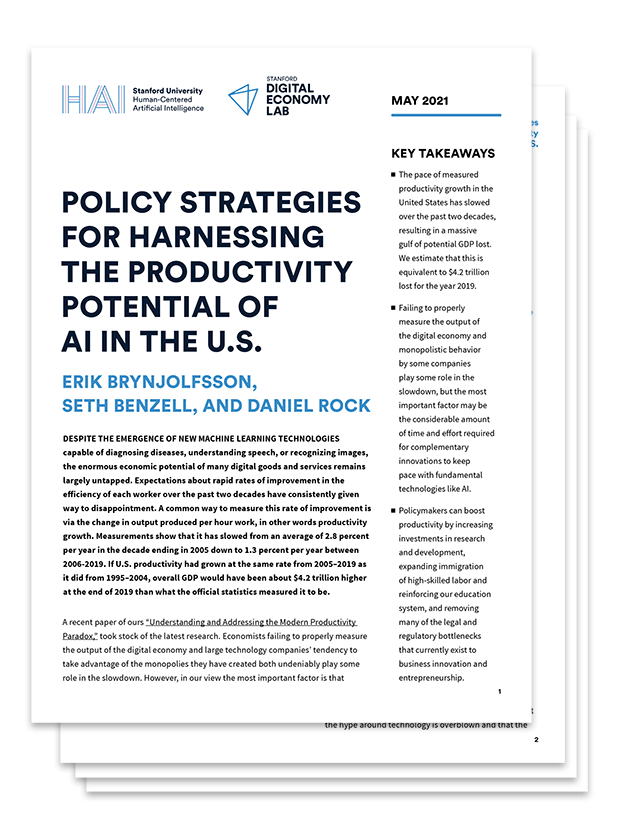
This brief outlines a set of policy recommendations that could increase productivity growth, make the U.S. more competitive, and reduce income inequality.
In collaboration with

Key Takeaways
The pace of measured productivity growth in the United States has slowed over the past two decades, resulting in a massive gulf of potential GDP lost. We estimate that this is equivalent to $4.2 trillion lost for the year 2019.
Failing to properly measure the output of the digital economy and monopolistic behavior by some companies play some role in the slowdown, but the most important factor may be the considerable amount of time and effort required for complementary innovations to keep pace with fundamental technologies like AI.
Policymakers can boost productivity by increasing investments in research and development, expanding immigration of high-skilled labor and reinforcing our education system, and removing many of the legal and regulatory bottlenecks that currently exist to business innovation and entrepreneurship.
Executive Summary
Despite the emergence of new machine learning technologies capable of diagnosing diseases, understanding speech, or recognizing images, the enormous economic potential of many digital goods and services remains largely untapped. Expectations about rapid rates of improvement in the efficiency of each worker over the past two decades have consistently given way to disappointment. A common way to measure this rate of improvement is via the change in output produced per hour work, in other words productivity growth. Measurements show that it has slowed from an average of 2.8 percent per year in the decade ending in 2005 down to 1.3 percent per year between 2006-2019. If U.S. productivity had grown at the same rate from 2005–2019 as it did from 1995–2004, overall GDP would have been about $4.2 trillion higher at the end of 2019 than what the official statistics measured it to be.
A recent paper of ours “Understanding and Addressing the Modern Productivity Paradox,” took stock of the latest research. Economists failing to properly measure the output of the digital economy and large technology companies’ tendency to take advantage of the monopolies they have created both undeniably play some role in the slowdown. However, in our view the most important factor is that transformative technologies like AI take time to be implemented throughout the economy. Just as earlier innovations like electricity required entirely rethinking the nation’s paradigm about factory organization, infrastructure and public utilities, these twenty-first century advances cannot simply be implemented without complementary investments. They must be accompanied by appropriate adjustments, workforce re-skilling and business process innovations in order to ensure that they translate into sustained improvements in productivity.
We propose here a set of policy recommendations that fall into three broad categories that might reverse the recent stagnation in productivity growth, make the United States more competitive, and reduce overall income inequality. First, increasing investments in research and development through direct grants and tax credits. Second, expanding the human capital available to the economy by boosting the nation’s education system and expanding immigration of high-skilled labor. Third, removing many of the legal and regulatory bottlenecks that currently exist to entrepreneurship and business innovation. We are optimistic that if policymakers implement the plan for shared prosperity that we outline in this brief, the coming decade will be one of higher productivity growth and one where the United States returns to its historical role as the most dynamic economy in the world.
Related Publications
The 2026 US Talent Report: Benchmarking America’s STEM Pipeline Amid the Great Talent Competition
This report assesses America's ability to develop, attract, and retain STEM talent and warns that its advantages over China are narrowing rapidly.
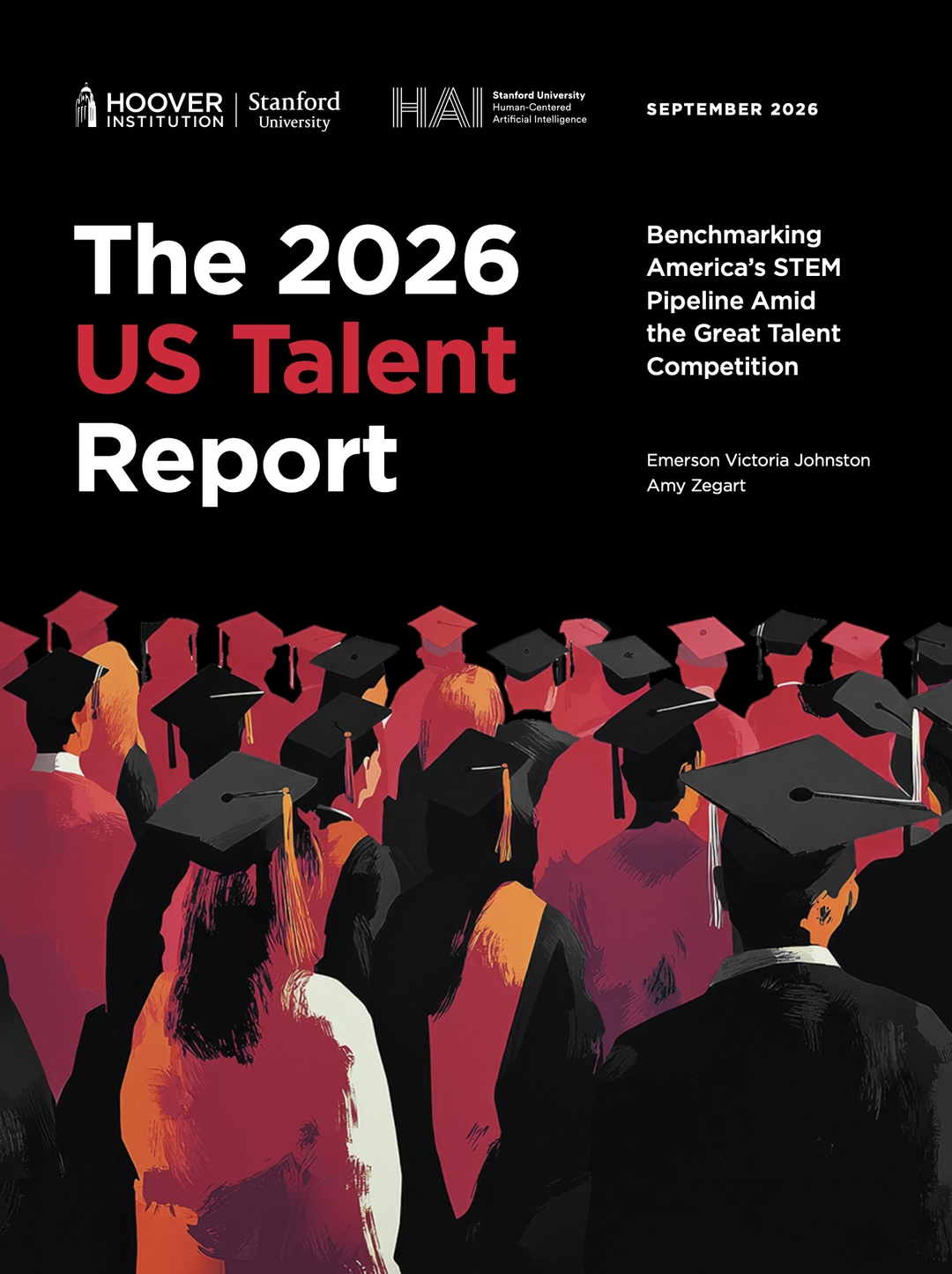
This report assesses America's ability to develop, attract, and retain STEM talent and warns that its advantages over China are narrowing rapidly.

This brief presents an analysis of Chinese AI startup DeepSeek’s talent base and calls for U.S. policymakers to reinvest in competing to attract and retain global AI talent.

This brief presents an analysis of Chinese AI startup DeepSeek’s talent base and calls for U.S. policymakers to reinvest in competing to attract and retain global AI talent.

Stanford scholars respond to a federal RFI regarding a study to advance a more productive tech economy, highlighting why productivity has not been sufficiently understood or measured, especially from AI.
Stanford scholars respond to a federal RFI regarding a study to advance a more productive tech economy, highlighting why productivity has not been sufficiently understood or measured, especially from AI.

In this testimony to the House Committee on the Budget’s hearing on “Machines, Artificial Intelligence, & the Workforce,” Susan Athey highlights AI’s vast promise and calls for continuous worker reskilling to ensure the technology tackles looming economic and societal challenges.
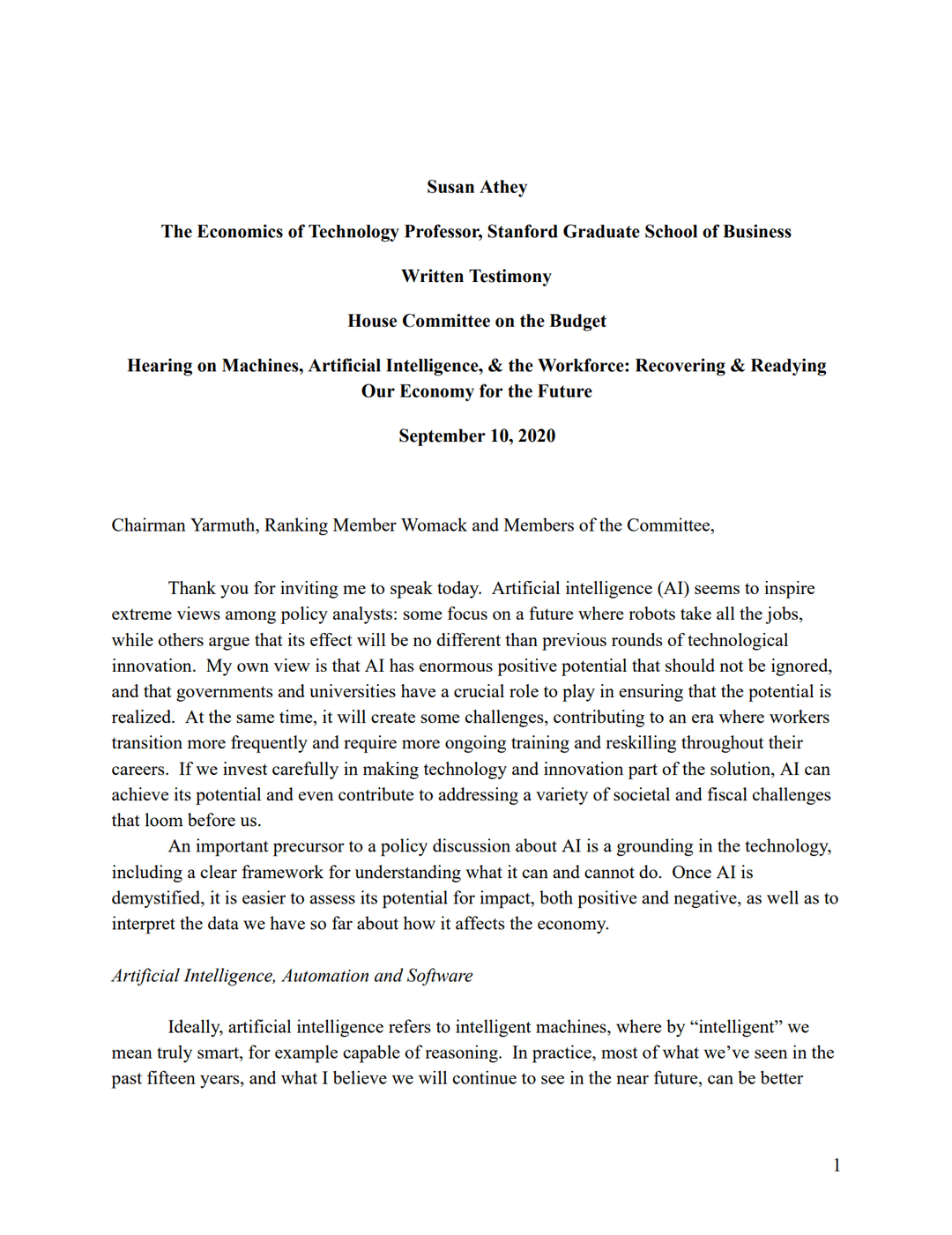
In this testimony to the House Committee on the Budget’s hearing on “Machines, Artificial Intelligence, & the Workforce,” Susan Athey highlights AI’s vast promise and calls for continuous worker reskilling to ensure the technology tackles looming economic and societal challenges.