All Work Published on Healthcare
Vision-based Estimation of MDS-UPDRS Gait Scoresfor Assessing Parkinson’s Disease Motor Severity

Parkinson’s disease (PD) is a progressive neurological disorder primarily affecting motor function resulting in tremor at rest, rigidity, bradykinesia, and postural instability. The physical severity of PD impairments can be quantified through the Movement Disorder Society Unified Parkinson’s Disease Rating Scale (MDS-UPDRS), a widely used clinical rating scale. Accurate and quantitative assessment of disease progression is critical to developing a treatment that slows or stops further advancement of the disease. Prior work has mainly focused on dopamine transport neuroimaging for diagnosis or costly and intrusive wearables evaluating motor impairments. For the first time, we propose a computer vision-based model that observes non-intrusive video recordings of individuals, extracts their 3D body skeletons, tracks them through time, and classifies the movements according to the MDS-UPDRS gait scores. Experimental results show that our proposed method performs significantly better than chance and competing methods with an F1-score of 0.83 and a balanced accuracy of 81%. This is the first benchmark for classifying PD patients based on MDS-UPDRS gait severity and could be an objective biomarker for disease severity. Our work demonstrates how computer-assisted technologies can be used to non-intrusively monitor patients and their motor impairments.
Parkinson’s disease (PD) is a progressive neurological disorder primarily affecting motor function resulting in tremor at rest, rigidity, bradykinesia, and postural instability. The physical severity of PD impairments can be quantified through the Movement Disorder Society Unified Parkinson’s Disease Rating Scale (MDS-UPDRS), a widely used clinical rating scale. Accurate and quantitative assessment of disease progression is critical to developing a treatment that slows or stops further advancement of the disease. Prior work has mainly focused on dopamine transport neuroimaging for diagnosis or costly and intrusive wearables evaluating motor impairments. For the first time, we propose a computer vision-based model that observes non-intrusive video recordings of individuals, extracts their 3D body skeletons, tracks them through time, and classifies the movements according to the MDS-UPDRS gait scores. Experimental results show that our proposed method performs significantly better than chance and competing methods with an F1-score of 0.83 and a balanced accuracy of 81%. This is the first benchmark for classifying PD patients based on MDS-UPDRS gait severity and could be an objective biomarker for disease severity. Our work demonstrates how computer-assisted technologies can be used to non-intrusively monitor patients and their motor impairments.

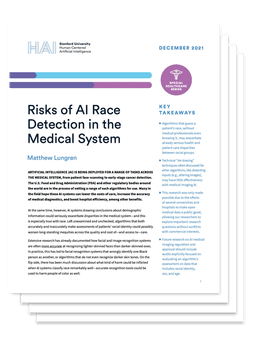
This brief warns that AI systems that infer patients’ race in medical settings could deepen existing healthcare disparities.
This brief warns that AI systems that infer patients’ race in medical settings could deepen existing healthcare disparities.
From Privacy to ‘Glass Box’ AI, Stanford Students Are Targeting Real-World Problems

An Amazon-backed fellowship will support 10 Stanford PhD students whose work explores everything from how we communicate to understanding disease and protecting our data.
An Amazon-backed fellowship will support 10 Stanford PhD students whose work explores everything from how we communicate to understanding disease and protecting our data.

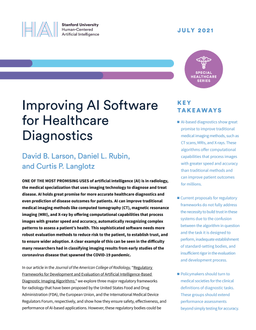
Improving AI Software for Healthcare Diagnostics
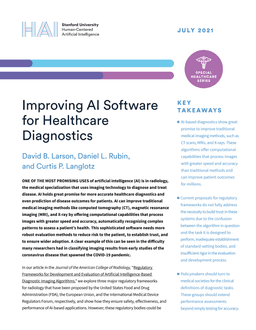
This brief explores current regulatory frameworks for AI use in radiology and calls for stronger regulatory guidance to improve testing, enhance safety, and establish performance standards.
This brief explores current regulatory frameworks for AI use in radiology and calls for stronger regulatory guidance to improve testing, enhance safety, and establish performance standards.
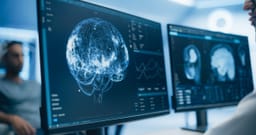
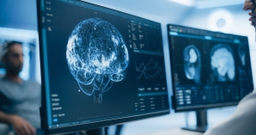
Stanford researchers have developed a deep learning model that transforms overwhelming brain data into clear trajectories, opening new possibilities for understanding thought, emotion, and neurological disease.
Stanford researchers have developed a deep learning model that transforms overwhelming brain data into clear trajectories, opening new possibilities for understanding thought, emotion, and neurological disease.
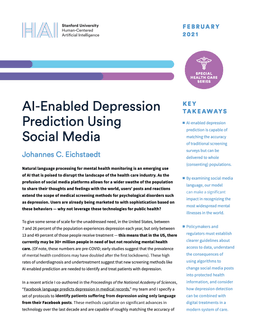
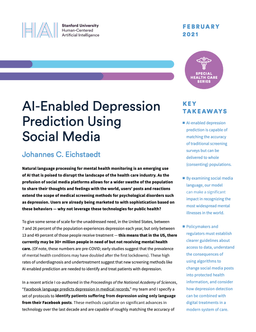
This brief introduces AI-enabled depression prediction through social media and calls for clear policy guidelines to ensure patient privacy.
This brief introduces AI-enabled depression prediction through social media and calls for clear policy guidelines to ensure patient privacy.