What are Weights? | Stanford HAI
Stanford
University
  • Stanford Home
  • Maps & Directions
  • Search Stanford
  • Emergency Info
  • Terms of Use
  • Privacy
  • Copyright
  • Trademarks
  • Non-Discrimination
  • Accessibility
© Stanford University.  Stanford, California 94305.
Skip to content
  • About

    • About
    • People
    • Get Involved with HAI
    • Support HAI
    • Subscribe to Email
  • Research

    • Research
    • Fellowship Programs
    • Grants
    • Student Affinity Groups
    • Centers & Labs
    • Research Publications
    • Research Partners
  • Education

    • Education
    • Executive and Professional Education
    • Government and Policymakers
    • K-12
    • Stanford Students
  • Policy

    • Policy
    • Policy Publications
    • Policymaker Education
    • Student Opportunities
  • AI Index

    • AI Index
    • AI Index Report
    • Global Vibrancy Tool
    • People
  • News
  • Events
  • Industry
  • Centers & Labs

What are Weights?

Weights are the numerical parameters within a neural network that determine the strength of connections between artificial neurons and ultimately shape how the model processes information. During training, these weights are continuously adjusted through algorithms like backpropagation to minimize errors and improve the model's predictions. The learned weights represent the model's "knowledge"—a trained AI model is essentially a specific configuration of billions of these weight values that encode patterns discovered from training data.

Navigate
  • About
  • Events
  • Careers
  • Search
Participate
  • Get Involved
  • Support HAI
  • Contact Us

Stay Up To Date

Get the latest news, advances in research, policy work, and education program updates from HAI in your inbox weekly.

Sign Up For Latest News


Weights mentioned at Stanford HAI

Explore Similar Terms:

Parameter | Hyperparameter | Tensor

See Full List of Terms & Definitions

Enroll in a Human-Centered AI Course

This AI program covers technical fundamentals, business implications, and societal considerations.
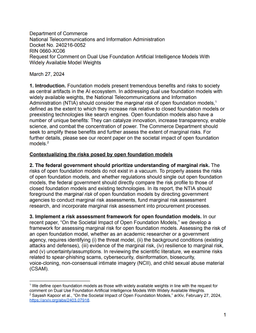
Response to NTIA’s Request for Comment on Dual Use Open Foundation Models
Researchers from Stanford HAI
Mar 27
response to request

Stanford scholars respond to a federal RFC on dual use foundation models with widely available model weights, urging policymakers to consider their marginal risks.
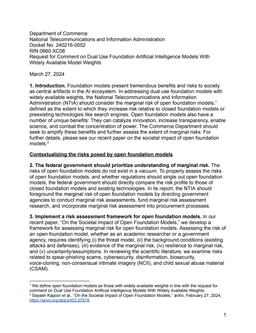
Response to NTIA’s Request for Comment on Dual Use Open Foundation Models

Researchers from Stanford HAI
Mar 27

Stanford scholars respond to a federal RFC on dual use foundation models with widely available model weights, urging policymakers to consider their marginal risks.

Foundation Models
Regulation, Policy, Governance
Privacy, Safety, Security
response to request
Considerations for Governing Open Foundation Models
Rishi Bommasani, Sayash Kapoor, Kevin Klyman, Shayne Longpre, Ashwin Ramaswami, Daniel Zhang, Marietje Schaake, Daniel E. Ho, Arvind Narayanan, Percy Liang
Quick ReadDec 13
issue brief

This brief highlights the benefits of open foundation models and calls for greater focus on their marginal risks.


Considerations for Governing Open Foundation Models

Rishi Bommasani, Sayash Kapoor, Kevin Klyman, Shayne Longpre, Ashwin Ramaswami, Daniel Zhang, Marietje Schaake, Daniel E. Ho, Arvind Narayanan, Percy Liang
Quick ReadDec 13

This brief highlights the benefits of open foundation models and calls for greater focus on their marginal risks.

Foundation Models
issue brief
How to Promote Responsible Open Foundation Models
Kevin Klyman
Oct 03
news

Experts from industry, academia, and government share lessons learned and outline a path forward at a Princeton-Stanford workshop.

How to Promote Responsible Open Foundation Models

Kevin Klyman
Oct 03

Experts from industry, academia, and government share lessons learned and outline a path forward at a Princeton-Stanford workshop.

Machine Learning
news
On the Societal Impact of Open Foundation Models
Sayash Kapoor, Rishi Bommasani, Daniel E. Ho, Percy Liang
and Arvind Narayanan
Feb 27
news

New research adds precision to the debate on openness in AI.

On the Societal Impact of Open Foundation Models

Sayash Kapoor, Rishi Bommasani, Daniel E. Ho, Percy Liang
and Arvind Narayanan
Feb 27

New research adds precision to the debate on openness in AI.

news
AI for Social Good: How One Nonprofit Hopes to Solve Global Health Challenges
Shana Lynch
Mar 19
news
Your browser does not support the video tag.

One nonprofit uses novel approaches to improve infant mortality, agricultural disaster, and tuberculosis diagnoses.

AI for Social Good: How One Nonprofit Hopes to Solve Global Health Challenges

Shana Lynch
Mar 19

One nonprofit uses novel approaches to improve infant mortality, agricultural disaster, and tuberculosis diagnoses.

Healthcare
Your browser does not support the video tag.
news
How Disruptive Is DeepSeek? Stanford HAI Faculty Discuss China’s New Model
Vanessa Parli
Feb 13
news

How Disruptive Is DeepSeek? Stanford HAI Faculty Discuss China’s New Model

Vanessa Parli
Feb 13

Machine Learning
news
TextGrad: AutoGrad for Text
Federico Bianchi, James Zou
Jun 19
news
Your browser does not support the video tag.

Scholars develop a new framework that optimizes compound AI systems by backpropagating large language model feedback.

TextGrad: AutoGrad for Text

Federico Bianchi, James Zou
Jun 19

Scholars develop a new framework that optimizes compound AI systems by backpropagating large language model feedback.

Machine Learning
Your browser does not support the video tag.
news