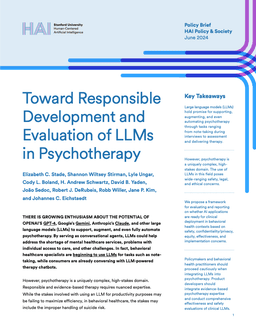
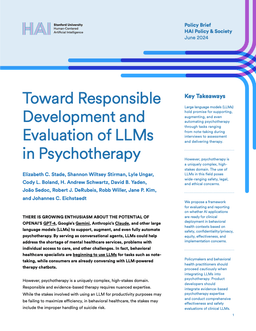
This brief reviews the current landscape of LLMs developed for psychotherapy and proposes a framework for evaluating the readiness of these AI tools for clinical deployment.
This brief reviews the current landscape of LLMs developed for psychotherapy and proposes a framework for evaluating the readiness of these AI tools for clinical deployment.
HAI’s Center for Research on Foundation Models launches Holistic Evaluation of Language Models (HELM), the first benchmarking project aimed at improving the transparency of language models and the broader category of foundation models.
HAI’s Center for Research on Foundation Models launches Holistic Evaluation of Language Models (HELM), the first benchmarking project aimed at improving the transparency of language models and the broader category of foundation models.
Mind the (Language) Gap: Mapping the Challenges of LLM Development in Low-Resource Language Contexts

This white paper maps the LLM development landscape for low-resource languages, highlighting challenges, trade-offs, and strategies to increase investment; prioritize cross-disciplinary, community-driven development; and ensure fair data ownership.
Mind the (Language) Gap: Mapping the Challenges of LLM Development in Low-Resource Language Contexts
This white paper maps the LLM development landscape for low-resource languages, highlighting challenges, trade-offs, and strategies to increase investment; prioritize cross-disciplinary, community-driven development; and ensure fair data ownership.

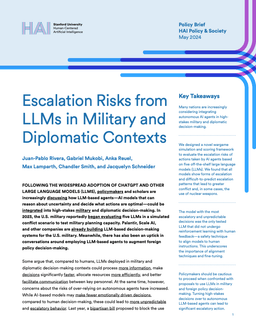
Escalation Risks from LLMs in Military and Diplomatic Contexts

This brief presents the results of a wargame simulation that aims to evaluate the escalation risks of large language models (LLMs) in high-stakes military and diplomatic decision-making.
This brief presents the results of a wargame simulation that aims to evaluate the escalation risks of large language models (LLMs) in high-stakes military and diplomatic decision-making.
Can AI Hold Consistent Values? Stanford Researchers Probe LLM Consistency and Bias

New research tests large language models for consistency across diverse topics, revealing that while they handle neutral topics reliably, controversial issues lead to varied answers.
New research tests large language models for consistency across diverse topics, revealing that while they handle neutral topics reliably, controversial issues lead to varied answers.

Silent Speech Interfaces (SSIs) offer a nonin- vasive alternative to brain-computer interfaces for soundless verbal communication. We in- troduce Multimodal Orofacial Neural Audio (MONA), a system that leverages cross-modal alignment through novel loss functions—cross- contrast (crossCon) and supervised temporal con- trast (supTcon)—to train a multimodal model with a shared latent representation. This archi- tecture enables the use of audio-only datasets like LibriSpeech to improve silent speech recog- nition. Additionally, our introduction of Large Language Model (LLM) Integrated Scoring Ad- justment (LISA) significantly improves recogni- tion accuracy. Together, MONA LISA reduces the state-of-the-art word error rate (WER) from 28.8% to 12.2% in the Gaddy (2020) benchmark dataset for silent speech on an open vocabulary. For vocal EMG recordings, our method improves the state-of-the-art from 23.3% to 3.7% WER. In the Brain-to-Text 2024 competition, LISA per- forms best, improving the top WER from 9.8% to 8.9%. To the best of our knowledge, this work represents the first instance where noninvasive silent speech recognition on an open vocabulary has cleared the threshold of 15% WER, demon- strating that SSIs can be a viable alternative to au- tomatic speech recognition (ASR). Our work not only narrows the performance gap between silent and vocalized speech but also opens new possi- bilities in human-computer interaction, demon- strating the potential of cross-modal approaches in noisy and data-limited regimes.
Silent Speech Interfaces (SSIs) offer a nonin- vasive alternative to brain-computer interfaces for soundless verbal communication. We in- troduce Multimodal Orofacial Neural Audio (MONA), a system that leverages cross-modal alignment through novel loss functions—cross- contrast (crossCon) and supervised temporal con- trast (supTcon)—to train a multimodal model with a shared latent representation. This archi- tecture enables the use of audio-only datasets like LibriSpeech to improve silent speech recog- nition. Additionally, our introduction of Large Language Model (LLM) Integrated Scoring Ad- justment (LISA) significantly improves recogni- tion accuracy. Together, MONA LISA reduces the state-of-the-art word error rate (WER) from 28.8% to 12.2% in the Gaddy (2020) benchmark dataset for silent speech on an open vocabulary. For vocal EMG recordings, our method improves the state-of-the-art from 23.3% to 3.7% WER. In the Brain-to-Text 2024 competition, LISA per- forms best, improving the top WER from 9.8% to 8.9%. To the best of our knowledge, this work represents the first instance where noninvasive silent speech recognition on an open vocabulary has cleared the threshold of 15% WER, demon- strating that SSIs can be a viable alternative to au- tomatic speech recognition (ASR). Our work not only narrows the performance gap between silent and vocalized speech but also opens new possi- bilities in human-computer interaction, demon- strating the potential of cross-modal approaches in noisy and data-limited regimes.
Vafa et al. (2024) introduced a transformer-based econometric model, CAREER, that predicts a worker’s next job as a function of career history (an “occupation model”). CAREER was initially estimated (“pre-trained”) using a large, unrepresentative resume dataset, which served as a “foundation model,” and parameter estimation was continued (“fine-tuned”) using data from a representative survey. CAREER had better predictive performance than benchmarks. This paper considers an alternative where the resume-based foundation model is replaced by a large language model (LLM). We convert tabular data from the survey into text files that resemble resumes and fine-tune the LLMs using these text files with the objective to predict the next token (word). The resulting fine-tuned LLM is used as an input to an occupation model. Its predictive performance surpasses all prior models. We demonstrate the value of fine-tuning and further show that by adding more career data from a different population, fine-tuning smaller LLMs surpasses the performance of fine-tuning larger models.
Vafa et al. (2024) introduced a transformer-based econometric model, CAREER, that predicts a worker’s next job as a function of career history (an “occupation model”). CAREER was initially estimated (“pre-trained”) using a large, unrepresentative resume dataset, which served as a “foundation model,” and parameter estimation was continued (“fine-tuned”) using data from a representative survey. CAREER had better predictive performance than benchmarks. This paper considers an alternative where the resume-based foundation model is replaced by a large language model (LLM). We convert tabular data from the survey into text files that resemble resumes and fine-tune the LLMs using these text files with the objective to predict the next token (word). The resulting fine-tuned LLM is used as an input to an occupation model. Its predictive performance surpasses all prior models. We demonstrate the value of fine-tuning and further show that by adding more career data from a different population, fine-tuning smaller LLMs surpasses the performance of fine-tuning larger models.