A Generative Model for Raw Audio using Transformer Architectures
A Generative Model for Raw Audio using Transformer Architectures
We present a new method of deconstructing class activation tokens of vision transformers into a new, overcomplete basis, where each basis vector is “monosemantic” and affiliated with a single, human-compatible conceptual description. We achieve this through the use of a highly optimized and customized version of the K-SVD algorithm, which we call Double-Batch K-SVD (DBK-SVD). We demonstrate the efficacy of our approach on the sbucaptions dataset, using CLIP embeddings and comparing our results to a Sparse Autoencoder (SAE) baseline. Our method significantly outperforms SAE in terms of reconstruction loss, recovering approximately 2/3 of the original signal compared to 1/6 for SAE. We introduce novel metrics for evaluating explanation faithfulness and specificity, showing that DBK-SVD produces more diverse and specific concept descriptions. We therefore show empirically for the first time that disentangling of concepts arising in Vision Transformers is possible, a statement that has previously been questioned when applying an additional sparsity constraint. Our research opens new avenues for model interpretability, failure mitigation, and downstream task domain transfer in vision transformer models. An interactive demo showcasing our results can be found at https://disentangling-sbucaptions.xyz, and we make our DBK-SVD implementation openly available at https://github.com/RomeoV/KSVD.jl.
We present a new method of deconstructing class activation tokens of vision transformers into a new, overcomplete basis, where each basis vector is “monosemantic” and affiliated with a single, human-compatible conceptual description. We achieve this through the use of a highly optimized and customized version of the K-SVD algorithm, which we call Double-Batch K-SVD (DBK-SVD). We demonstrate the efficacy of our approach on the sbucaptions dataset, using CLIP embeddings and comparing our results to a Sparse Autoencoder (SAE) baseline. Our method significantly outperforms SAE in terms of reconstruction loss, recovering approximately 2/3 of the original signal compared to 1/6 for SAE. We introduce novel metrics for evaluating explanation faithfulness and specificity, showing that DBK-SVD produces more diverse and specific concept descriptions. We therefore show empirically for the first time that disentangling of concepts arising in Vision Transformers is possible, a statement that has previously been questioned when applying an additional sparsity constraint. Our research opens new avenues for model interpretability, failure mitigation, and downstream task domain transfer in vision transformer models. An interactive demo showcasing our results can be found at https://disentangling-sbucaptions.xyz, and we make our DBK-SVD implementation openly available at https://github.com/RomeoV/KSVD.jl.

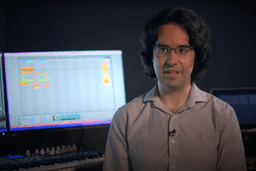
The Anticipatory Music Transformer assists composers in a way most generative AI cannot.
The Anticipatory Music Transformer assists composers in a way most generative AI cannot.
Vafa et al. (2024) introduced a transformer-based econometric model, CAREER, that predicts a worker’s next job as a function of career history (an “occupation model”). CAREER was initially estimated (“pre-trained”) using a large, unrepresentative resume dataset, which served as a “foundation model,” and parameter estimation was continued (“fine-tuned”) using data from a representative survey. CAREER had better predictive performance than benchmarks. This paper considers an alternative where the resume-based foundation model is replaced by a large language model (LLM). We convert tabular data from the survey into text files that resemble resumes and fine-tune the LLMs using these text files with the objective to predict the next token (word). The resulting fine-tuned LLM is used as an input to an occupation model. Its predictive performance surpasses all prior models. We demonstrate the value of fine-tuning and further show that by adding more career data from a different population, fine-tuning smaller LLMs surpasses the performance of fine-tuning larger models.
Vafa et al. (2024) introduced a transformer-based econometric model, CAREER, that predicts a worker’s next job as a function of career history (an “occupation model”). CAREER was initially estimated (“pre-trained”) using a large, unrepresentative resume dataset, which served as a “foundation model,” and parameter estimation was continued (“fine-tuned”) using data from a representative survey. CAREER had better predictive performance than benchmarks. This paper considers an alternative where the resume-based foundation model is replaced by a large language model (LLM). We convert tabular data from the survey into text files that resemble resumes and fine-tune the LLMs using these text files with the objective to predict the next token (word). The resulting fine-tuned LLM is used as an input to an occupation model. Its predictive performance surpasses all prior models. We demonstrate the value of fine-tuning and further show that by adding more career data from a different population, fine-tuning smaller LLMs surpasses the performance of fine-tuning larger models.

The MUSK model combines clinical notes and images to predict prognosis and immunotherapy response.
The MUSK model combines clinical notes and images to predict prognosis and immunotherapy response.

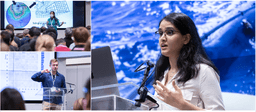
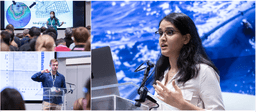
At Stanford HAI’s recent fall conference, scholars showed how artificial intelligence is opening up new approaches to studying science.
At Stanford HAI’s recent fall conference, scholars showed how artificial intelligence is opening up new approaches to studying science.