Scalable Differential Privacy with Sparse Network Fine-Tuning
Scalable Differential Privacy with Sparse Network Fine-Tuning

The lessons learned from the fine-tuning and evaluation of Vietnamese LLMs could help broaden access to models beyond English speakers.
The lessons learned from the fine-tuning and evaluation of Vietnamese LLMs could help broaden access to models beyond English speakers.

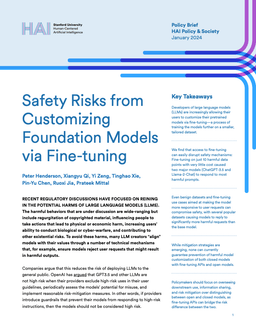
Safety Risks from Customizing Foundation Models via Fine-Tuning
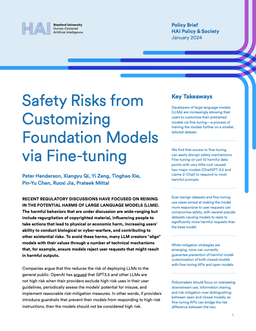
This brief underscores the safety risks inherent in custom fine-tuning of large language models.
This brief underscores the safety risks inherent in custom fine-tuning of large language models.

Despite advancements in AI, new research reveals that large language models continue to perpetuate harmful racial biases, particularly against speakers of African American English.
Despite advancements in AI, new research reveals that large language models continue to perpetuate harmful racial biases, particularly against speakers of African American English.

Vafa et al. (2024) introduced a transformer-based econometric model, CAREER, that predicts a worker’s next job as a function of career history (an “occupation model”). CAREER was initially estimated (“pre-trained”) using a large, unrepresentative resume dataset, which served as a “foundation model,” and parameter estimation was continued (“fine-tuned”) using data from a representative survey. CAREER had better predictive performance than benchmarks. This paper considers an alternative where the resume-based foundation model is replaced by a large language model (LLM). We convert tabular data from the survey into text files that resemble resumes and fine-tune the LLMs using these text files with the objective to predict the next token (word). The resulting fine-tuned LLM is used as an input to an occupation model. Its predictive performance surpasses all prior models. We demonstrate the value of fine-tuning and further show that by adding more career data from a different population, fine-tuning smaller LLMs surpasses the performance of fine-tuning larger models.
Vafa et al. (2024) introduced a transformer-based econometric model, CAREER, that predicts a worker’s next job as a function of career history (an “occupation model”). CAREER was initially estimated (“pre-trained”) using a large, unrepresentative resume dataset, which served as a “foundation model,” and parameter estimation was continued (“fine-tuned”) using data from a representative survey. CAREER had better predictive performance than benchmarks. This paper considers an alternative where the resume-based foundation model is replaced by a large language model (LLM). We convert tabular data from the survey into text files that resemble resumes and fine-tune the LLMs using these text files with the objective to predict the next token (word). The resulting fine-tuned LLM is used as an input to an occupation model. Its predictive performance surpasses all prior models. We demonstrate the value of fine-tuning and further show that by adding more career data from a different population, fine-tuning smaller LLMs surpasses the performance of fine-tuning larger models.

Stanford researchers show that although top language models cannot yet accurately diagnose children’s speech disorders, fine-tuning and other approaches could well change the game.
Stanford researchers show that although top language models cannot yet accurately diagnose children’s speech disorders, fine-tuning and other approaches could well change the game.


Stanford AIMI scholars found a way to generate synthetic chest X-rays by fine-tuning the open-source Stable Diffusion foundation model.
Stanford AIMI scholars found a way to generate synthetic chest X-rays by fine-tuning the open-source Stable Diffusion foundation model.