AI Reshapes Global Power: Insights from Stanford HAI’s Congressional Boot Camp
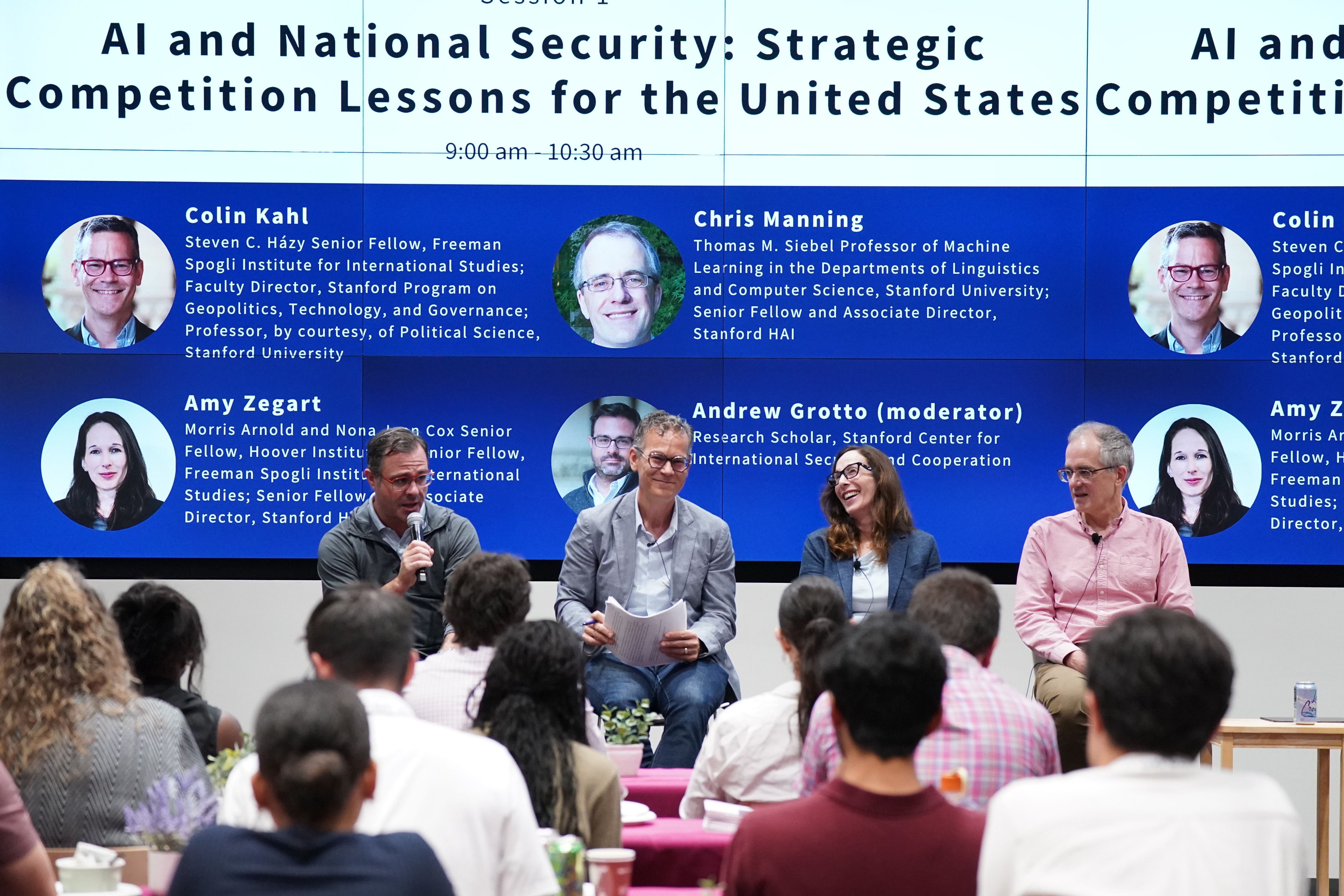
From left: Panel moderator Andrew Grotto with Colin Kahl, Amy Zegart, and Chris Manning.
The U.S must sharpen its competitive edge against China and invest in the talent pipeline, said a panel of security and technology experts.
This summer, 24 congressional staff members attended the Stanford Institute for Human-Centered AI’s Congressional Boot Camp, a three-day program to explore the latest in AI development, potential, and risks to effectively regulate this technology.
Participants heard from Stanford experts in health care, education, privacy and safety, economics, and more; visited Stanford labs; and connected with colleagues across the aisle.
During one session, faculty including Stanford HAI Associate Directors Chris Manning and Amy Zegart, along with Freeman Spogli Institute for International Studies Senior Fellow Colin Kahl, discussed AI’s role in national security, its implications for the U.S. economy, and the risk of China’s competitive rise.
Here are several of their main points.
It’s the Economy, Stupid
According to computer scientist Chris Manning, artificial intelligence has made remarkable advancements over the past eight years, particularly in the realm of large language models. In contrast to other technology sectors, such as smartphones, which tend to plateau after major breakthroughs and now see only incremental improvements, AI continues to evolve at a rapid pace. However, Manning cautions against overstating its growth, highlighting that areas like computer vision and robotics still contain major unsolved research challenges.
Overall, today’s AI is enhancing productivity and transforming the nature of work, which, in turn, will significantly impact the economy.
“AI is going to have an enormous economic impact across all industries because there’s just so much that can be automated,” Manning said. “And the strength of economies is very connected to the strength of countries.”
While the United States currently leads in AI innovation, Manning warned against complacency. China’s rapidly growing AI sector poses a significant competitive threat. While less of a threat, the Middle East and Europe are also developing their AI ecosystems.
The continued success of American AI companies hinges on skilled talent, Manning said. Universities have a long history of training top talent who go on to build American tech companies. Keeping our competitive edge means sustaining strong U.S. universities.
A Shift in Power and Talent
Today, power increasingly derives from intangible assets – such as data, knowledge, and algorithms – rather than traditional, tangible resources like military might and territory, said Amy Zegart, senior fellow at the Hoover Institution and Stanford HAI. This shift necessitates a reevaluation of how national power is perceived, measured, and used.
Knowledge-based power operates differently from conventional power. Unlike military assets, knowledge is generated outside the government; it is born unclassified, it is portable, and it is irreversible. These features make knowledge power more challenging for governments to understand, track, and control. The U.S. intelligence community lacks the capabilities to measure American technological knowledge power effectively, which means it is poorly prepared to assess competition with nations like China in key technological domains.
Moreover, China is putting resources toward building its AI capabilities and talent pipeline while the U.S. lags. Zegart’s recent analysis on the DeepSeek project revealed that China’s talent pipeline for AI researchers is now robust enough that it relies less on U.S. education; in fact, more than half of DeepSeek’s researchers were educated and trained entirely in China. The U.S., meanwhile, is falling behind on math and science education and developing its AI talent. Zegart highlighted the need for improved awareness and strategic action regarding talent competition and a more data-driven approach to analyzing the capabilities of both the U.S. and its global competitors.
“The bottom line here is that we need to be much more aware of the talent competition,” she warned.
The AI Race(s)
When it comes to global competition, we aren’t in one AI race, we’re in several, said Colin Kahl, senior fellow at the Freeman Spogli Institute for International Studies and professor, by courtesy, of political science.
The first race is to dominate global AI capabilities, crucial for economic and military benefits. What country is producing the most innovations? Today, American companies have the lead, Kahl noted, but the gap is closing between the U.S. and China.
“If you had asked me a year ago, how far ahead U.S. companies are relative to China at the frontier, I would have said the consensus is a year or two,” he said. “Now I think the consensus is measured in months, not years, and it might be six to nine months.”
Another race is integrating AI into national security. While the U.S. may have the top AI companies and models, it hasn’t widely integrated these technologies into military or national security applications. The Pentagon lacks sufficient AI literacy and access to cutting-edge models, Kahl noted. “Militarily, these models are going to have huge effects as they relate to intelligence advantage, decision advantage, the ability to support autonomous and semi-autonomous, attritable drones,” he said.
Similarly, the U.S. is lagging in the race for widespread AI adoption across the economy. Here, he said, China has the advantage due to its digital native economy, strong manufacturing base, and commitment to robotics. China is also outpacing the U.S. in building digital infrastructure globally that includes AI; if the world is using AI aligned with the Chinese Communist Party’s values, propaganda, censorship, and authoritarian surveillance risks increase, Kahl argued.
However, one race isn’t worth winning: the race to the bottom. Kahl cautioned against viewing the competitive dynamic in only positive terms, warning of potential negative consequences from harmful AI, including malicious use and loss of control over advanced AI systems. He recommended that the U.S. and China find common ground in addressing dangerous AI scenarios, drawing a parallel with arms control measures established during the Cold War.
Learn more about the Stanford HAI Congressional Boot Camp:
Inside Stanford HAI's Congressional Boot Camp on AI
Related News
It's one of AI policy's hardest unsolved problems. Expert Deb Raji joins Stanford HAI to find answers that move beyond principles and into practice.
It's one of AI policy's hardest unsolved problems. Expert Deb Raji joins Stanford HAI to find answers that move beyond principles and into practice.
Analyzing thousands of human-AI conversations, a new study shows that people are turning to chatbots for increasingly critical tasks – and that productive outcomes depend on how the collaboration unfolds.
Analyzing thousands of human-AI conversations, a new study shows that people are turning to chatbots for increasingly critical tasks – and that productive outcomes depend on how the collaboration unfolds.

How managers introduce and support AI determines whether workers engage with or resist the technology.

How managers introduce and support AI determines whether workers engage with or resist the technology.