Labeling AI-Generated Content May Not Change Its Persuasiveness

This brief evaluates the impact of authorship labels on the persuasiveness of AI-written policy messages.
Key Takeaways
In response to the rapidly improving ability of AI tools to create persuasive content, policymakers are increasingly calling for labels on AI-generated content—but little research has measured whether adding a label impacts the persuasiveness of the underlying messages.
We surveyed how more than 1,500 people perceive AI-generated policy messages when told the content had been created by an expert AI model, a human policy expert, or told nothing about its authorship.
Adding the label changed people’s perceptions of whether the author was AI or human but did not significantly change the persuasiveness of the content itself, regardless of the policy domain (e.g., allowing colleges to pay student athletes) or participant demographics (e.g., political party).
Policy proposals requiring AI content labels may enhance transparency, but their inability to affect persuasiveness highlights the need for complementary safeguards (e.g., media literacy education) and ongoing research into how AI disclosure policies shape the information ecosystem.
Executive Summary
Generative AI tools can now produce persuasive content at previously unprecedented scale and speed. There are many ways in which these tools can be used for positive impact in the world. But the emergence of persuasive, AI-generated content also makes possible many negative uses — such as influence operations, misinformation campaigns, and other kinds of deception — particularly in political contexts. These risks are compounded by a key issue: People struggle to distinguish AI-generated content from content written by humans, which helps influence campaigns and misinformation thrive.
These risks have led policymakers to call for authorship labels on AI-made content. In the European Union, for instance, the AI Act requires that entities deploying AI-generated or -manipulated content label it as such. In the United States, the AI Labeling Act and the AI Disclosure Act, both introduced in Congress in 2023 but not passed, would have implemented similar rules. Policymakers’ calls for labels on AI-made content raise a key question: Will a label change how much the content influences people’s political and public policy views?
In our paper “Labeling Messages as AI-Generated Does Not Reduce Their Persuasive Effects,” we surveyed a diverse group of Americans to investigate how adding authorship labels did or did not affect how they perceive AI-written policy appeals. Across four less-polarized public policy topics, we found no significant difference between people’s support for a policy argument when told the argument had been generated by an expert AI model, a human policy expert, or told nothing about its authorship. The labels also had no significant effects on people’s judgments of the content’s accuracy or people’s intentions to share the policy argument with others.
Policymakers should continue studying and debating effective AI disclosure policies, including how AI content labels may empower users to make more informed decisions about content consumption. Yet, while labels may enhance transparency, our work suggests that on their own, they may be insufficient in addressing the challenges posed by AI-generated information. Policymakers need to conduct further research and explore alternative interventions, including media literacy education and deamplification of AI-generated content.
Introduction
Previous work has explored the persuasiveness of AI-generated content without AI labels; perceptions of the credibility, reliability, or quality of labeled information; and the effect of different labels for AI-generated images on viewers’ beliefs. There remains a gap when it comes to research on the impact of attaching labels to AI-generated text on the content’s persuasiveness. We therefore chose to investigate how AI labels affect persuasiveness of messages on public policy issues.
There is good reason to assume that AI labels make people more skeptical of the underlying content. For instance, prior research has found that people generally prefer human content over AI content in news, public health messaging, donation solicitation, and social media content because they perceive the human content to be more trustworthy. On the other hand, AI labels could trigger people’s perceptions of technological expertise and sophistication, making them trust the AI-generated information more than if it were written by a human.
Our study tested both these hypotheses through a randomized experiment with 1,500 U.S. participants. We compared participants’ responses to AI-generated policy messages when labeled as AI-created versus human-authored versus unlabeled across four public policy domains: geoengineering, drug importation, college athlete salaries, and social media platform liability. We selected these four domains from the persuasion dataset as they are neither widely discussed nor highly polarizing policy issues — and thus less likely to clash with people’s well-established or deeply held views.
After surveying participants’ prior knowledge about, support for, and confidence in their beliefs about one of the four public policy topics, we showed them an AI-generated argument about that policy area. We used OpenAI’s GPT-4o to generate the policy messages, manually editing the text only to correct factual errors. Examples of article titles include:
“Geoengineering poses too many risks and should not be considered.”
“Drug importation jeopardizes safety controls and the domestic pharma industry.”
“College athletes should be paid salaries.”
All participants were shown the same message related to their assigned policy issue area. But they were variably told, at random, either that the message had been written by an expert AI model or a human policy expert, or they were given no details regarding authorship. Participants then indicated their levels of support for the policies, confidence in their support, their judgments of how accurate the message was, and their intentions to share it with others. They were also asked about their perceptions of the message’s source. We collected demographic data (e.g., political party affiliation, education level, age) so we could test how background characteristics impact the effects of AI labels.
Related Publications
Response to FDA’s Request for Feedback on Considerations for the Regulation of GenAI-Enabled Medical Devices
Stanford scholars respond to a federal request for feedback, offering policy recommendations for the regulation of generative AI-enabled medical devices.
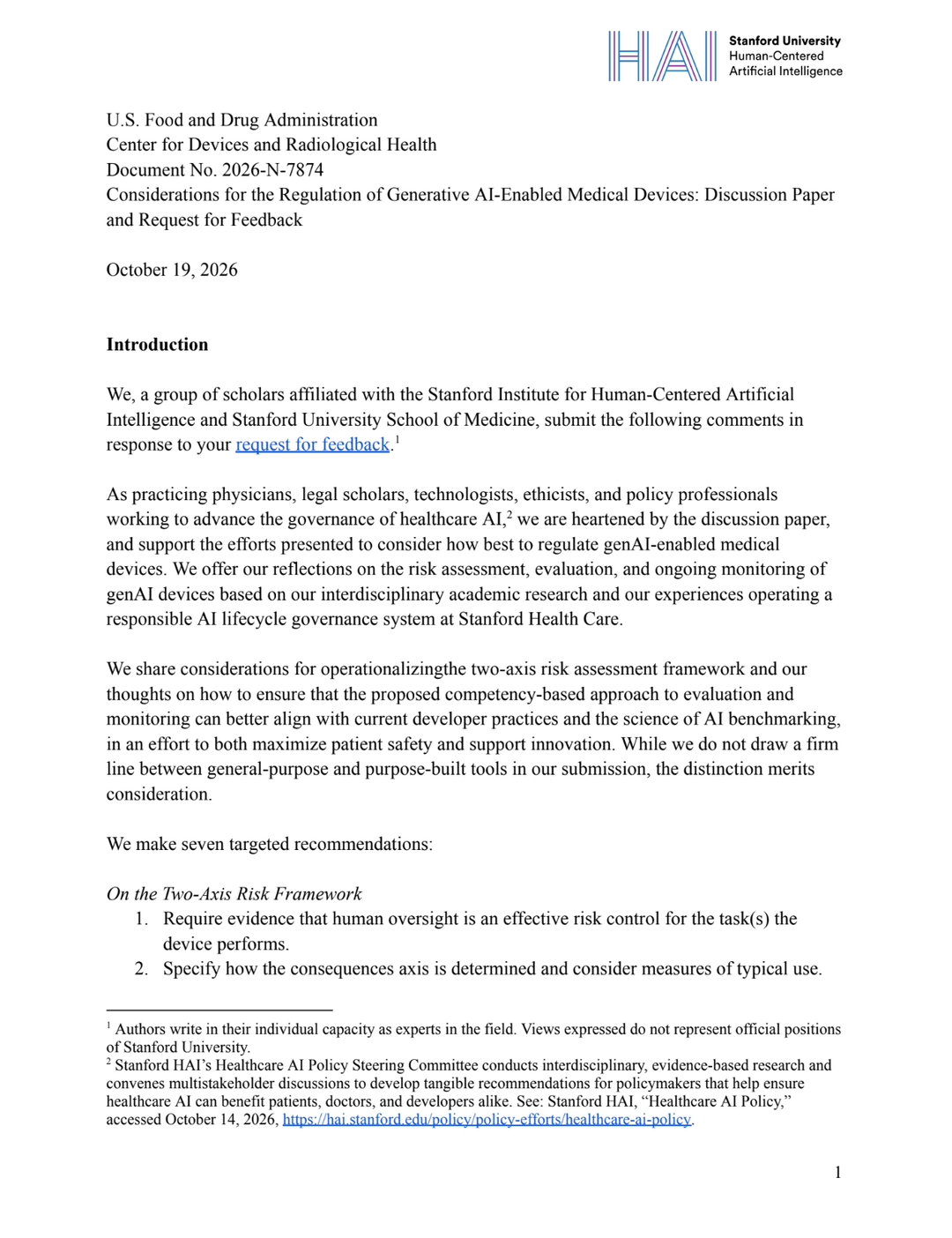
Stanford scholars respond to a federal request for feedback, offering policy recommendations for the regulation of generative AI-enabled medical devices.
Implementing the Transparency in Frontier AI Act Report for the California Department of Technology Multistakeholder Workshops
In this paper, HAI Associate Director and Senior Fellow Rob Reich and UC Berkeley School of Information Professor Deirdre K. Mulligan provide concrete recommendations to the California Department of Technology on the implementation of its frontier AI transparency requirements.
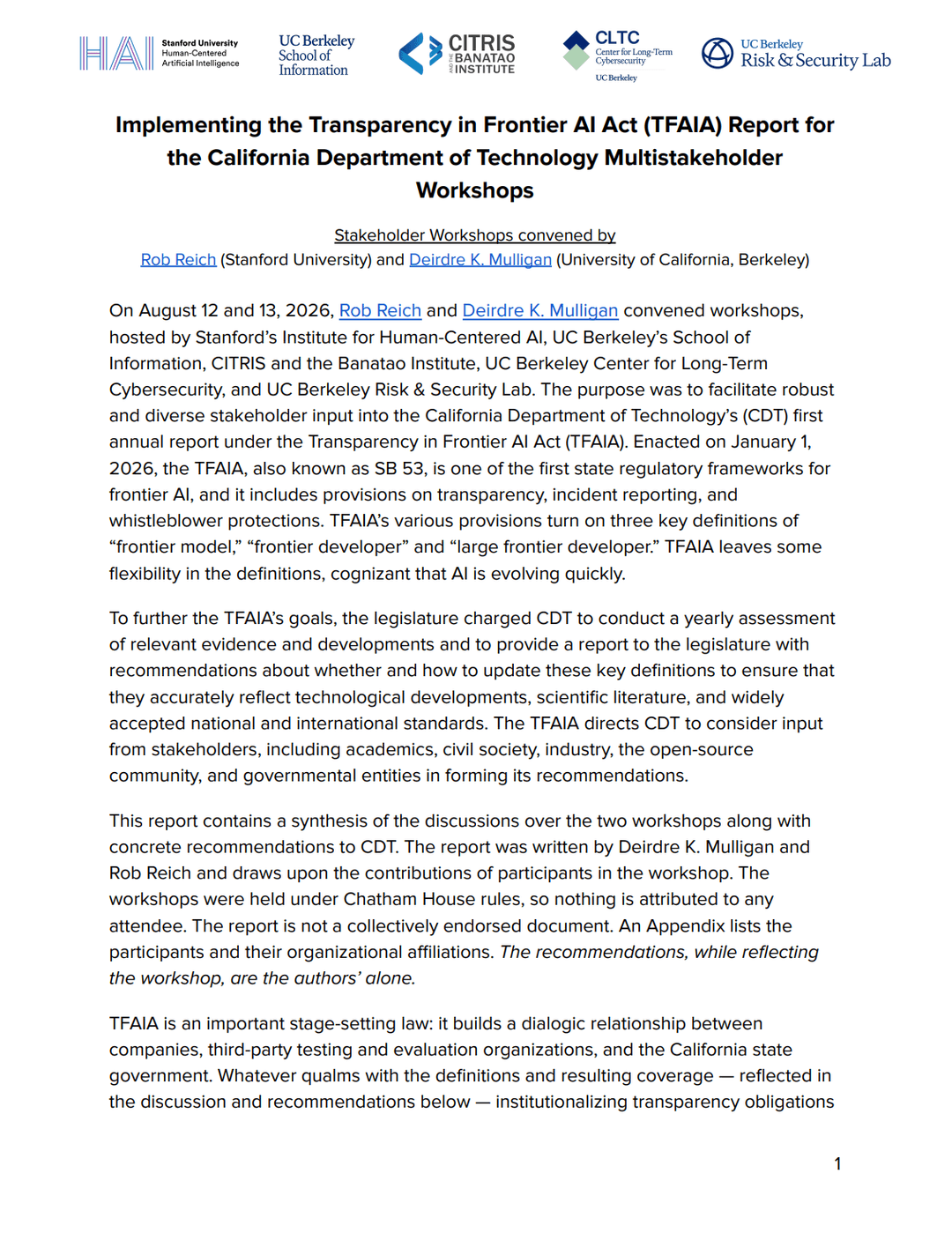
In this paper, HAI Associate Director and Senior Fellow Rob Reich and UC Berkeley School of Information Professor Deirdre K. Mulligan provide concrete recommendations to the California Department of Technology on the implementation of its frontier AI transparency requirements.
Designing Loyalty: AI Agents and Conflicts of Interest
This brief examines the conflict-of-interest risks posed by AI agents and calls for imposing a duty of loyalty on developers and deployers.
This brief examines the conflict-of-interest risks posed by AI agents and calls for imposing a duty of loyalty on developers and deployers.
Regulating Data Brokers in the Age of AI: A California Case Study
This brief assesses data broker compliance with California privacy laws and calls for more stringent consumer protections.
This brief assesses data broker compliance with California privacy laws and calls for more stringent consumer protections.