Balancing Fairness and Efficiency in Health Plan Payments
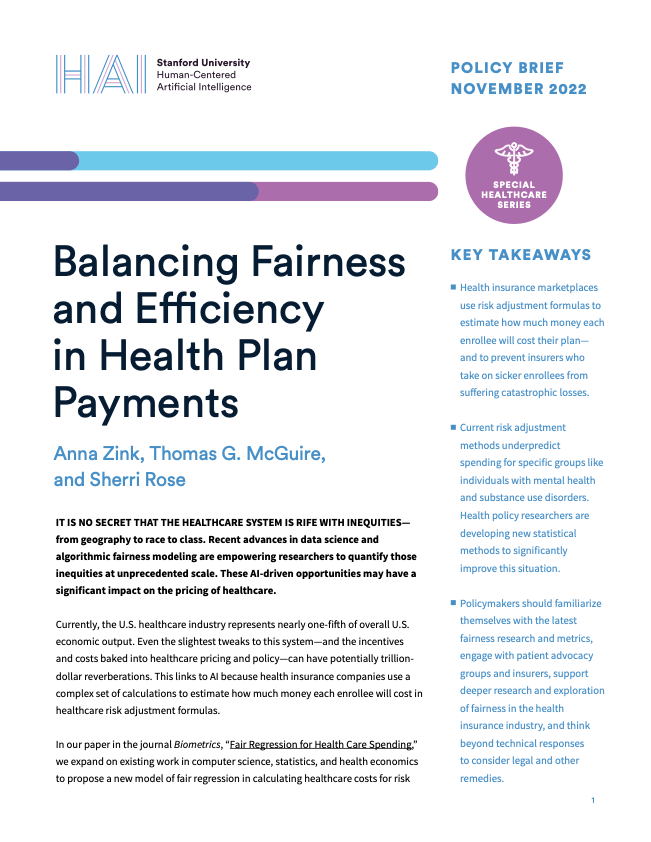
This brief urges policymakers to realign the healthcare market’s incentives in favor of patients, recommending interventions that shape companies’ incentives around the pricing models they deploy.
Key Takeaways
Health insurance marketplaces use risk adjustment formulas to estimate how much money each enrollee will cost their plan—and to prevent insurers who take on sicker enrollees from suffering catastrophic losses.
Current risk adjustment methods underpredict spending for specific groups like individuals with mental health and substance use disorders. Health policy researchers are developing new statistical methods to significantly improve this situation.
Policymakers should familiarize themselves with the latest fairness research and metrics, engage with patient advocacy groups and insurers, support deeper research and exploration of fairness in the health insurance industry, and think beyond technical responses to consider legal and other remedies.
Executive Summary
It is no secret that the healthcare system is rife with inequities—from geography to race to class. Recent advances in data science and algorithmic fairness modeling are empowering researchers to quantify those inequities at unprecedented scale. These AI-driven opportunities may have a significant impact on the pricing of healthcare.
Currently, the U.S. healthcare industry represents nearly one-fifth of overall U.S. economic output. Even the slightest tweaks to this system—and the incentives and costs baked into healthcare pricing and policy—can have potentially trillion dollar reverberations. This links to AI because health insurance companies use a complex set of calculations to estimate how much money each enrollee will cost in healthcare risk adjustment formulas.
In our paper in the journal Biometrics, “Fair Regression for Health Care Spending,” we expand on existing work in computer science, statistics, and health economics to propose a new model of fair regression in calculating healthcare costs for risk adjustment formulas. We examine the lack of incentives for insurers to cover undercompensated groups of individuals, such as those diagnosed with a mental health or substance use disorder, and how our method can realign coverage incentives. Our new statistical methods have the potential to improve the healthcare risk framework and the provision of healthcare in the United States.
Two additional publications, “Improving the Performance of Risk Adjustment Systems” in the American Journal of Health Economics and “Identifying Undercompensated Groups Defined by Multiple Attributes in Risk Adjustment” in BMJ Health & Care Informatics, build on this work. In the former, we examine how reinsurance (which protects insurance firms from high-dollar claims), machine learning methods, and other design elements impact the risk adjustment systems used to pay health plans. In the latter, we present a new way of identifying marginalized groups across multiple characteristics, focused especially on people with chronic conditions.
For policymakers, our work provides a new opportunity to realign the healthcare market’s incentives in favor of patients. Policymakers could explore policy interventions that shape companies’ incentives around the pricing models they deploy—all of which come with their own
trade-offs. Although we refrain from advocating for one specific replacement over any other at this time, policymakers should consider the following set of recommendations:
Familiarize themselves with the details of these fairness metrics;
Welcome dialogue and debate with patients’ groups, researchers, and insurers as to which of these methods would be best to implement, centering principles of justice;
Prioritize deeper research and promote exploration of algorithmic fairness in the healthcare industry; and
Think beyond purely technical responses, such as considering legal improvements to better protect individuals marginalized by the healthcare system.
Related Publications
Response to FDA’s Request for Feedback on Considerations for the Regulation of GenAI-Enabled Medical Devices
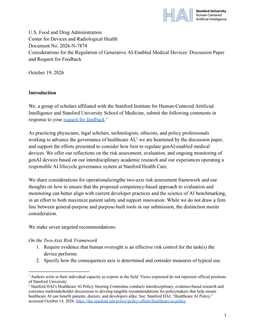
Stanford scholars respond to a federal request for feedback, offering policy recommendations for the regulation of generative AI-enabled medical devices.
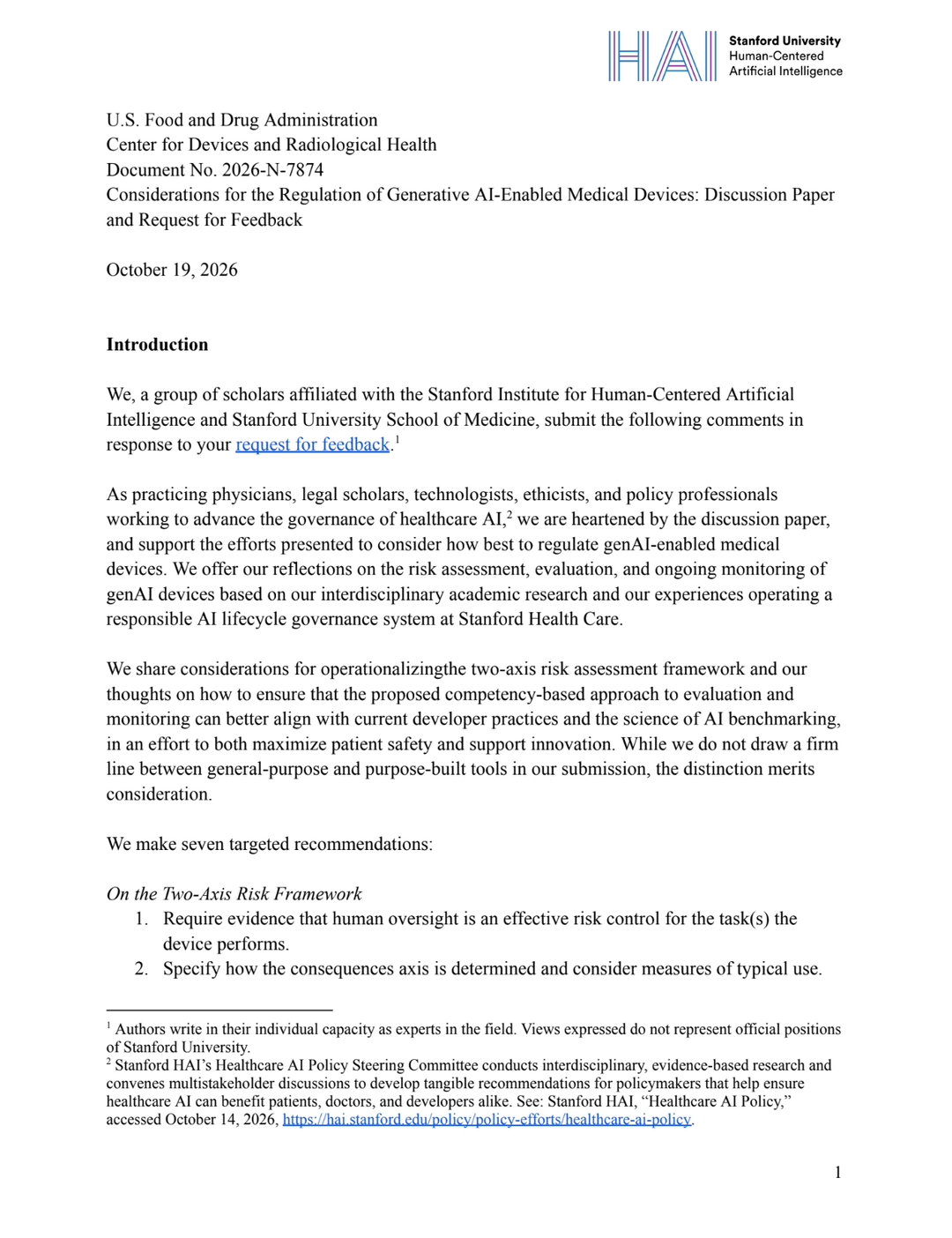
Stanford scholars respond to a federal request for feedback, offering policy recommendations for the regulation of generative AI-enabled medical devices.
Making Local Law Legible: LLM-Assisted Detection of Discrimination
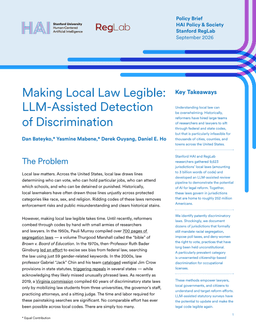
This brief demonstrates the potential of LLM-assisted review to accelerate legal reform.
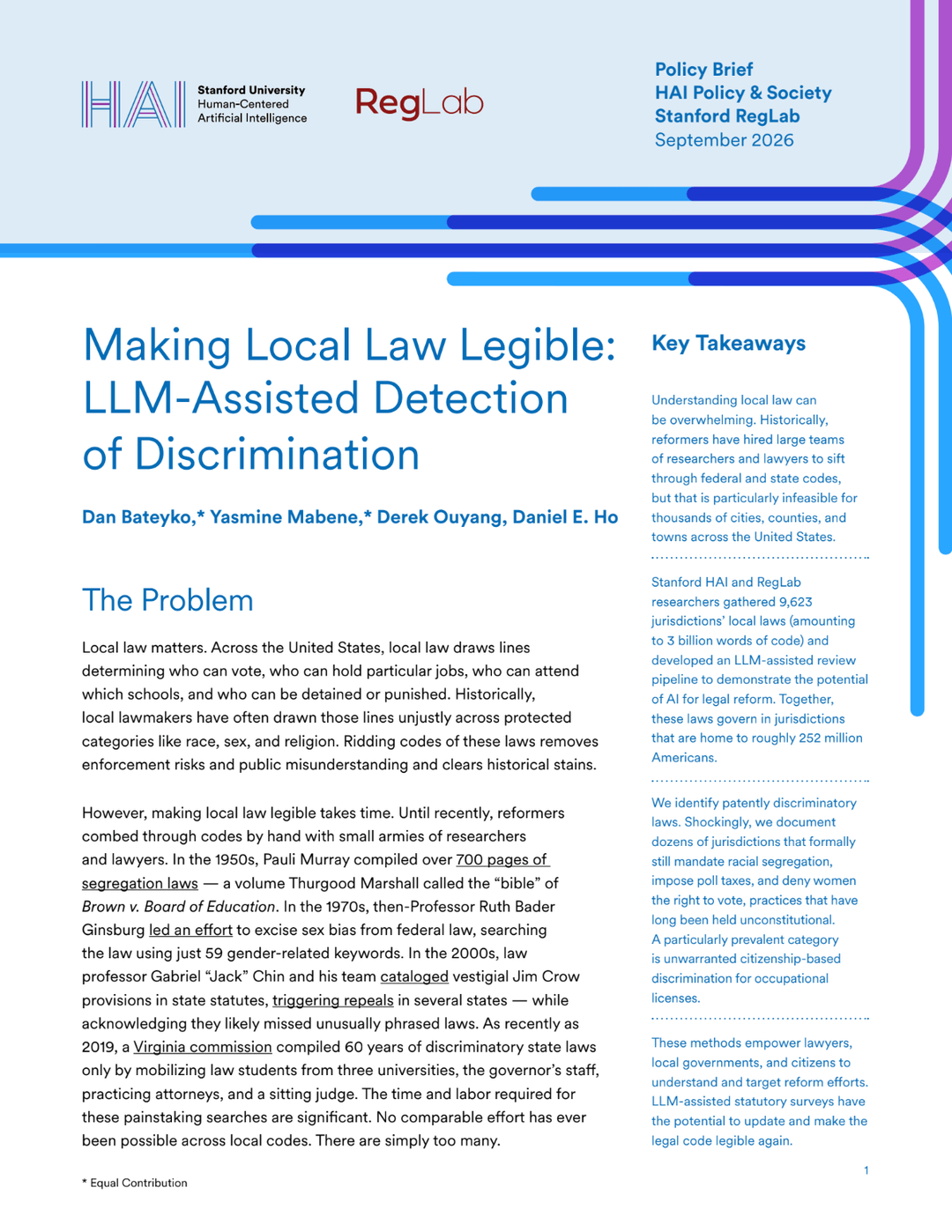
This brief demonstrates the potential of LLM-assisted review to accelerate legal reform.
Operationalizing Real-Time Monitoring of Clinical AI

This brief demonstrates how real-time monitoring can address critical gaps in the oversight of radiological AI tools.

This brief demonstrates how real-time monitoring can address critical gaps in the oversight of radiological AI tools.
How Can AI Support Language Digitization and Digital Inclusion?

This white paper analyzes the varying ways AI tools can advance language digitization work, and provides recommendations for responsibly realizing the potential of AI in supporting the digital inclusion of digitally disadvantaged languages.

This white paper analyzes the varying ways AI tools can advance language digitization work, and provides recommendations for responsibly realizing the potential of AI in supporting the digital inclusion of digitally disadvantaged languages.