Using AI to Understand Residential Solar Power
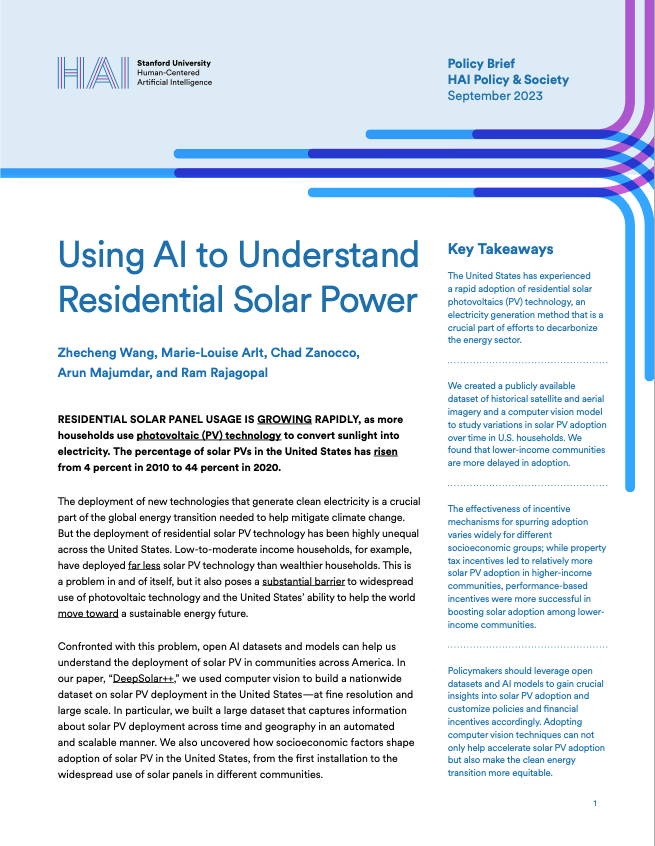
This brief introduces a computer-vision approach to analyzing solar panel adoption in U.S. households that can help policymakers tailor incentive mechanisms.
Key Takeaways
The United States has experienced a rapid adoption of residential solar photovoltaics (PV) technology, an electricity generation method that is a crucial part of efforts to decarbonize the energy sector.
We created a publicly available dataset of historical satellite and aerial imagery and a computer vision model to study variations in solar PV adoption over time in U.S. households. We found that lower-income communities are more delayed in adoption.
The effectiveness of incentive mechanisms for spurring adoption varies widely for different socioeconomic groups; while property tax incentives led to relatively more solar PV adoption in higher-income communities, performance-based incentives were more successful in boosting solar adoption among lower-income communities.
Policymakers should leverage open datasets and AI models to gain crucial insights into solar PV adoption and customize policies and financial incentives accordingly. Adopting computer vision techniques can not only help accelerate solar PV adoption but also make the clean energy transition more equitable.
Executive Summary
Residential solar panel usage is growing rapidly, as more households use photovoltaic (PV) technology to convert sunlight into electricity. The percentage of solar PVs in the United States has risen from 4 percent in 2010 to 44 percent in 2020.
The deployment of new technologies that generate clean electricity is a crucial part of the global energy transition needed to help mitigate climate change. But the deployment of residential solar PV technology has been highly unequal across the United States. Low-to-moderate income households, for example, have deployed far less solar PV technology than wealthier households. This is a problem in and of itself, but it also poses a substantial barrier to widespread use of photovoltaic technology and the United States' ability to help the world move toward a sustainable energy future.
Confronted with this problem, open Al datasets and models can help us understand the deployment of solar PV in communities across America. In our paper, "DeepSolar++," we used computer vision to build a nationwide dataset on solar PV deployment in the United States-at fine resolution and large scale. In particular, we built a large dataset that captures information about solar PV deployment across time and geography in an automated and scalable manner. We also uncovered how socioeconomic factors shape adoption of solar PV in the United States, from the first installation to the widespread use of solar panels in different communities.
Studying the spread of solar PV technology in the United States is vital to identifying and tackling barriers to adoption. Our paper, “DeepSolar++: Understanding residential solar adoption trajectories with computer vision and technology diffusion models,” improves on previous research and demonstrates that computer vision is an essential technique for understanding residential solar usage in the United States and holds great promise for helping policymakers address the climate crisis.
Related Publications
Using AI to Map Urban Change
This brief introduces a novel street-view image dataset and AI model as a more accurate proxy for detecting and assessing urban changes such as gentrification.
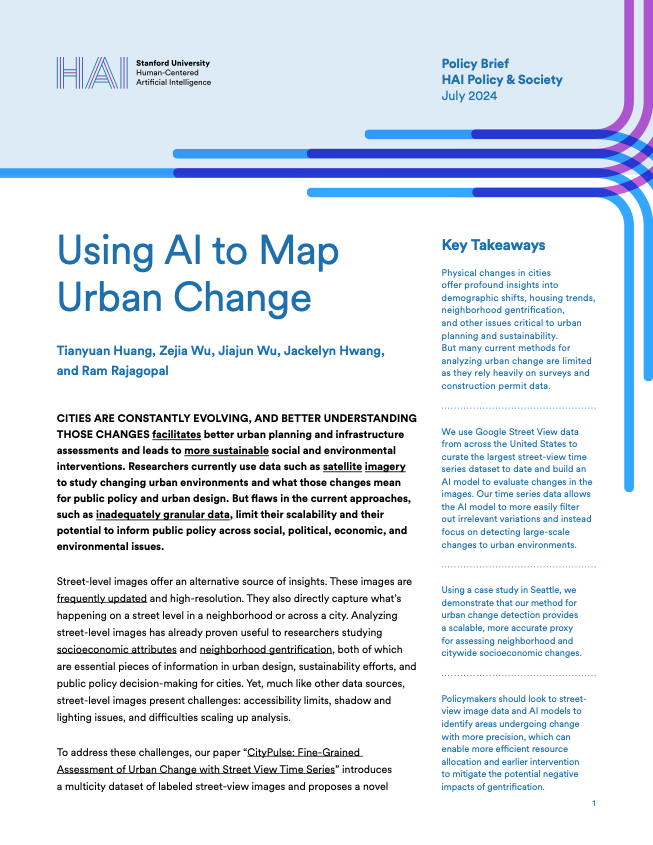
This brief introduces a novel street-view image dataset and AI model as a more accurate proxy for detecting and assessing urban changes such as gentrification.
Using Satellite Imagery to Understand and Promote Sustainable Development

This brief discusses the opportunities and limitations of AI models that can map satellite image inputs to sustainable development outcomes.

This brief discusses the opportunities and limitations of AI models that can map satellite image inputs to sustainable development outcomes.
Evaluating Facial Recognition Technology: A Protocol for Performance Assessment in New Domains

This white paper provides research- and scientifically-grounded recommendations for how to give context to calls for testing the operational accuracy of facial recognition technology.

This white paper provides research- and scientifically-grounded recommendations for how to give context to calls for testing the operational accuracy of facial recognition technology.
Beyond Pilots and PR: What Makes AI-for-Good Partnerships Work

This paper examines how nonprofits and frontier AI labs partner to deploy AI for social good and offers recommendations for structuring these partnerships for greater impact.

This paper examines how nonprofits and frontier AI labs partner to deploy AI for social good and offers recommendations for structuring these partnerships for greater impact.