Stanford
University
  • Stanford Home
  • Maps & Directions
  • Search Stanford
  • Emergency Info
  • Terms of Use
  • Privacy
  • Copyright
  • Trademarks
  • Non-Discrimination
  • Accessibility
© Stanford University.  Stanford, California 94305.
Response to USAID's Request for Information on AI in Global Development Playbook | Stanford HAI
Skip to content
  • About

    • About
    • People
    • Get Involved with HAI
    • Support HAI
    • Subscribe to Email
  • Research

    • Research
    • Fellowship Programs
    • Grants
    • Student Affinity Groups
    • Centers & Labs
    • Research Publications
    • Research Partners
  • Education

    • Education
    • Executive and Professional Education
    • Government and Policymakers
    • K-12
    • Stanford Students
  • Policy

    • Policy
    • Policy Publications
    • Policymaker Education
    • Student Opportunities
  • AI Index

    • AI Index
    • AI Index Report
    • Global Vibrancy Tool
    • People
  • News
  • Events
  • Industry
  • Centers & Labs
Navigate
  • About
  • Events
  • Careers
  • Search
Participate
  • Get Involved
  • Support HAI
  • Contact Us

Stay Up To Date

Get the latest news, advances in research, policy work, and education program updates from HAI in your inbox weekly.

Sign Up For Latest News

policyResponse to Request

Response to USAID's Request for Information on AI in Global Development Playbook
Date
March 01, 2024
Topics
International Affairs, International Security, International Development
Read Paper
abstract

Scholars respond to a federal RFI on AI in global development, calling for an approach that is grounded in local perspectives and tailored to Global Majority country circumstances.

In collaboration with

Executive Summary

In this response to the U.S. Agency for International Development’s (USAID) request for information on the development of an AI in Global Development Playbook, scholars from Stanford HAI and The Asia Foundation call for an approach to AI in global development that is grounded in local perspectives and tailored to the specific circumstances of Global Majority countries. They highlight several barriers preventing Global Majority countries from harnessing AI, outline two areas in which they believe AI technologies hold particular promise in advancing the UN Sustainable Development Goals, and draw lessons from existing AI policymaking efforts in Global Majority contexts.

Read Paper
Share
Link copied to clipboard!
Authors
  • headshot
    Caroline Meinhardt
  • Toni Friedman
    Toni Friedman
  • Haifa Badi Uz Zaman
    Haifa Badi Uz Zaman
  • Daniel Zhang
    Daniel Zhang
  • Rodrigo Balbontín
    Rodrigo Balbontín
  • Juan Pava
    Juan Pava
  • Vyoma Raman
    Vyoma Raman
  • Kevin Klyman
    Kevin Klyman
  • Marietje Schaake
    Marietje Schaake
  • Jef Caers
    Jef Caers
  • Francis Fukuyama
    Francis Fukuyama
Related
  • Caroline Meinhardt
    Policy Research Manager
    headshot

Related Publications

How Can AI Support Language Digitization and Digital Inclusion?
Juan Pava, Thomas S. Mullaney, Caroline Meinhardt, Audrey Gao, Diyi Yang
Deep DiveFeb 26, 2026
White Paper

This white paper analyzes the varying ways AI tools can advance language digitization work, and provides recommendations for responsibly realizing the potential of AI in supporting the digital inclusion of digitally disadvantaged languages.
White Paper

How Can AI Support Language Digitization and Digital Inclusion?

Juan Pava, Thomas S. Mullaney, Caroline Meinhardt, Audrey Gao, Diyi Yang
Ethics, Equity, InclusionInternational Affairs, International Security, International DevelopmentNatural Language ProcessingDeep DiveFeb 26

This white paper analyzes the varying ways AI tools can advance language digitization work, and provides recommendations for responsibly realizing the potential of AI in supporting the digital inclusion of digitally disadvantaged languages.

Beyond DeepSeek: China's Diverse Open-Weight AI Ecosystem and Its Policy Implications
Caroline Meinhardt, Sabina Nong, Graham Webster, Tatsunori Hashimoto, Christopher Manning
Deep DiveDec 16, 2025
Issue Brief

Almost one year after the “DeepSeek moment,” this brief analyzes China’s diverse open-model ecosystem and examines the policy implications of their widespread global diffusion.
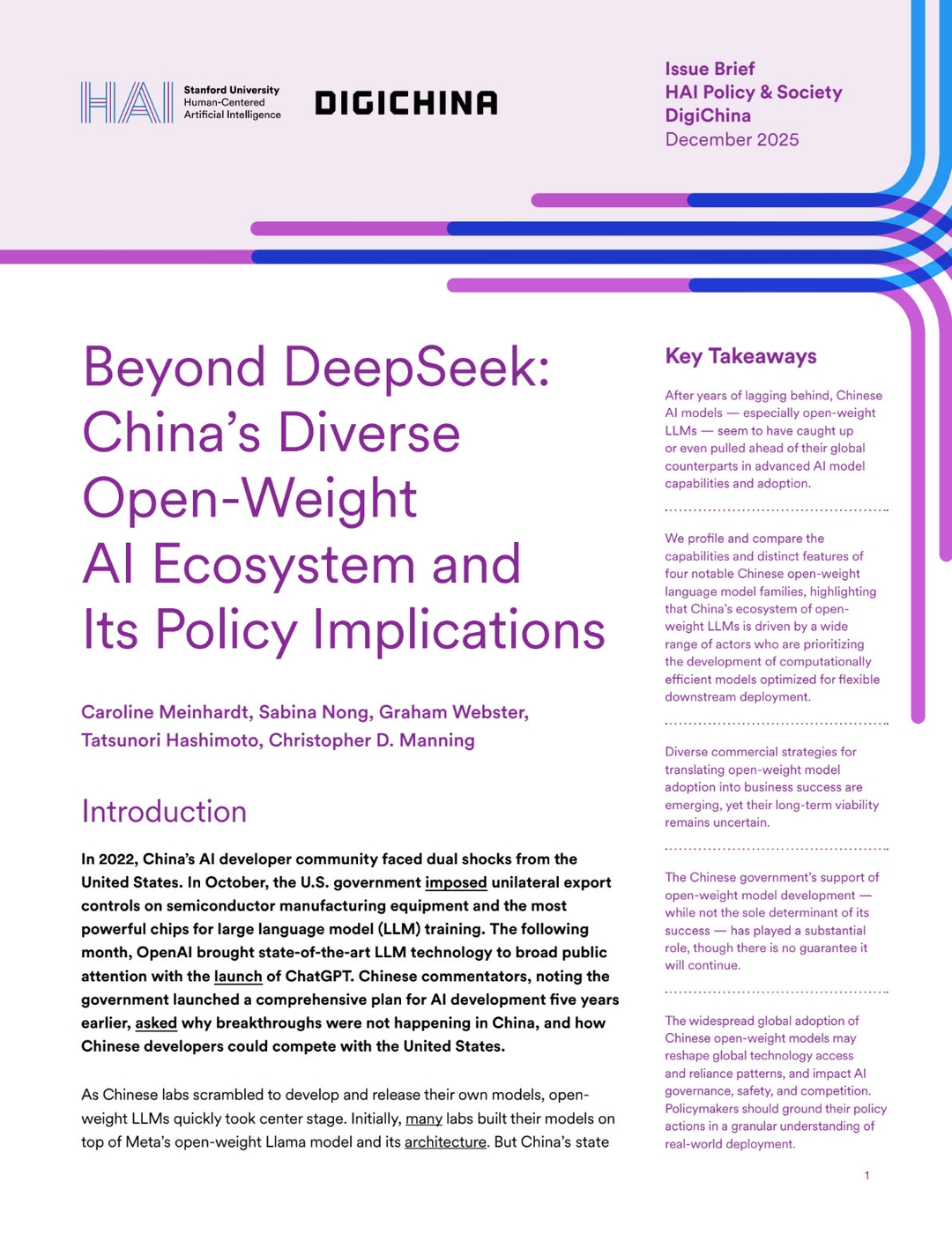
Issue Brief

Beyond DeepSeek: China's Diverse Open-Weight AI Ecosystem and Its Policy Implications

Caroline Meinhardt, Sabina Nong, Graham Webster, Tatsunori Hashimoto, Christopher Manning
Foundation ModelsInternational Affairs, International Security, International DevelopmentDeep DiveDec 16

Almost one year after the “DeepSeek moment,” this brief analyzes China’s diverse open-model ecosystem and examines the policy implications of their widespread global diffusion.

Moving Beyond the Term "Global South" in AI Ethics and Policy
Evani Radiya-Dixit, Angèle Christin
Quick ReadNov 19, 2025
Issue Brief

This brief examines the limitations of the term "Global South" in AI ethics and policy, and highlights the importance of grounding such work in specific regions and power structures.

Issue Brief

Moving Beyond the Term "Global South" in AI Ethics and Policy

Evani Radiya-Dixit, Angèle Christin
Ethics, Equity, InclusionInternational Affairs, International Security, International DevelopmentQuick ReadNov 19

This brief examines the limitations of the term "Global South" in AI ethics and policy, and highlights the importance of grounding such work in specific regions and power structures.

Yejin Choi’s Briefing to the United Nations Security Council
Yejin Choi
Quick ReadSep 24, 2025
Testimony

In this address, presented to the United Nations Security Council meeting on "Maintenance of International Peace and Security," Yejin Choi calls on the global scientific and policy communities to expand the AI frontier for all by pursuing intelligence that is not only powerful, but also accessible, robust, and efficient. She stresses the need to rethink our dependence on massive-scale data and computing resources from the outset, and design methods that do more with less — by building AI that is smaller and serves all communities.

Testimony

Yejin Choi’s Briefing to the United Nations Security Council

Yejin Choi
International Affairs, International Security, International DevelopmentQuick ReadSep 24

In this address, presented to the United Nations Security Council meeting on "Maintenance of International Peace and Security," Yejin Choi calls on the global scientific and policy communities to expand the AI frontier for all by pursuing intelligence that is not only powerful, but also accessible, robust, and efficient. She stresses the need to rethink our dependence on massive-scale data and computing resources from the outset, and design methods that do more with less — by building AI that is smaller and serves all communities.