Generative AI: Perspectives from Stanford HAI
A diversity of perspectives from Stanford leaders in medicine, science, engineering, humanities, and the social sciences on how generative AI might affect their fields and our world
The current wave of generative AI is a subset of artificial intelligence that, based on a textual prompt, generates novel content. ChatGPT might write an essay, Midjourney could create beautiful illustrations, or MusicLM could compose a jingle. Most modern generative AI is powered by foundation models, or AI models trained on broad data using self-supervision at scale, then adapted to a wide range of downstream tasks.
The opportunities these models present for our lives, our communities, and our society are vast, as are the risks they pose. While on the one hand, they may seamlessly complement human labor, making us more productive and creative, on the other, they could amplify the bias we already experience or undermine our trust of information.
We believe that interdisciplinary collaboration is essential in ensuring these technologies benefit us all. The following are perspectives from Stanford leaders in medicine, science, engineering, humanities, and the social sciences on how generative AI might affect their fields and our world. Some study the impact of technology on society, others study how to best apply these technologies to advance their field, and others have developed the technical principles of the algorithms that underlie foundation models.
Related Publications

We invited 11 sci-fi filmmakers and AI researchers to Stanford for Stories for the Future, a day-and-a-half experiment in fostering new narratives about AI. Researchers shared perspectives on AI and filmmakers reflected on the challenges of writing AI narratives. Together researcher-writer pairs transformed a research paper into a written scene. The challenge? Each scene had to include an AI manifestation, but could not be about the personhood of AI or AI as a threat. Read the results of this project.

We invited 11 sci-fi filmmakers and AI researchers to Stanford for Stories for the Future, a day-and-a-half experiment in fostering new narratives about AI. Researchers shared perspectives on AI and filmmakers reflected on the challenges of writing AI narratives. Together researcher-writer pairs transformed a research paper into a written scene. The challenge? Each scene had to include an AI manifestation, but could not be about the personhood of AI or AI as a threat. Read the results of this project.
Current societal trends reflect an increased mistrust in science and a lowered civic engagement that threaten to impair research that is foundational for ensuring public health and advancing health equity. One effective countermeasure to these trends lies in community-facing citizen science applications to increase public participation in scientific research, making this field an important target for artificial intelligence (AI) exploration. We highlight potentially promising citizen science AI applications that extend beyond individual use to the community level, including conversational large language models, text-to-image generative AI tools, descriptive analytics for analyzing integrated macro- and micro-level data, and predictive analytics. The novel adaptations of AI technologies for community-engaged participatory research also bring an array of potential risks. We highlight possible negative externalities and mitigations for some of the potential ethical and societal challenges in this field.
Current societal trends reflect an increased mistrust in science and a lowered civic engagement that threaten to impair research that is foundational for ensuring public health and advancing health equity. One effective countermeasure to these trends lies in community-facing citizen science applications to increase public participation in scientific research, making this field an important target for artificial intelligence (AI) exploration. We highlight potentially promising citizen science AI applications that extend beyond individual use to the community level, including conversational large language models, text-to-image generative AI tools, descriptive analytics for analyzing integrated macro- and micro-level data, and predictive analytics. The novel adaptations of AI technologies for community-engaged participatory research also bring an array of potential risks. We highlight possible negative externalities and mitigations for some of the potential ethical and societal challenges in this field.
Interventions on model-internal states are fundamental operations in many areas of AI, including model editing, steering, robustness, and interpretability. To facilitate such research, we introduce pyvene, an open-source Python library that supports customizable interventions on a range of different PyTorch modules. pyvene supports complex intervention schemes with an intuitive configuration format, and its interventions can be static or include trainable parameters. We show how pyvene provides a unified and extensible framework for performing interventions on neural models and sharing the intervened upon models with others. We illustrate the power of the library via interpretability analyses using causal abstraction and knowledge localization. We publish our library through Python Package Index (PyPI) and provide code, documentation, and tutorials at ‘https://github.com/stanfordnlp/pyvene‘.
Interventions on model-internal states are fundamental operations in many areas of AI, including model editing, steering, robustness, and interpretability. To facilitate such research, we introduce pyvene, an open-source Python library that supports customizable interventions on a range of different PyTorch modules. pyvene supports complex intervention schemes with an intuitive configuration format, and its interventions can be static or include trainable parameters. We show how pyvene provides a unified and extensible framework for performing interventions on neural models and sharing the intervened upon models with others. We illustrate the power of the library via interpretability analyses using causal abstraction and knowledge localization. We publish our library through Python Package Index (PyPI) and provide code, documentation, and tutorials at ‘https://github.com/stanfordnlp/pyvene‘.
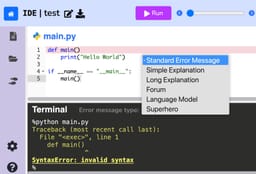
In this paper, we evaluate the most effective error message types through a large-scale randomized controlled trial conducted in an open-access, online introductory computer science course with 8,762 students from 146 countries. We assess existing error message enhancement strategies, as well as two novel approaches of our own: (1) generating error messages using OpenAI's GPT in real time and (2) constructing error messages that incorporate the course discussion forum. By examining students' direct responses to error messages, and their behavior throughout the course, we quantitatively evaluate the immediate and longer term efficacy of different error message types. We find that students using GPT generated error messages repeat an error 23.1% less often in the subsequent attempt, and resolve an error in 34.8% fewer additional attempts, compared to students using standard error messages. We also perform an analysis across various demographics to understand any disparities in the impact of different error message types. Our results find no significant difference in the effectiveness of GPT generated error messages for students from varying socioeconomic and demographic backgrounds. Our findings underscore GPT generated error messages as the most helpful error message type, especially as a universally effective intervention across demographics.
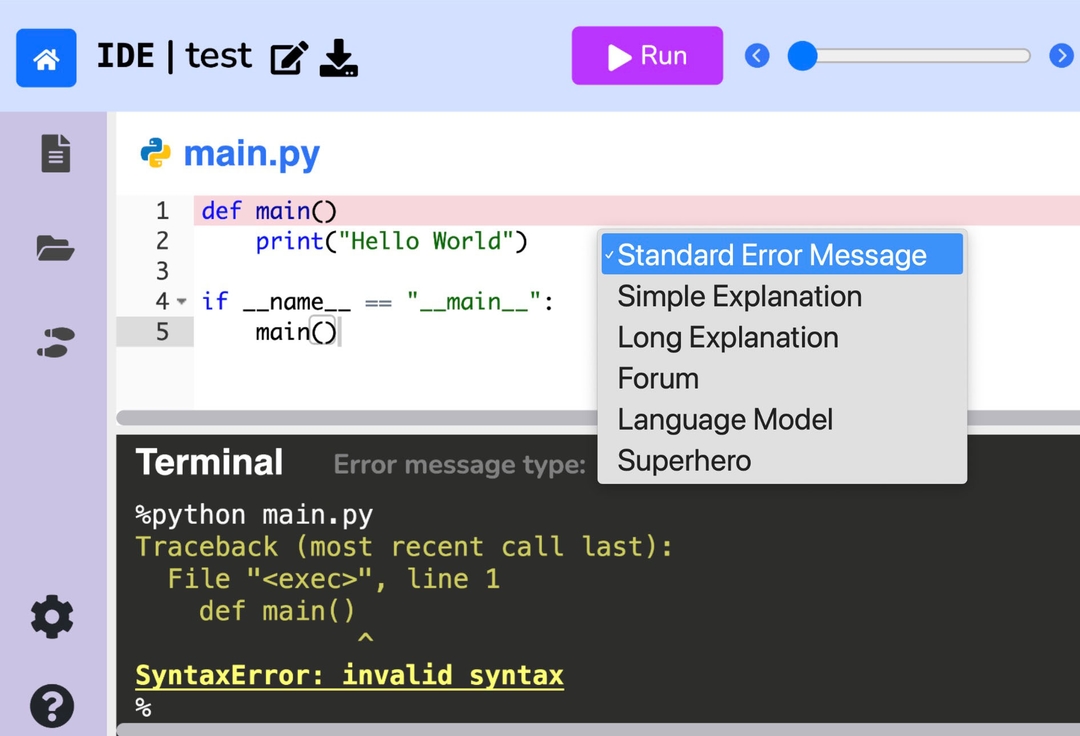
In this paper, we evaluate the most effective error message types through a large-scale randomized controlled trial conducted in an open-access, online introductory computer science course with 8,762 students from 146 countries. We assess existing error message enhancement strategies, as well as two novel approaches of our own: (1) generating error messages using OpenAI's GPT in real time and (2) constructing error messages that incorporate the course discussion forum. By examining students' direct responses to error messages, and their behavior throughout the course, we quantitatively evaluate the immediate and longer term efficacy of different error message types. We find that students using GPT generated error messages repeat an error 23.1% less often in the subsequent attempt, and resolve an error in 34.8% fewer additional attempts, compared to students using standard error messages. We also perform an analysis across various demographics to understand any disparities in the impact of different error message types. Our results find no significant difference in the effectiveness of GPT generated error messages for students from varying socioeconomic and demographic backgrounds. Our findings underscore GPT generated error messages as the most helpful error message type, especially as a universally effective intervention across demographics.