Governor Newsom Convenes GenAI Leaders for Landmark Summit
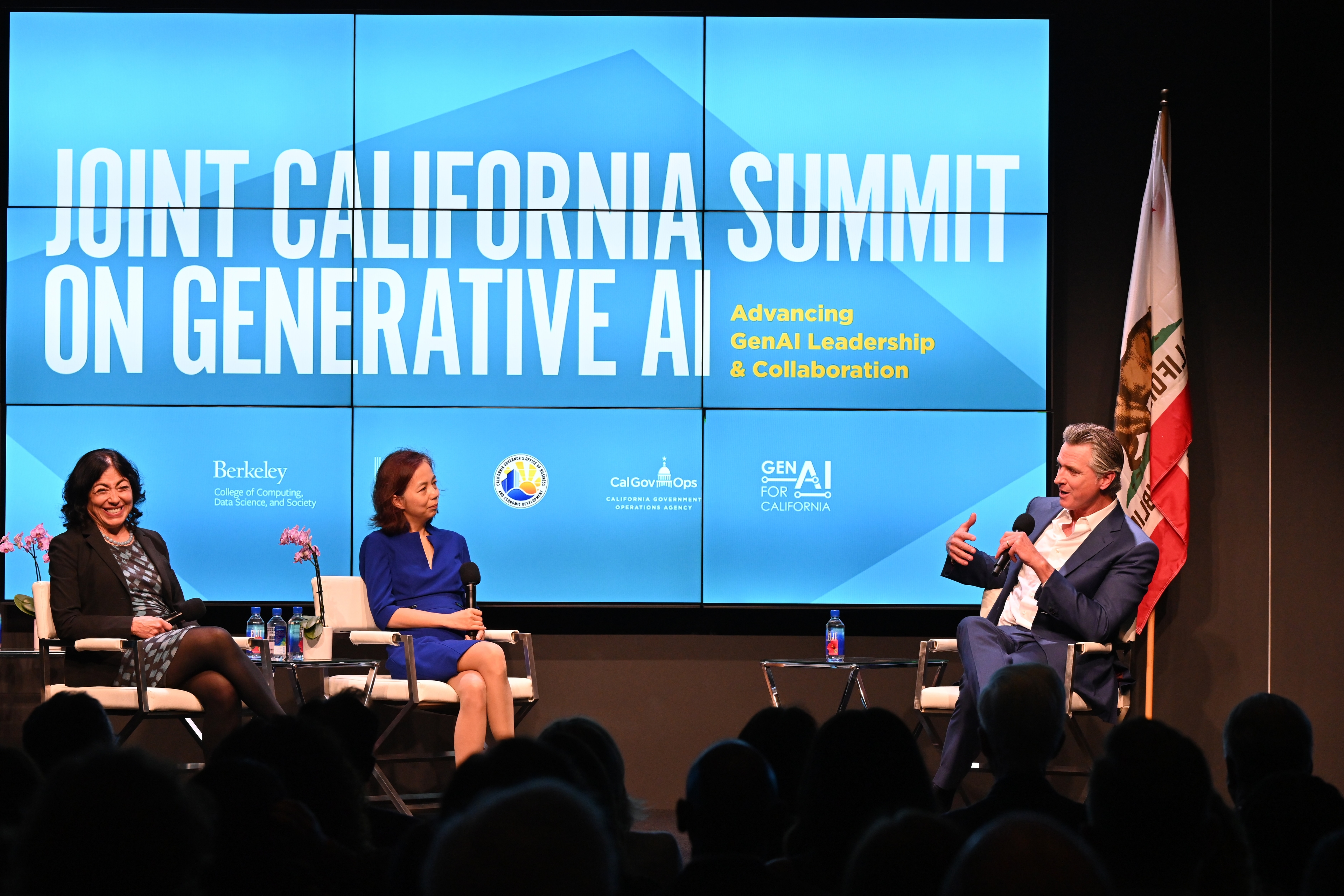
California Governor Gavin Newsom and leaders representing technology, government, academia, labor, civic organizations and more convened at the Joint California Summit on Generative AI to collaborate on and examine this transformative technology.
More than 100 changemakers came together at the Commonwealth Club in San Francisco to discuss new ways generative artificial intelligence could better serve the public.
“California is the globe’s artificial intelligence leader, and today’s summit continues to showcase the state’s commitment to innovation,” said Newsom. “It’s clear that GenAI has arrived and is moving quickly, and our innovation hubs and state leaders are evolving with the speed necessary to find ways it can be used equitably and responsibly so it benefits all of us and not just a select few.”
The summit was developed and hosted by the California Governor's Office of Business and Economic Development (GO-Biz), the California Government Operations Agency, the UC Berkeley College of Computing, Data Science, and Society, and the Stanford Institute for Human-Centered Artificial Intelligence (HAI). Newsom directed his agencies to pursue a partnership with the higher education institutions as part of his executive order on GenAI last year.
GenAI is already changing the world, and California will play a pivotal role in defining that future. The state is home to 35 of the world’s 50 leading AI companies, high-impact research and education institutions, and a quarter of the technology’s patents and conference papers.
The path forward for AI will have enormous implications across society. Summit panelists discussed how this technology is impacting and will shape the future of work in California. They also highlighted its potential to help solve urgent problems like the climate crisis, assessed the infrastructure barriers that could impede those efforts, and considered how to address them.
"We want to ensure the future we are building with generative AI puts humanity at the forefront," said Jennifer Chayes, dean of the UC Berkeley College of Computing, Data Science, and Society. "California provides a vibrant environment for AI development. We have a window of opportunity to collectively pursue a measured approach that incentivizes innovation while ensuring safety."
Attendees from the federal and state government, Fortune 500 companies, and the world’s leading universities explored ways to responsibly implement and incorporate shared benefits of AI into the next wave of investments, discoveries, and partnerships. Panels featured speakers including NVIDIA Head of Strategic Initiatives Louis Stewart, Databricks Chief Technology Officer Matei Zaharia, U.S. General Services Administration Administrator Robin Carnahan, California Government Operations Agency Secretary Amy Tong, California Labor and Workforce Development Agency Secretary Stewart Knox, and the Governor’s Office of Business and Economic Development Director Dee Dee Myers. Incoming university leaders at Berkeley and Stanford, Rich Lyons and Jonathan Levin, also participated in the joint event.
“With AI’s potential to radically transform every industry and every society, it’s critical that we design machine intelligence to be human-centered and benevolent,” said Stanford HAI Co-Director Fei-Fei Li. “For this to happen, we must invest more in the public sector, to help shape the development and path of this technology to serve humanity. With Stanford HAI’s multidisciplinary approach that balances diverse expertise across disciplines, we are delighted to play a role in this timely summit of government, industry, academia and civic organizations working in concert for not just the betterment of California, but the greater good of humanity.”
For More Information
Video from the Joint California Summit on Generative AI
Read more from the Office of the Governor, State of California
Related News
It's one of AI policy's hardest unsolved problems. Expert Deb Raji joins Stanford HAI to find answers that move beyond principles and into practice.
It's one of AI policy's hardest unsolved problems. Expert Deb Raji joins Stanford HAI to find answers that move beyond principles and into practice.
Analyzing thousands of human-AI conversations, a new study shows that people are turning to chatbots for increasingly critical tasks – and that productive outcomes depend on how the collaboration unfolds.
Analyzing thousands of human-AI conversations, a new study shows that people are turning to chatbots for increasingly critical tasks – and that productive outcomes depend on how the collaboration unfolds.

How managers introduce and support AI determines whether workers engage with or resist the technology.

How managers introduce and support AI determines whether workers engage with or resist the technology.