Inaugural AI Research Grants Advance Transformational Projects in Education, Health Care and Government
The Hoffman-Yee Research Grant Program seeks to harness artificial intelligence to build a better future for humanity.
The Stanford Institute for Human-Centered Artificial Intelligence (HAI) today announced six inaugural recipients of the Hoffman-Yee Research Grant Program, a multiyear initiative to invest in research that leverages artificial intelligence (AI) to address real-world problems.
The projects were selected for their boldness, ingenuity and potential for transformative impact. The grantees comprise interdisciplinary teams of faculty members, postdoctoral scholars and graduate students spanning the Schools of Business, Education, Engineering, Humanities and Sciences, Law and Medicine.
Philanthropists Reid Hoffman and Michelle Yee are providing foundational support for the grants.
“The Hoffman-Yee Research Grant Program is helping to drive new collaborations across campus, harnessing AI to benefit humanity,” said Stanford President Marc Tessier-Lavigne. “Technological advancements must be inextricably linked to research about their potential societal impacts. I am very grateful to Reid and Michelle for their vision and extraordinary generosity in creating this program.”
HAI received submissions from 22 different departments and all of Stanford’s seven schools. Each of the six teams selected will receive significant funding to enable ambitious research by assisting with hiring students and postdocs, procuring data and equipment and accessing computational and other resources.
“These projects will initiate and sustain exciting new collaborations across the university,” said John Etchemendy, Denning Co-Director of HAI and the Patrick Suppes Family Professor in the School of Humanities and Sciences. “The interdisciplinary teams each apply AI in a novel context to address challenges whose solutions could bring significant benefits to human wellbeing.”
The six projects, which were submitted for review before the COVID-19 pandemic, will push the boundaries of how AI can advance education, health care and government. Project goals range from advancing AI technology through better understanding of human learning, creating more adaptable, collaborative AI agents for a wide range of assistive tasks, applying AI to facilitate and improve student learning, elder care and government operations, and creating tools for understanding the history and evolution of concepts.
“Michelle and I are delighted to help enable Stanford HAI to diversify and scale the research community applying artificial intelligence toward a range of major societal issues,” said Reid Hoffman. “Extraordinary opportunities for discovery and innovation will result from uniting technologists, humanists and educators together to take on pressing challenges that bridge their respective fields.”
An entrepreneur, executive and investor, Reid Hoffman plays an integral role in building many of today’s leading consumer technology businesses and is chair of the HAI Advisory Council. In 2003 he co-founded LinkedIn, the world’s largest professional networking service. In 2009 he joined Greylock Partners. Reid serves on the boards of multiple companies and nonprofits, including Kiva, Endeavor, CZI Biohub, Do Something and the MacArthur Foundation’s 100&Change. Michelle Yee earned her undergraduate degree from Stanford and her doctorate in education from the University of San Francisco.
The Hoffman-Yee Research Grant Program provides each award recipient an initial year of research funding, which can potentially be extended to three years. Each of the six research projects was reviewed carefully for ethical risks and benefits to society and subgroups within society as well as the global community.
“While the algorithms that drive artificial intelligence may appear to be neutral, the data and applications that shape the outcomes of those algorithms are not. What matters are the people building it, why they’re building it and for whom. AI research must take into account its impact on people,” said Fei-Fei Li, Sequoia Professor of Computer Science, Stanford and Denning Co-Director of Stanford HAI. “That’s why these research projects are so promising. Each of them can make a significant difference in the lives of ordinary people, supporting HAI’s purpose to improve the human condition.”
The projects and principal investigators are:
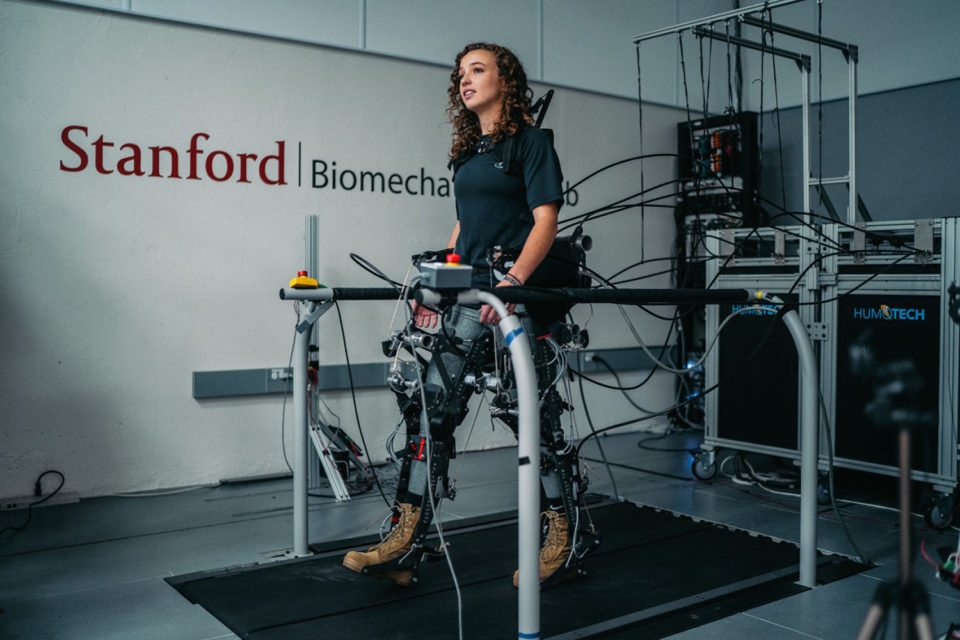
Intelligent Wearable Robotic Devices for Augmenting Human Locomotion
PI: Karen Liu, Associate Professor of Computer Science
Faculty, postdoctoral scholars and graduate students from Mechanical Engineering, Bioengineering, Orthopedic Surgery and Medicine
Falling injuries among the elderly cost the U.S. health system $50 billion (2015) – while causing immeasurable suffering and loss of independence. This research team seeks to develop wearable robotic devices using an AI system that both aids in human locomotion, as well as predicts and prevents falls among older people.
AI Tutors to Help Prepare Students for the 21st Century Workforce
PI: Christopher Piech, Assistant Professor of Computer Science Education.
Faculty and postdoctoral scholars from Education, Psychology and Computer Science
The project aims to demonstrate a path to effective, inspiring education that is accessible and scalable. The team will create new AI systems that model and support learners as they work through open-ended activities like writing, drawing, working on a science lab, or coding. The research will monitor learners’ motivation, identity and competency to improve student learning. Tested solutions will be implemented in code.org, brick-and-mortar schools, virtual science labs and beyond.
Toward Grounded, Adaptive Communication Agents
PI: Christopher Potts, Professor of Linguistics and, by courtesy, Computer Science
Faculty and postdoctoral scholars from Electrical Engineering, Philosophy, Psychology, Linguistics, Law
This project aims to develop next-generation, language-based virtual agents capable of collaborating with humans on meaningful, challenging tasks such as caring for patients. The research could be particularly impactful for assistive technologies, where a human’s behavior and language use will change over repeated interactions with their personal agent.
Curious, Self-aware AI Agents to Build Cognitive Models and Understand Developmental Disorders
PI: Daniel Yamins, Assistant Professor of Psychology and Computer Science.
Faculty, postdoctoral scholars and graduate students affiliated with Psychology, Graduate School of Education, Computer Science, School of Medicine
Human children learn about their world and other people as they explore. This project will bring together tools from AI and cognitive and clinical sciences, creating playful, socially interactive artificial agents and improving the understanding and diagnosis of development variability, including Autism Spectrum Disorder. In the process, the team hopes to gain insights into building robots that can handle new environments and interact naturally in social settings.
Reinventing Government with AI: Modern Tax Administration
PI: Jacob Goldin, Associate Professor of Law
Faculty, postdoctoral scholars and graduate students from Law, Business, Engineering and Economics
This team seeks to demonstrate how AI-driven, evidence-based learning can benefit U.S. government agencies by driving efficiencies and improving the delivery of services. The team proposes an active-learning system that uses an AI algorithm to decide which tax returns should be prioritized for auditing for a more effective and fairer tax collection system. This research will have implications for a wide range of other governmental contexts, including environmental and health compliance.
An AI “Time Machine” for Investigating the History of Concepts
PI: Dan Jurafsky, Professor of Humanities, Linguistics and Computer Science
Faculty from English and Digital Humanities, Philosophy, Economics, French, Political Science, History of Science, Sociology, Psychology and Biomedical Data Science
This research will develop new AI technology to examine historical texts in multiple languages to help humanists and social scientists better interpret history and society. Researchers will investigate key questions on morality, immigration, bias, aesthetics and more. Using AI to help analyze how ideas change over time and how thought shapes society could be a breakthrough contribution not only to AI but to the humanities as well.
Stanford HAI's mission is to advance AI research, education, policy and practice to improve the human condition. Learn more.
Related News

Over three years, we’ve built progressively harder, more realistic benchmarks for medical AI. Here’s what we learned.

Over three years, we’ve built progressively harder, more realistic benchmarks for medical AI. Here’s what we learned.
Analyzing thousands of human-AI conversations, a new study shows that people are turning to chatbots for increasingly critical tasks – and that productive outcomes depend on how the collaboration unfolds.
Analyzing thousands of human-AI conversations, a new study shows that people are turning to chatbots for increasingly critical tasks – and that productive outcomes depend on how the collaboration unfolds.

How managers introduce and support AI determines whether workers engage with or resist the technology.

How managers introduce and support AI determines whether workers engage with or resist the technology.