Increasing Fairness in Medicare Payment Algorithms
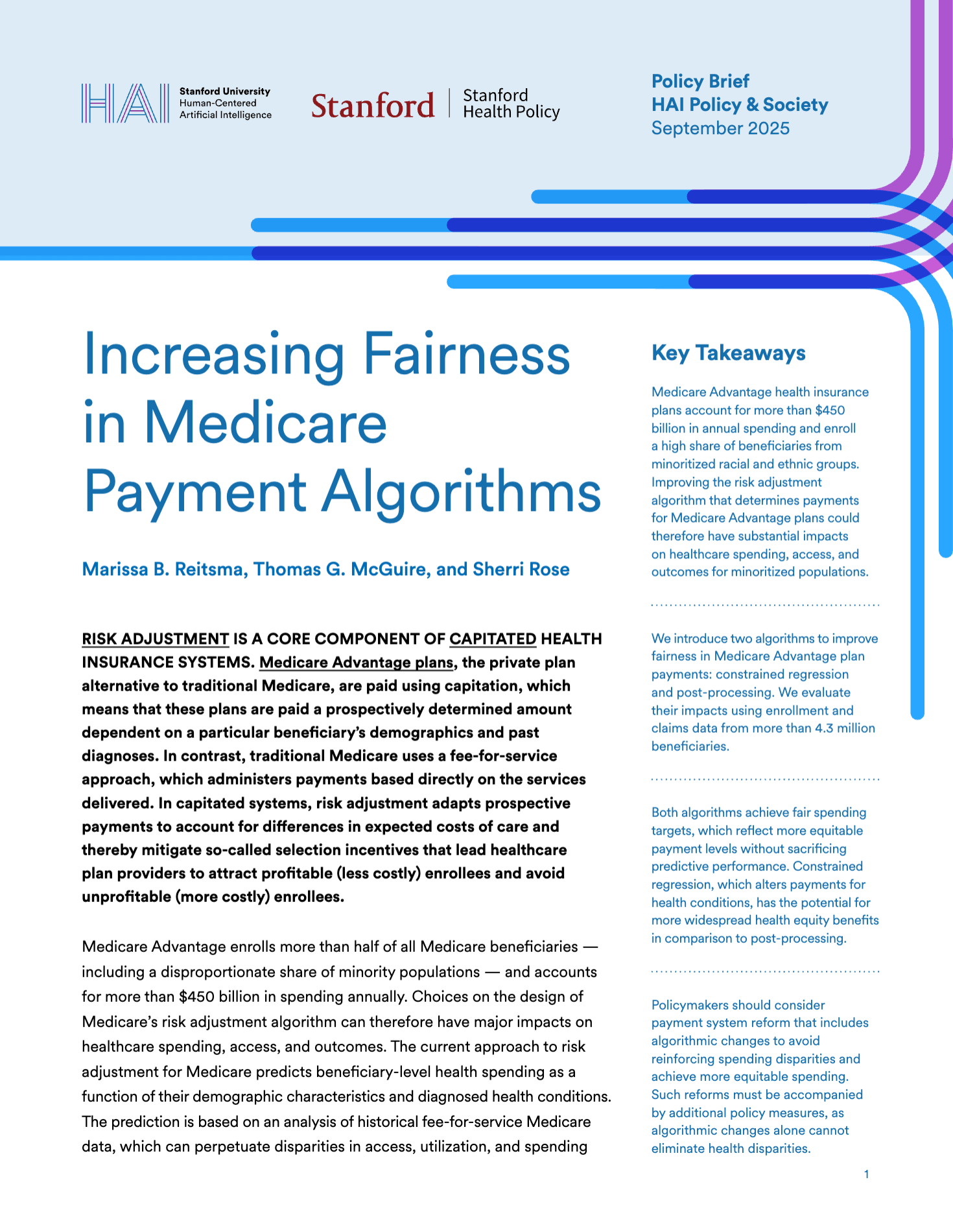
This brief introduces two algorithms that can promote fairer Medicare Advantage spending for minority populations.
In collaboration with

Key Takeaways
Medicare Advantage health insurance plans account for more than $450 billion in annual spending and enroll a high share of beneficiaries from minoritized racial and ethnic groups. Improving the risk adjustment algorithm that determines payments for Medicare Advantage plans could therefore have substantial impacts on healthcare spending, access, and outcomes for minoritized populations.
We introduce two algorithms to improve fairness in Medicare Advantage plan payments: constrained regression and post-processing. We evaluate their impacts using enrollment and claims data from more than 4.3 million beneficiaries.
Both algorithms achieve fair spending targets, which reflect more equitable payment levels without sacrificing predictive performance. Constrained regression, which alters payments for health conditions, has the potential for more widespread health equity benefits in comparison to post-processing.
Policymakers should consider payment system reform that includes algorithmic changes to avoid reinforcing spending disparities and achieve more equitable spending. Such reforms must be accompanied by additional policy measures, as algorithmic changes alone cannot eliminate health disparities.
Executive Summary
Risk adjustment is a core component of capitated health insurance systems. Medicare Advantage plans, the private plan alternative to traditional Medicare, are paid using capitation, which means that these plans are paid a prospectively determined amount dependent on a particular beneficiary’s demographics and past diagnoses. In contrast, traditional Medicare uses a fee-for-service approach, which administers payments based directly on the services delivered. In capitated systems, risk adjustment adapts prospective payments to account for differences in expected costs of care and thereby mitigate so-called selection incentives that lead healthcare plan providers to attract profitable (less costly) enrollees and avoid unprofitable (more costly) enrollees.
Medicare Advantage enrolls more than half of all Medicare beneficiaries — including a disproportionate share of minority populations — and accounts for more than $450 billion in spending annually. Choices on the design of Medicare’s risk adjustment algorithm can therefore have major impacts on healthcare spending, access, and outcomes. The current approach to risk adjustment for Medicare predicts beneficiary-level health spending as a function of their demographic characteristics and diagnosed health conditions. The prediction is based on an analysis of historical fee-for-service Medicare data, which can perpetuate disparities in access, utilization, and spending when applied to Medicare Advantage beneficiaries. Exploring how these risk adjustment algorithms can achieve fairness goals for multiple minoritized racial and ethnic groups remains an understudied area.
In our paper “Algorithms to Improve Fairness in Medicare Risk Adjustment,” we seek to close this important evidence gap by developing risk adjustment algorithms that can promote fairer spending for minoritized racial and ethnic groups. We analyzed a random sample of Medicare fee-for-service beneficiaries to assess existing levels of net compensation, which is the difference between predicted and observed spending, by racial and ethnic group. We proposed a basic measure of healthcare spending disparity that informed potential fair spending targets and then developed and evaluated two algorithms to achieve fair spending targets.
Policymakers can use the findings from our study to better understand how modifications to the risk adjustment algorithm can achieve greater fairness in health plan payments without sacrificing overall predictive performance. We made our open source code publicly available so that future research can build upon our work to drive further progress in improving healthcare payment systems.
Introduction
Medicare spending accounts for 14% of the federal budget and Medicare Advantage accounts for more than half of Medicare spending. Medicare Advantage plans receive risk-adjusted payments for each beneficiary they enroll. Currently, risk adjustment is based on a least squares regression, which generates spending predictions from observed data (i.e., beneficiaries’ demographic characteristics and clinical conditions). Prior research has examined approaches to improve the risk adjustment algorithm by increasing the accuracy of spending predictions, mitigating opportunities for upcoding (i.e., where providers document more severe conditions to increase payments), and reducing the potential for favorable selection (i.e., where insurers aim to attract profitable beneficiaries and avoid enrolling unprofitable beneficiaries).
However, few prior studies have examined fair regression methods, which optimize for both overall and group-level performance. An important finding from previous studies is that adding marginalized group indicators as predictors in the risk adjustment algorithm can reinforce data-embedded inequities in spending between populations, necessitating alternative approaches. Past literature has not specifically examined algorithms to achieve fairness goals across multiple minoritized racial and ethnic groups in Medicare.
This research gap matters for several reasons. First, a greater percentage of Black, Hispanic, and Asian/Pacific Islander beneficiaries, compared to non-Hispanic white beneficiaries, are enrolled in Medicare Advantage plans. Second, the population aged 65 years and older, which is the largest Medicare-eligible population, is projected to become more racially and ethnically diverse in the coming decades. Third, although Medicare eligibility reduces racial and ethnic disparities in insurance coverage, disparities persist in healthcare access, utilization, spending, and outcomes. Historical fee-for-service spending data, which are used to estimate risk scores and determine payments, embed many of these long-standing disparities.
Related Publications
Response to FDA’s Request for Feedback on Considerations for the Regulation of GenAI-Enabled Medical Devices
Stanford scholars respond to a federal request for feedback, offering policy recommendations for the regulation of generative AI-enabled medical devices.
Stanford scholars respond to a federal request for feedback, offering policy recommendations for the regulation of generative AI-enabled medical devices.
Making Local Law Legible: LLM-Assisted Detection of Discrimination
This brief demonstrates the potential of LLM-assisted review to accelerate legal reform.
This brief demonstrates the potential of LLM-assisted review to accelerate legal reform.
Operationalizing Real-Time Monitoring of Clinical AI

This brief demonstrates how real-time monitoring can address critical gaps in the oversight of radiological AI tools.

This brief demonstrates how real-time monitoring can address critical gaps in the oversight of radiological AI tools.
How Can AI Support Language Digitization and Digital Inclusion?

This white paper analyzes the varying ways AI tools can advance language digitization work, and provides recommendations for responsibly realizing the potential of AI in supporting the digital inclusion of digitally disadvantaged languages.

This white paper analyzes the varying ways AI tools can advance language digitization work, and provides recommendations for responsibly realizing the potential of AI in supporting the digital inclusion of digitally disadvantaged languages.