AI has the potential to transform healthcare delivery yet there is an urgent need for governance processes to guide the safe, fair, and secure adoption of AI in clinical settings. Stanford HAI’s multidisciplinary Healthcare AI Policy Steering Committee conducts research and convenes discussions to develop tangible recommendations for policymakers.

Get the latest news, advances in research, policy work, and education program updates from HAI in your inbox weekly.
Sign Up For Latest News
Stanford HAI’s Healthcare AI Policy Steering Committee is a multidisciplinary committee of Stanford faculty and scholars that are working together to advance the governance of healthcare AI. We are a group of academics, physicians, lawyers, computer scientists, and ethicists who believe deeply in both the power of AI applications to transform healthcare delivery and the urgent need to review existing regulatory frameworks to ensure these tools are safe, fair, and secure for clinical use.
By conducting interdisciplinary, evidence-based research and convening multi-stakeholder discussions, we aim to develop tangible recommendations for policymakers that help ensure healthcare AI can benefit patients, doctors, and developers alike.
Our committee members publish timely research at the intersection of healthcare, law, policy, ethics, and AI. We highlight a selection of their latest research papers at the bottom of this page.


In addition to conducting research, the Healthcare AI Policy Steering Committee convenes policy workshops with select groups of around 50-60 leading policymakers, scientists, healthcare providers, ethicists, AI developers, and patient advocates. The workshop is part of Stanford’s Health AI Week, which every year brings together thousands of experts to engage with the future of AI in healthcare through expert panels and workshops.
In May 2024, the Committee convened a closed-door workshop to discuss the path forward for healthcare AI governance. Participants discussed shortcomings in federal healthcare AI policy in three areas: AI software for clinical decision support, healthcare enterprise AI tools, and patient-facing AI applications.

In June 2025, the Committee convened a closed-door workshop to discuss how to integrate patient perspectives into the development and deployment of AI in healthcare and the development of policy solutions. Participants explored policy challenges in AI-related payment policy, the application of AI tools to insurance decisions, and mechanisms for cultivating patient trust in AI applications.


Leading policymakers, academics, healthcare providers, AI developers, and patient advocates discuss the path forward for healthcare AI policy at closed-door workshop.

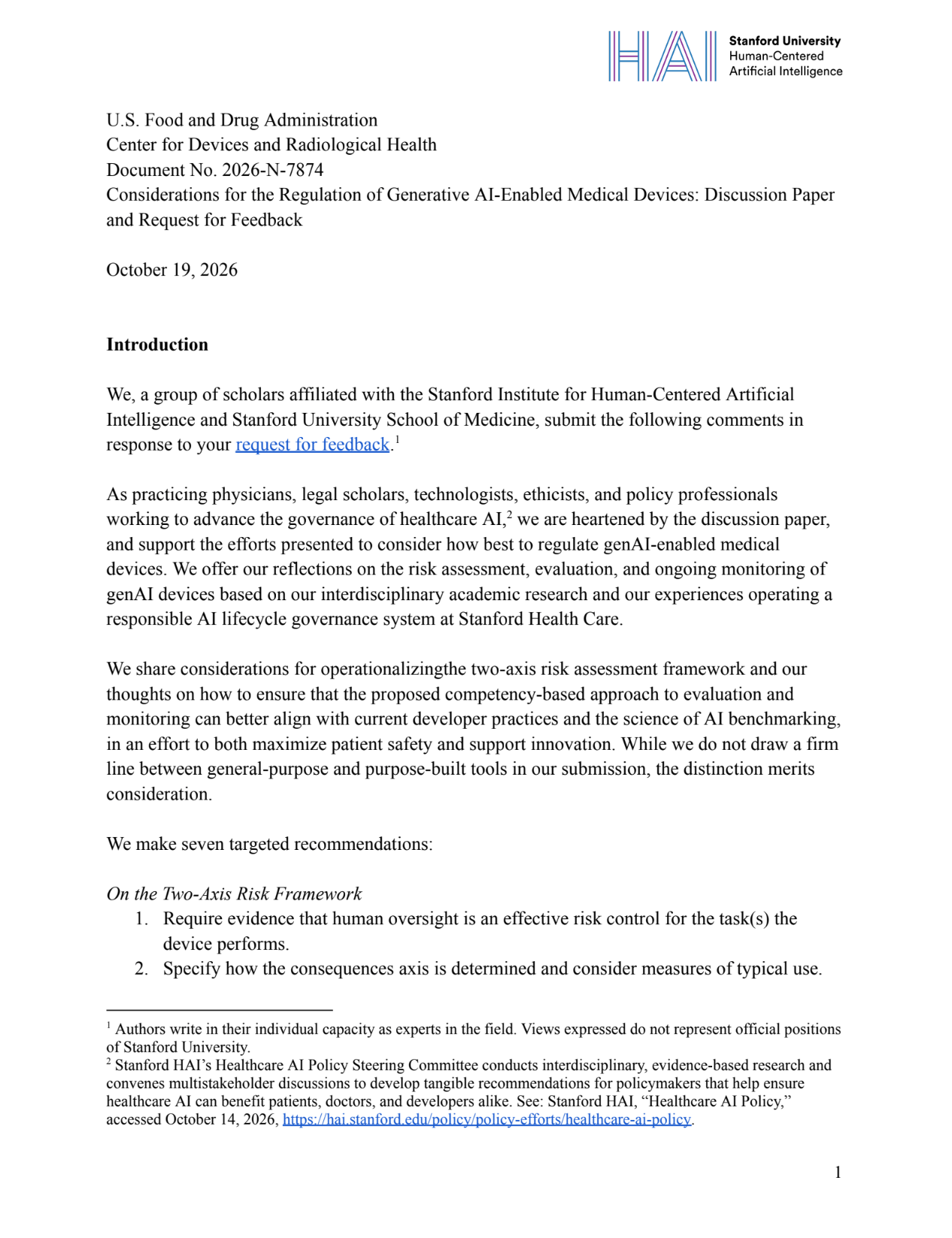
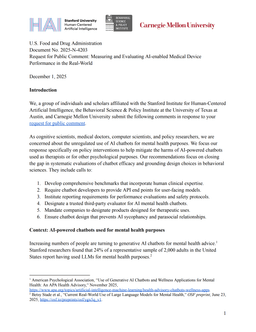
Stanford scholars respond to a federal RFC on evaluating AI-enabled medical devices, recommending policy interventions to help mitigate the harms of AI-powered chatbots used as therapists.

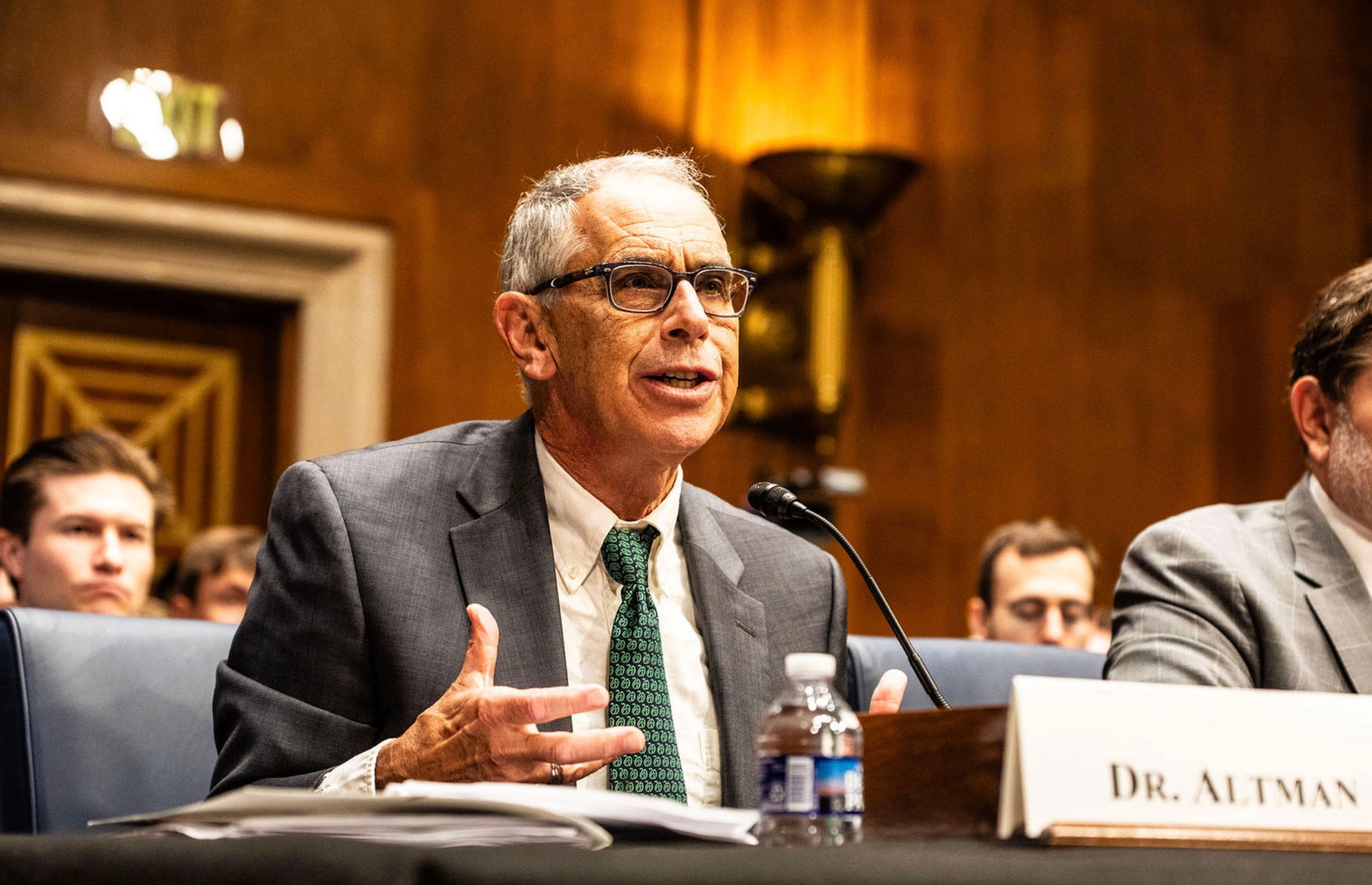
In this testimony presented to the U.S. Senate Committee on Health, Education, Labor, and Pensions hearing titled “AI’s Potential to Support Patients, Workers, Children, and Families,” Russ Altman highlights opportunities for congressional support to make AI applications for patient care and drug discovery stronger, safer, and human-centered.

In this testimony presented to the U.S. House Committee on Energy and Commerce’s Subcommittee on Health hearing titled “Examining Opportunities to Advance American Health Care through the Use of Artificial Intelligence Technologies,” Michelle M. Mello calls for policy changes that will promote effective integration of AI tools into healthcare by strengthening trust.

This brief introduces two algorithms that can promote fairer Medicare Advantage spending for minority populations.

This policy brief explores the complexities of accounting for race in clinical algorithms for evaluating kidney disease and the implications for tackling deep-seated health inequities.
Health insurers and health care provider organizations are increasingly using artificial intelligence (AI) tools in prior authorization and claims processes. AI offers many potential benefits, but its adoption has raised concerns about the role of the “humans in the loop,” users’ understanding of AI, opacity of algorithmic determinations, underperformance in certain tasks, automation bias, and unintended social consequences. To date, institutional governance by insurers and providers has not fully met the challenge of ensuring responsible use. However, several steps could be taken to help realize the benefits of AI use while minimizing risks. Drawing on empirical work on AI use and our own ethical assessments of provider-facing tools as part of the AI governance process at Stanford Health Care, we examine why utilization review has attracted so much AI innovation and why it is challenging to ensure responsible use of AI. We conclude with several steps that could be taken to help realize the benefits of AI use while minimizing risks.
Artificial intelligence (AI) tools for radiology are commonly unmonitored once deployed. The lack of real-time case-by-case assessments of AI prediction confidence requires users to independently distinguish between trustworthy and unreliable AI predictions, which increases cognitive burden, reduces productivity, and potentially leads to misdiagnoses. To address these challenges, we introduce Ensembled Monitoring Model (EMM), a framework inspired by clinical consensus practices using multiple expert reviews. Designed specifically for black-box commercial AI products, EMM operates independently without requiring access to internal AI components or intermediate outputs, while still providing robust confidence measurements. Using intracranial hemorrhage detection as our test case on a large, diverse dataset of 2919 studies, we demonstrate that EMM can successfully categorize confidence in the AI-generated prediction, suggest appropriate actions, and help physicians recognize low confidence scenarios, ultimately reducing cognitive burden. Importantly, we provide key technical considerations and best practices for successfully translating EMM into clinical settings.
In order to realize the potential of mental health AI applications to deliver improved care, a multipronged approach is needed, including representative AI datasets, research practices that reflect and anticipate potential sources of bias, stakeholder engagement, and equitable design practices.
Permeation of artificial intelligence (AI) tools into health care tests traditional understandings of what patients should be told about their care. Despite the general importance of informed consent, decision support tools (eg, automatic electrocardiogram readers, rule-based risk classifiers, and UpToDate summaries) are not usually discussed with patients even though they affect treatment decisions. Should AI tools be treated similarly? The legal doctrine of informed consent requires disclosing information that is material to a reasonable patient’s decision to accept a health care service, and evidence suggests that many patients would think differently about care if they knew it was guided by AI. In recent surveys, 60% of US adults said they would be uncomfortable with their physician relying on AI,1 70% to 80% had low expectations AI would improve important aspects of their care,2 only one-third trusted health care systems to use AI responsibly,3 and 63% said it was very true that they would want to be notified about use of AI in their care.
Current societal trends reflect an increased mistrust in science and a lowered civic engagement that threaten to impair research that is foundational for ensuring public health and advancing health equity. One effective countermeasure to these trends lies in community-facing citizen science applications to increase public participation in scientific research, making this field an important target for artificial intelligence (AI) exploration. We highlight potentially promising citizen science AI applications that extend beyond individual use to the community level, including conversational large language models, text-to-image generative AI tools, descriptive analytics for analyzing integrated macro- and micro-level data, and predictive analytics. The novel adaptations of AI technologies for community-engaged participatory research also bring an array of potential risks. We highlight possible negative externalities and mitigations for some of the potential ethical and societal challenges in this field.