Using Satellite Imagery to Understand and Promote Sustainable Development

This brief discusses the opportunities and limitations of AI models that can map satellite image inputs to sustainable development outcomes.
Key Takeaways
The data needed to inform policymaking for sustainable development is often lacking or inaccurate.
Machine learning analysis of satellite imagery could help estimate sustainable development outcomes—broadening the availability of existing high-quality development data.
Currently, there is relatively limited adoption of satellite imagery analysis in many sustainable development domains, with the primary exceptions being population and agricultural measurement.
Policymakers and researchers should explore using synthetic data and pursue more work on model explainability and scalability to ensure ML models can be appropriately trained for satellite images.
Executive Summary
The number of non-military satellites in orbit is rapidly growing. Each of these satellites offers unprecedented access to imagery to help measure sustainable development outcomes, such as eliminating hunger, promoting health and wellbeing, and building sustainable communities. Images previously held only by governments and a few corporations are now widely available to academics, civil society organizations, and individuals. Researchers can analyze these images for a wide range of purposes, including to measure agricultural productivity, urban population density, and rural economic activity. A single satellite image, for example, might be able to tell the story of a village’s economic health—its crop yields, its agricultural diversity, and its infrastructure development.
Artificial intelligence (AI)-powered machine learning (ML) tools can extract and assess such information from satellite imagery, making them an intriguing and valuable addition to the sustainable development toolkit. Yet many questions remain. In particular, researchers and policymakers need to better understand how well these models can map satellite image inputs to sustainable development outcomes and what limits the models’ performance. Our paper in Science, “Using Satellite Imagery to Understand and Promote Sustainable Development,” outlines how researchers have used ML models to estimate sustainable development outcomes, assess methods for model training, examine the challenges hindering models’ improvement, and consider models’ future applications. We conclude by identifying current limitations to these approaches and ways to respond.
Related Publications
Using AI to Map Urban Change
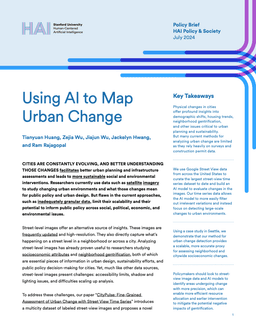
This brief introduces a novel street-view image dataset and AI model as a more accurate proxy for detecting and assessing urban changes such as gentrification.
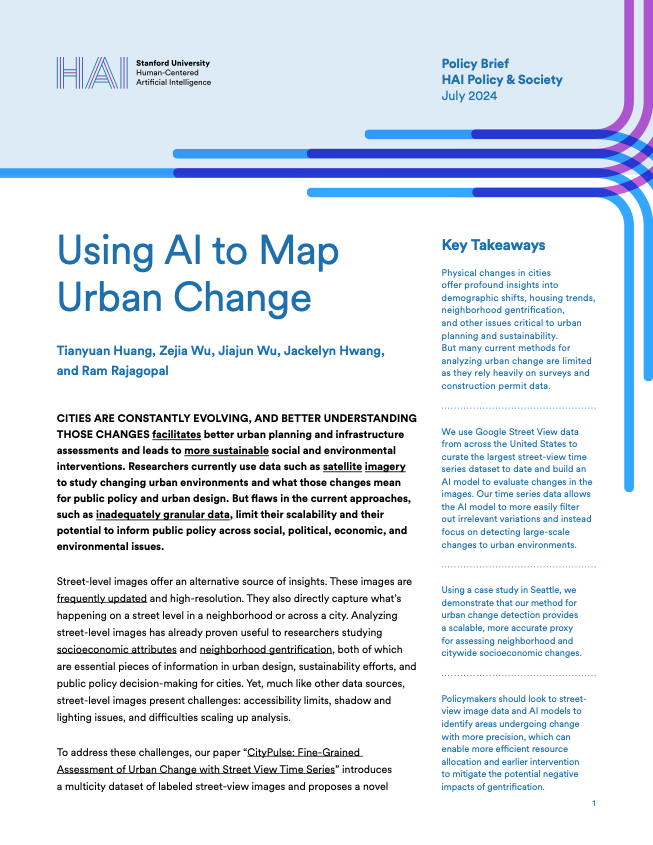
This brief introduces a novel street-view image dataset and AI model as a more accurate proxy for detecting and assessing urban changes such as gentrification.
Using AI to Understand Residential Solar Power

This brief introduces a computer-vision approach to analyzing solar panel adoption in U.S. households that can help policymakers tailor incentive mechanisms.
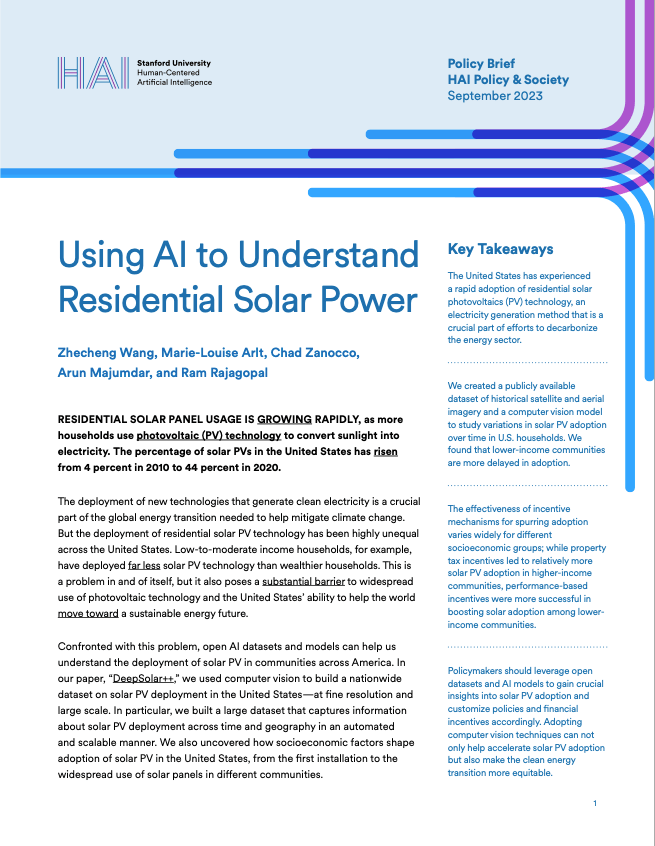
This brief introduces a computer-vision approach to analyzing solar panel adoption in U.S. households that can help policymakers tailor incentive mechanisms.
Beyond Pilots and PR: What Makes AI-for-Good Partnerships Work
This paper examines how nonprofits and frontier AI labs partner to deploy AI for social good and offers recommendations for structuring these partnerships for greater impact.
This paper examines how nonprofits and frontier AI labs partner to deploy AI for social good and offers recommendations for structuring these partnerships for greater impact.
The 2026 US Talent Report: Benchmarking America’s STEM Pipeline Amid the Great Talent Competition

This report assesses America's ability to develop, attract, and retain STEM talent and warns that its advantages over China are narrowing rapidly.
This report assesses America's ability to develop, attract, and retain STEM talent and warns that its advantages over China are narrowing rapidly.