Stanford
University
  • Stanford Home
  • Maps & Directions
  • Search Stanford
  • Emergency Info
  • Terms of Use
  • Privacy
  • Copyright
  • Trademarks
  • Non-Discrimination
  • Accessibility
© Stanford University.  Stanford, California 94305.
Response to U.S. AI Safety Institute’s Request for Comment on Managing Misuse Risk For Dual-Use Foundation Models | Stanford HAI

Stay Up To Date

Get the latest news, advances in research, policy work, and education program updates from HAI in your inbox weekly.

Sign Up For Latest News

Navigate
  • About
  • Events
  • Careers
  • Search
Participate
  • Get Involved
  • Support HAI
  • Contact Us
Skip to content
  • About

    • About
    • People
    • Get Involved with HAI
    • Support HAI
    • Subscribe to Email
  • Research

    • Research
    • Fellowship Programs
    • Grants
    • Student Affinity Groups
    • Centers & Labs
    • Research Publications
    • Research Partners
  • Education

    • Education
    • Executive and Professional Education
    • Government and Policymakers
    • K-12
    • Stanford Students
  • Policy

    • Policy
    • Policy Publications
    • Policymaker Education
    • Student Opportunities
  • AI Index

    • AI Index
    • AI Index Report
    • Global Vibrancy Tool
    • People
  • News
  • Events
  • Industry
  • Centers & Labs
policyResponse to Request

Response to U.S. AI Safety Institute’s Request for Comment on Managing Misuse Risk For Dual-Use Foundation Models
Date
September 09, 2024
Topics
Regulation, Policy, Governance
Foundation Models
Privacy, Safety, Security
Read Paper
abstract

Stanford scholars respond to a federal RFC on the U.S. AI Safety Institute’s draft guidelines for managing the misuse risk for dual-use foundation models.

In collaboration with
Executive Summary

In this response to the U.S. AI Safety Institute’s (US AISI) request for comment on its draft guidelines for managing the misuse risk for dual-use foundation models, scholars from Stanford HAI, the Center for Research on Foundation Models (CRFM), and the Regulation, Evaluation, and Governance Lab (RegLab) urge the US AISI to strengthen its guidance on reproducible evaluations and third- party evaluations, as well as clarify guidance on post-deployment monitoring. They also encourage the institute to develop similar guidance for other actors in the foundation model supply chain and for non-misuse risks, while ensuring the continued open release of foundation models absent evidence of marginal risk.

Read Paper
Share
Link copied to clipboard!
Authors
  • Rishi Bommasani
    Rishi Bommasani
  • Alexander Wan
    Alexander Wan
  • Yifan Mai
    Yifan Mai
  • Percy Liang
    Percy Liang
  • Dan Ho headshot
    Daniel E. Ho

Related Publications

Response to OSTP's Request for Information on Accelerating the American Scientific Enterprise
Rishi Bommasani, John Etchemendy, Surya Ganguli, Daniel E. Ho, Guido Imbens, James Landay, Fei-Fei Li, Russell Wald
Quick ReadDec 26, 2025
Response to Request

Stanford scholars respond to a federal RFI on scientific discovery, calling for the government to support a new “team science” academic research model for AI-enabled discovery.

Response to Request

Response to OSTP's Request for Information on Accelerating the American Scientific Enterprise

Rishi Bommasani, John Etchemendy, Surya Ganguli, Daniel E. Ho, Guido Imbens, James Landay, Fei-Fei Li, Russell Wald
Sciences (Social, Health, Biological, Physical)Regulation, Policy, GovernanceQuick ReadDec 26

Stanford scholars respond to a federal RFI on scientific discovery, calling for the government to support a new “team science” academic research model for AI-enabled discovery.

Beyond DeepSeek: China's Diverse Open-Weight AI Ecosystem and Its Policy Implications
Caroline Meinhardt, Sabina Nong, Graham Webster, Tatsunori Hashimoto, Christopher Manning
Deep DiveDec 16, 2025
Issue Brief

Almost one year after the “DeepSeek moment,” this brief analyzes China’s diverse open-model ecosystem and examines the policy implications of their widespread global diffusion.

Issue Brief

Beyond DeepSeek: China's Diverse Open-Weight AI Ecosystem and Its Policy Implications

Caroline Meinhardt, Sabina Nong, Graham Webster, Tatsunori Hashimoto, Christopher Manning
Foundation ModelsInternational Affairs, International Security, International DevelopmentDeep DiveDec 16

Almost one year after the “DeepSeek moment,” this brief analyzes China’s diverse open-model ecosystem and examines the policy implications of their widespread global diffusion.

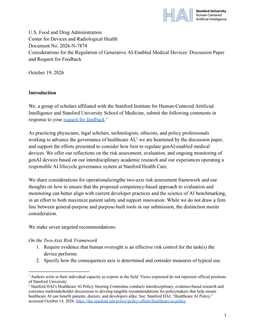
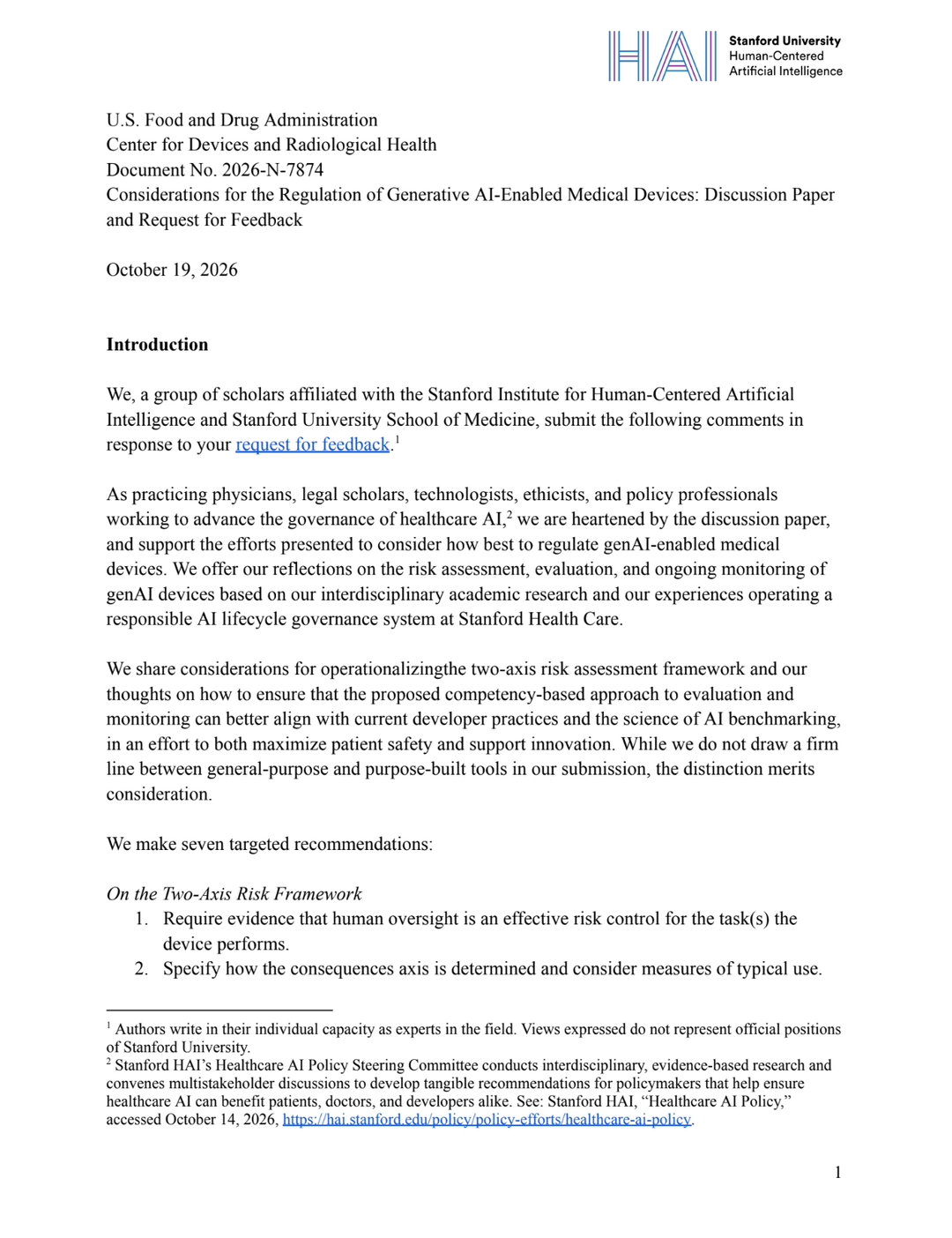
Response to FDA's Request for Comment on AI-Enabled Medical Devices
Desmond C. Ong, Jared Moore, Nicole Martinez-Martin, Caroline Meinhardt, Eric Lin, William Agnew
Quick ReadDec 02, 2025
Response to Request

Stanford scholars respond to a federal RFC on evaluating AI-enabled medical devices, recommending policy interventions to help mitigate the harms of AI-powered chatbots used as therapists.

Response to Request

Response to FDA's Request for Comment on AI-Enabled Medical Devices

Desmond C. Ong, Jared Moore, Nicole Martinez-Martin, Caroline Meinhardt, Eric Lin, William Agnew
HealthcareRegulation, Policy, GovernanceQuick ReadDec 02

Stanford scholars respond to a federal RFC on evaluating AI-enabled medical devices, recommending policy interventions to help mitigate the harms of AI-powered chatbots used as therapists.

Jen King's Testimony Before the U.S. House Committee on Energy and Commerce Oversight and Investigations Subcommittee
Jennifer King
Quick ReadNov 18, 2025
Testimony

In this testimony presented to the U.S. House Committee on Energy and Commerce’s Subcommittee on Oversights and Investigations hearing titled “Innovation with Integrity: Examining the Risks and Benefits of AI Chatbots,” Jen King shares insights on data privacy concerns connected with the use of chatbots. She highlights opportunities for congressional action to protect chatbot users from related harms.

Testimony

Jen King's Testimony Before the U.S. House Committee on Energy and Commerce Oversight and Investigations Subcommittee

Jennifer King
Privacy, Safety, SecurityQuick ReadNov 18

In this testimony presented to the U.S. House Committee on Energy and Commerce’s Subcommittee on Oversights and Investigations hearing titled “Innovation with Integrity: Examining the Risks and Benefits of AI Chatbots,” Jen King shares insights on data privacy concerns connected with the use of chatbots. She highlights opportunities for congressional action to protect chatbot users from related harms.