All Work Published on Privacy, Safety, Security

Stanford scholars respond to a federal RFC on AI accountability policy issued by the National Telecommunications and Information Administration (NTIA).
Stanford scholars respond to a federal RFC on AI accountability policy issued by the National Telecommunications and Information Administration (NTIA).


A Stanford study reveals that leading AI companies are pulling user conversations for training, highlighting privacy risks and a need for clearer policies.
A Stanford study reveals that leading AI companies are pulling user conversations for training, highlighting privacy risks and a need for clearer policies.

Daniel E. Ho's Testimony Before the Senate Committee on Homeland Security and Governmental Affairs
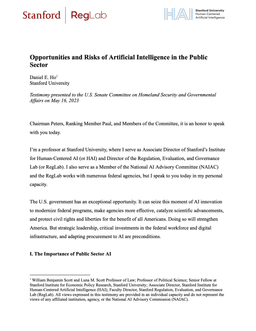
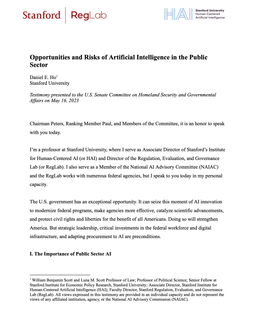
In this testimony presented to the U.S. Senate Committee on Homeland Security and Governmental Affairs, Daniel E. Ho calls for Congress to seize AI’s potential to modernize federal programs and protect civil rights to maintain American leadership in AI innovation and responsible AI.
In this testimony presented to the U.S. Senate Committee on Homeland Security and Governmental Affairs, Daniel E. Ho calls for Congress to seize AI’s potential to modernize federal programs and protect civil rights to maintain American leadership in AI innovation and responsible AI.
How Congress Could Stifle The Onslaught Of AI-Generated Child Sexual Abuse Material
HAI Policy Fellow Riana Pfefferkorn advises on ways in which the United States Congress could move the needle on model safety regarding AI-generated CSAM.
HAI Policy Fellow Riana Pfefferkorn advises on ways in which the United States Congress could move the needle on model safety regarding AI-generated CSAM.
Algorithms and the Perceived Legitimacy of Content Moderation

This brief explores people’s views of Facebook’s content moderation processes, providing a pathway for better online speech platforms and improving content moderation processes.
This brief explores people’s views of Facebook’s content moderation processes, providing a pathway for better online speech platforms and improving content moderation processes.

HAI Policy Fellow Riana Pfefferkorn discusses scenarios when third parties might be able to access personal messaging data and how to keep those forms of digital communication private.
HAI Policy Fellow Riana Pfefferkorn discusses scenarios when third parties might be able to access personal messaging data and how to keep those forms of digital communication private.