Science | The 2026 AI Index Report | Stanford HAI
Stanford
University
  • Stanford Home
  • Maps & Directions
  • Search Stanford
  • Emergency Info
  • Terms of Use
  • Privacy
  • Copyright
  • Trademarks
  • Non-Discrimination
  • Accessibility
© Stanford University.  Stanford, California 94305.
Skip to content
  • About

    • About
    • People
    • Get Involved with HAI
    • Support HAI
    • Subscribe to Email
  • Research

    • Research
    • Fellowship Programs
    • Grants
    • Student Affinity Groups
    • Centers & Labs
    • Research Publications
    • Research Partners
  • Education

    • Education
    • Executive and Professional Education
    • Government and Policymakers
    • K-12
    • Stanford Students
  • Policy

    • Policy
    • Policy Publications
    • Policymaker Education
    • Student Opportunities
  • AI Index

    • AI Index
    • AI Index Report
    • Global Vibrancy Tool
    • People
  • News
  • Events
  • Industry
  • Centers & Labs
Navigate
  • About
  • Events
  • AI Glossary
  • Careers
  • Search
Participate
  • Get Involved
  • Support HAI
  • Contact Us

Stay Up To Date

Get the latest news, advances in research, policy work, and education program updates from HAI in your inbox weekly.

Sign Up For Latest News

05

Science

Sciences (Social, Health, Biological, Physical)

This chapter is a new addition in this year’s AI Index report, and looks into AI’s expanding role across scientific domains, such as Biology, Chemistry, Physics and Astronomy. 

See Chapter 6

All Chapters

  • Back to Overview
  • 01Research and Development
  • 02Technical Performance
  • 03Responsible AI
  • 04Economy
  • 05Science
  • 06Medicine
  • 07Education
  • 08Policy and Governance
  • 09Public Opinion

1. AI-related scientific publications are growing year-over–year.

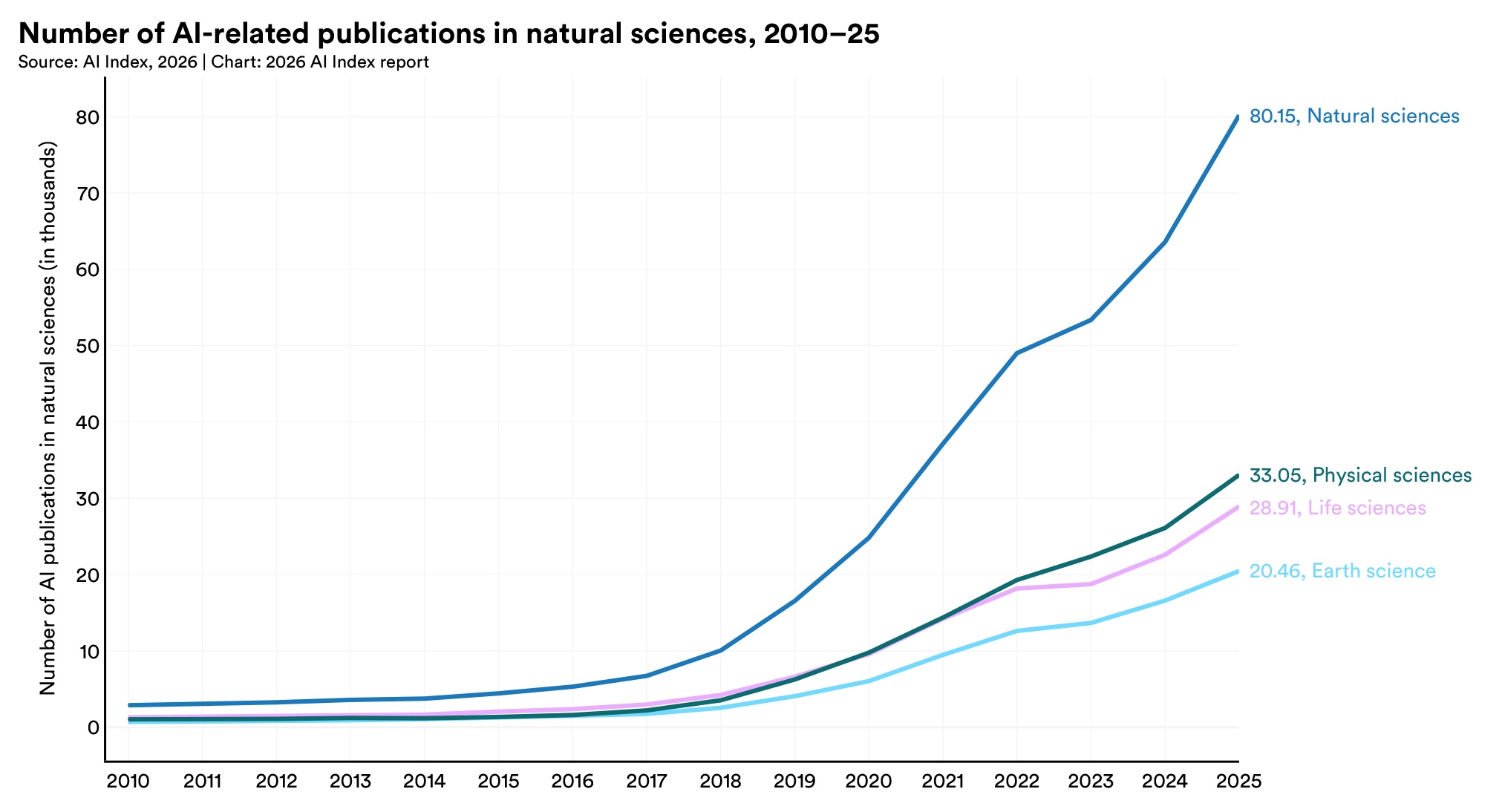
Natural sciences reached approximately 80,150 AI publications in 2025, up 26% from 2024. AI now accounts for 5.8%–8.8% of scientific research output depending on the field, up from below 1% in 2010.

2. Frontier models outperform human chemists on average but cannot reproduce published research.

On ChemBench, the best models surpass human expert averages across 2,700+ chemistry questions while struggling with basic tasks. On ReplicationBench, frontier models score below 20% on paper-scale replication in astrophysics. On UnivEarth, LLM agents answer earth observation questions with 33% accuracy, and their code fails 58% of the time.

3. Astronomy released its first foundation model, first visualization benchmark, and a 100TB training dataset in 2025, signaling a field-wide shift toward AI infrastructure.

AION-1, trained on over 200 million celestial objects from 5 major surveys, is the first astronomy foundation model. AstroVisBench introduced the first benchmark for LLM scientific computing and visualization in the field.
4. An AI system ran a full weather forecasting pipeline end-to-end for the first time in 2025.

Aardvark Weather replaced the traditional numerical prediction pipeline with a single ML system, and multiple AI weather models reached operational deployment. FourCastNet 3 generates a 60-day global forecast in under 4 minutes, running 8 to 60 times faster than prior approaches.

5. On end-to-end scientific research tasks, the best AI agents score roughly half of what PhD experts achieve.

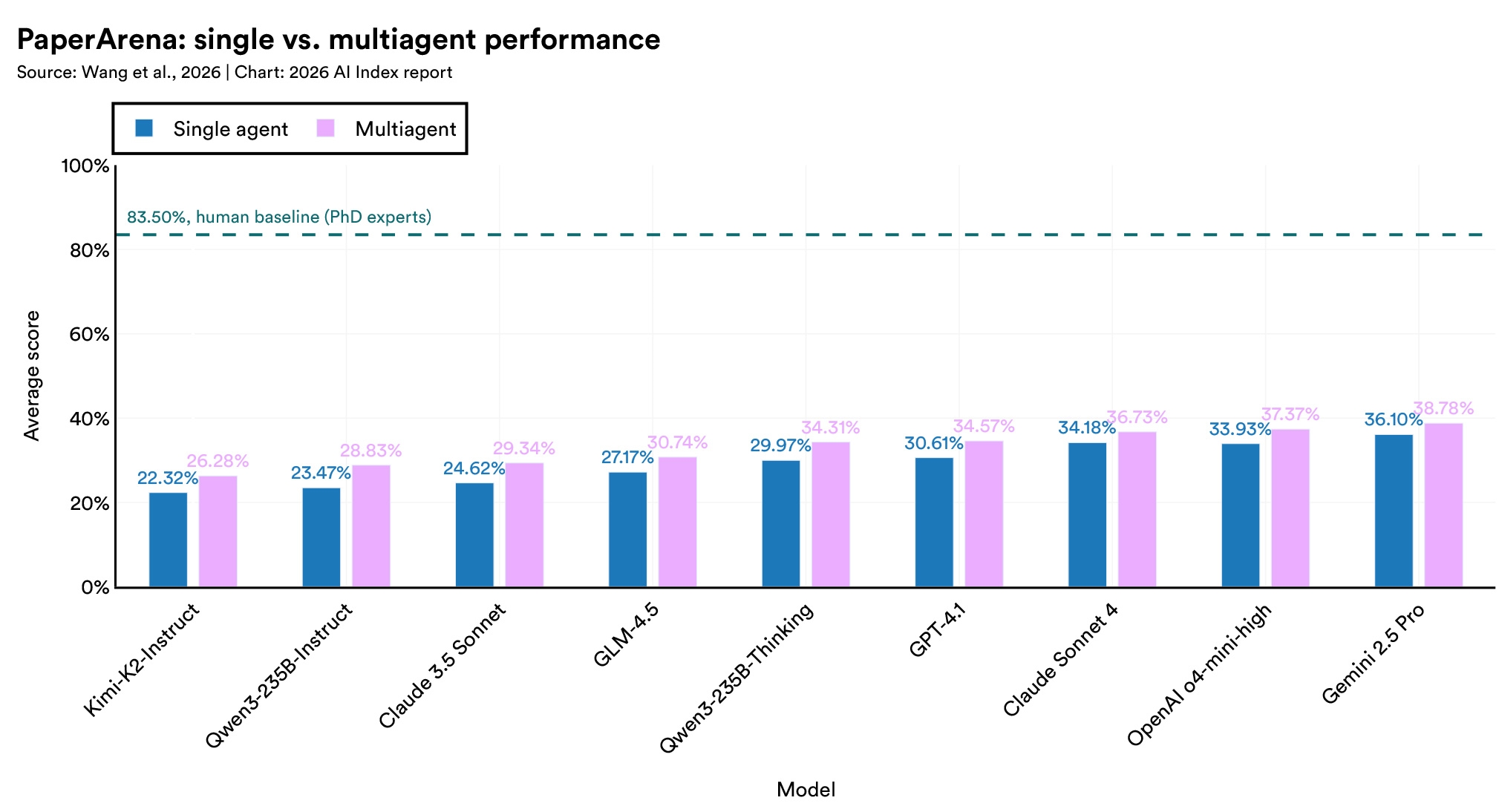
On PaperArena, the best agent reaches 38.8% accuracy versus a PhD expert baseline of 83.5%. On BixBench, frontier models achieve roughly 17% accuracy on real-world bioinformatics analysis.
6. The first fully AI-generated paper was accepted at a peer-reviewed workshop in 2025, but the list of experimentally confirmed AI discoveries remains short.

Sakana's AI Scientist-v2 produced a paper accepted at an ICLR workshop without human-coded templates. Google's AI Co-Scientist was validated in three biomedical areas.
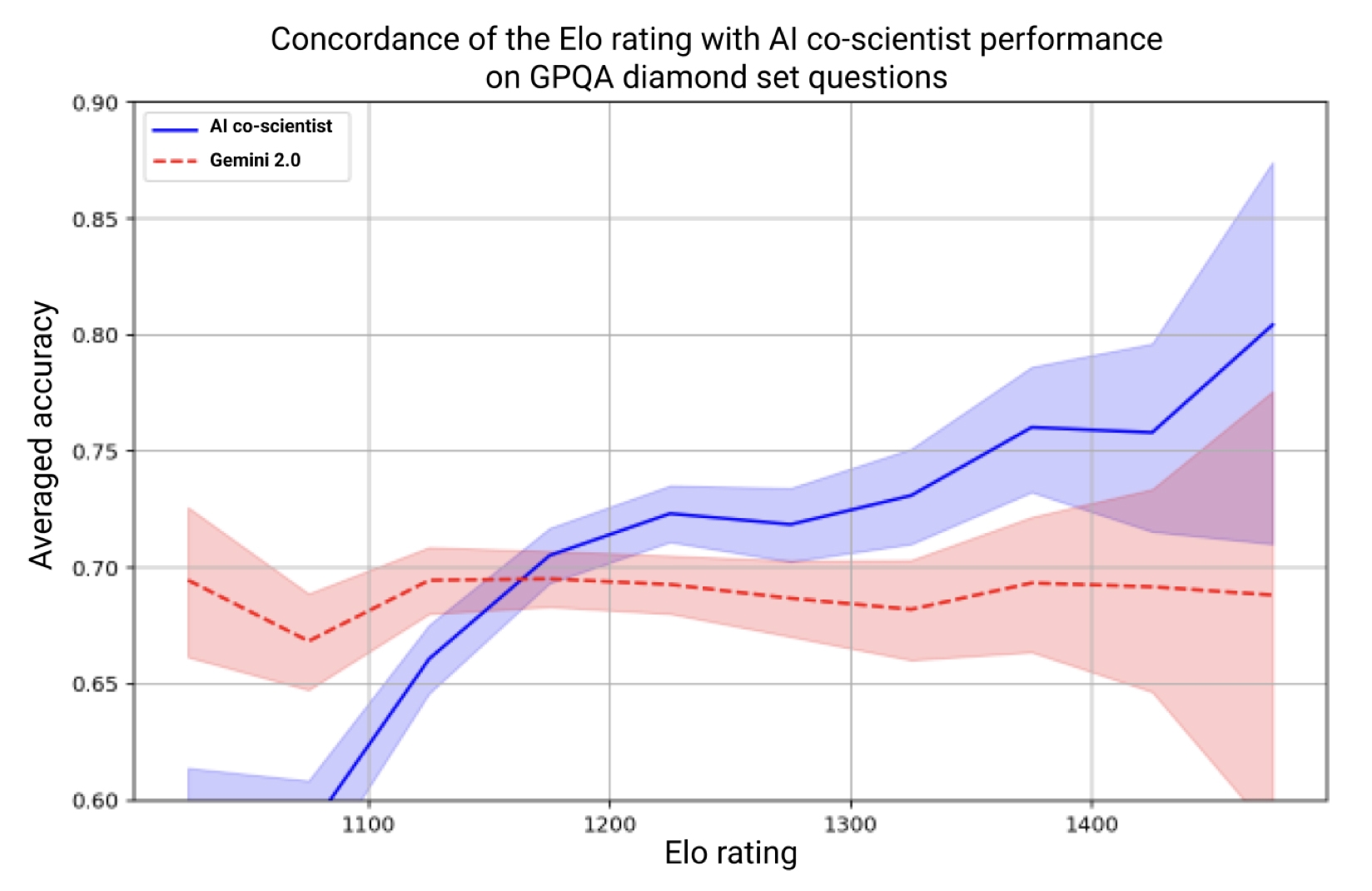
Source: Gottweis et al., 2025

7. Most AI models for science originate from academic and government institutions, in contrast with the industry-dominated landscape of general-purpose AI.

Many AI foundation models for science result from international collaborations. Earth science datasets come entirely from government and academic sources, while industry leads foundation model development in weather and climate.


Support the Stanford Institute for Human-Centered AI (HAI) in our mission to advance ethical and impactful advancements in artificial intelligence.

Your support helps foster research, education, policy, and collaboration across diverse fields. Whether you are an individual, a corporation, a foundation, or a family office, together we can ensure AI serves humanity’s best interests.

Make a Gift to AI Index