Get the latest news, advances in research, policy work, and education program updates from HAI in your inbox weekly.
Sign Up For Latest News
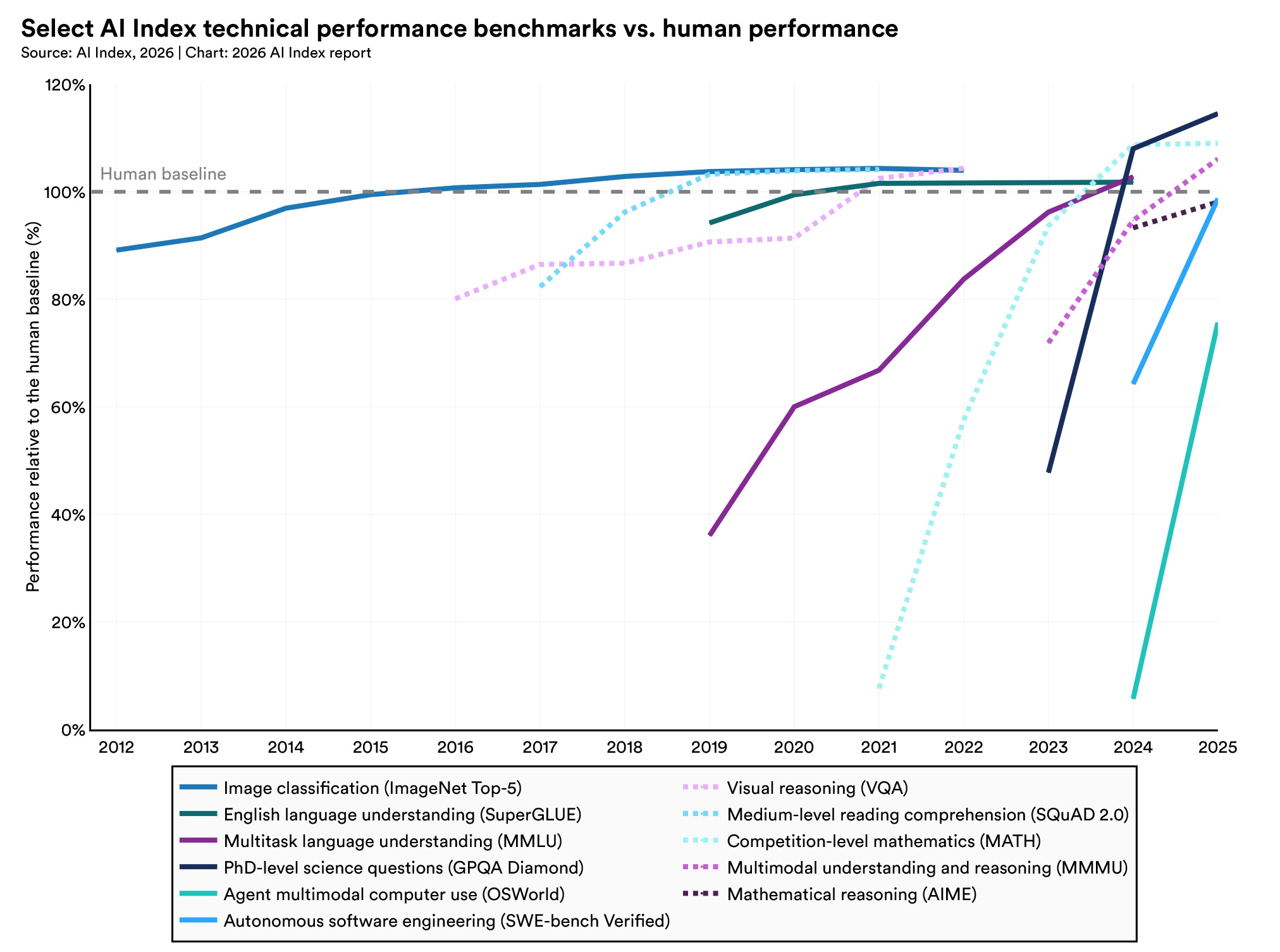
Frontier models gained 30 percentage points in a single year on Humanity's Last Exam, a benchmark built to be hard for AI and favorable to human experts. Evaluations intended to be challenging for years are saturated in months, compressing the window in which benchmarks remain useful for tracking progress.
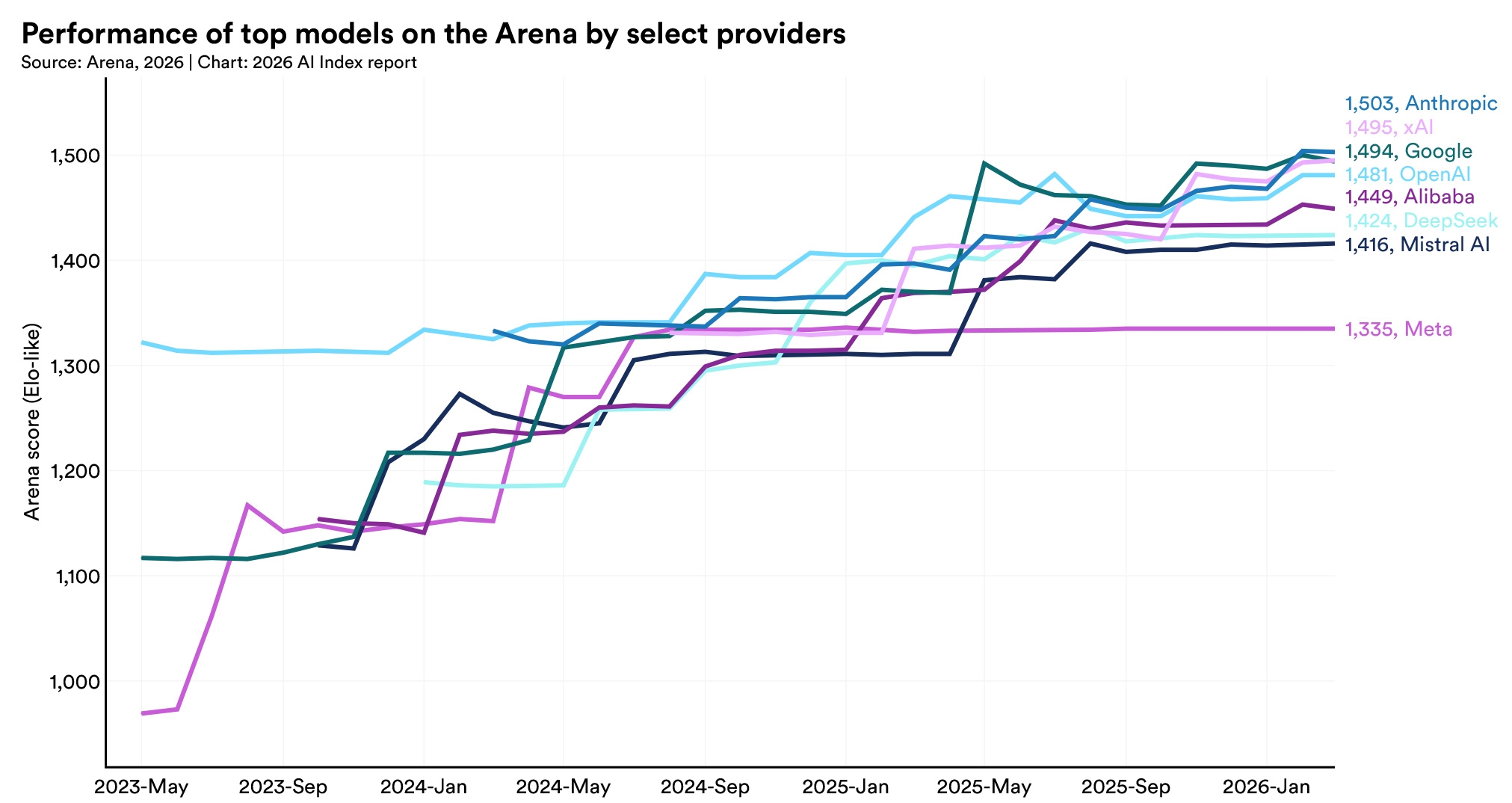
As of March 2026, Anthropic (1,503), xAI (1,495), Google (1,494), OpenAI (1,481), Alibaba (1,449), and DeepSeek (1,424) all occupy the top tier of the Arena Elo ratings, shifting competitive pressure toward cost, reliability, and domain-specific performance.
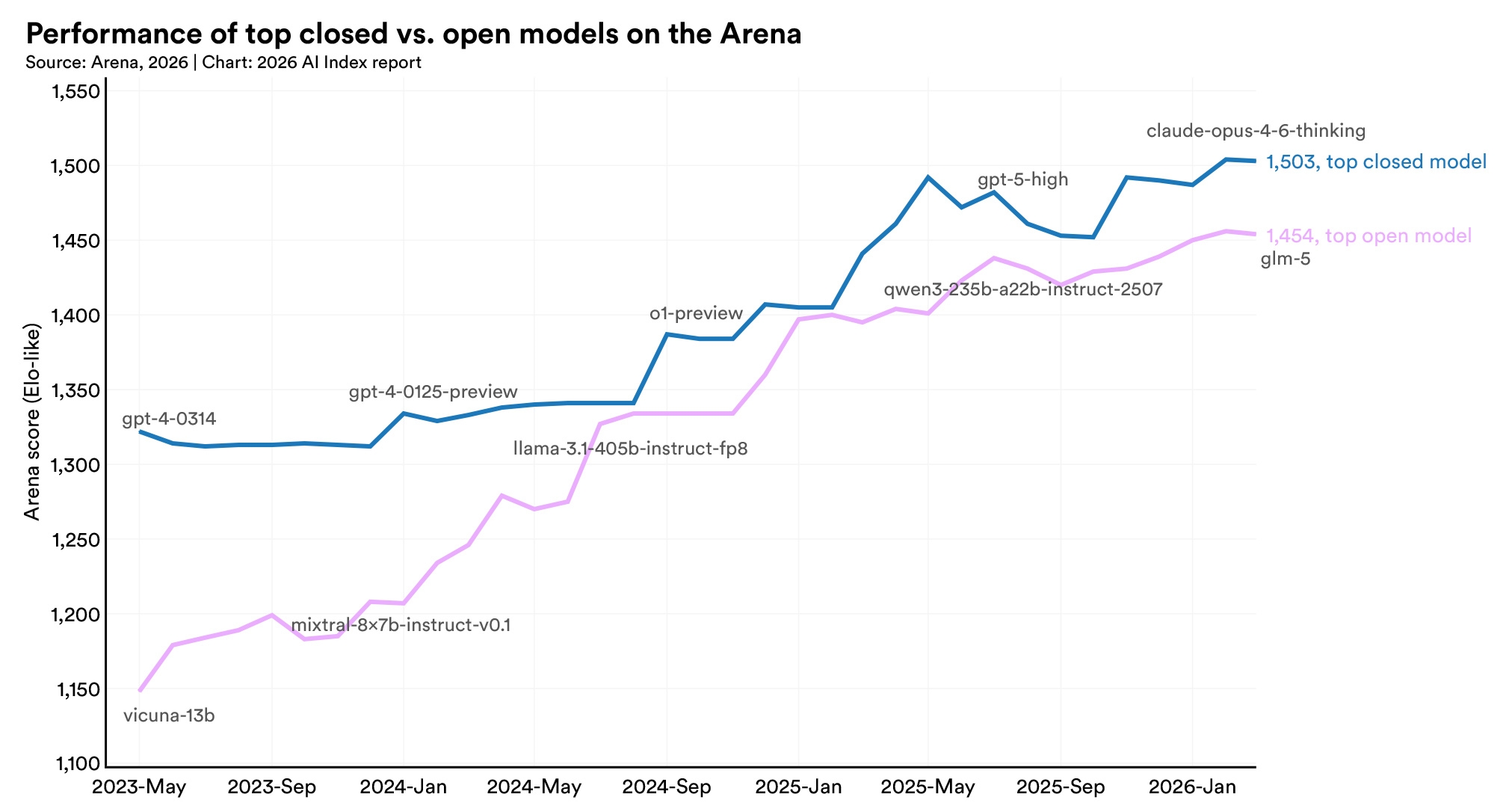
As of March 2026, the top closed model leads the top open model by 3.3%, up from 0.5% in August 2024. Six of the top ten models on the Arena Leaderboard are now closed.
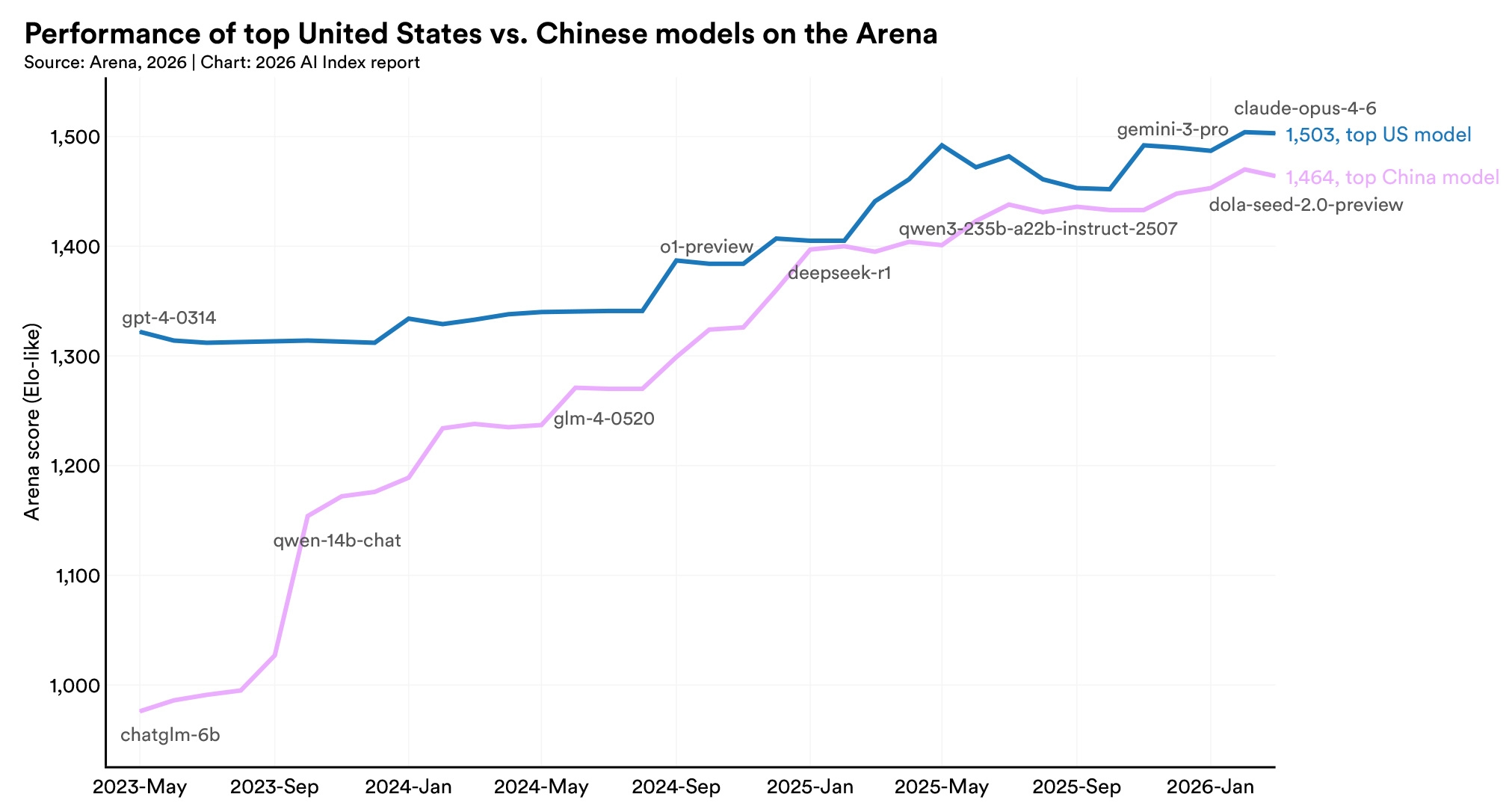
U.S. and Chinese models have traded places at the top of performance rankings multiple times since early 2025. In February 2025, DeepSeek-R1 briefly matched the top U.S. model. As of March 2026, the top U.S. model leads by 2.7%, with a gap that fluctuated over the past year while remaining in the single digits.
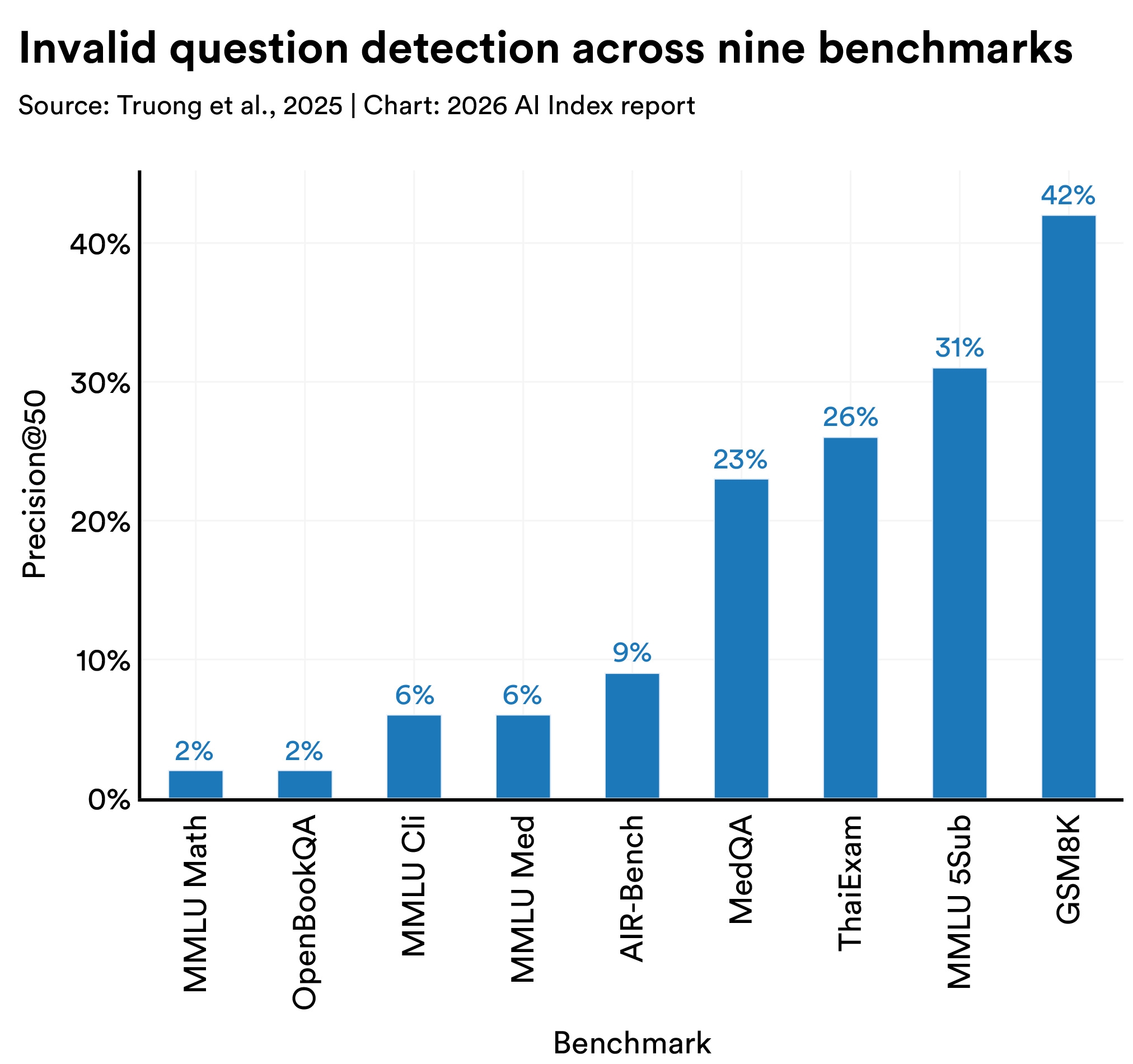
A review found invalid question rates ranging from 2% on MMLU Math to 42% on GSM8K. Separate research suggests that Arena leaderboard standing may partly reflect adaptation to the platform rather than general capability.
Google DeepMind’s Veo 3, tested across more than 18,000 generated videos, demonstrated abilities like simulating buoyancy and solving mazes without being trained on those tasks.
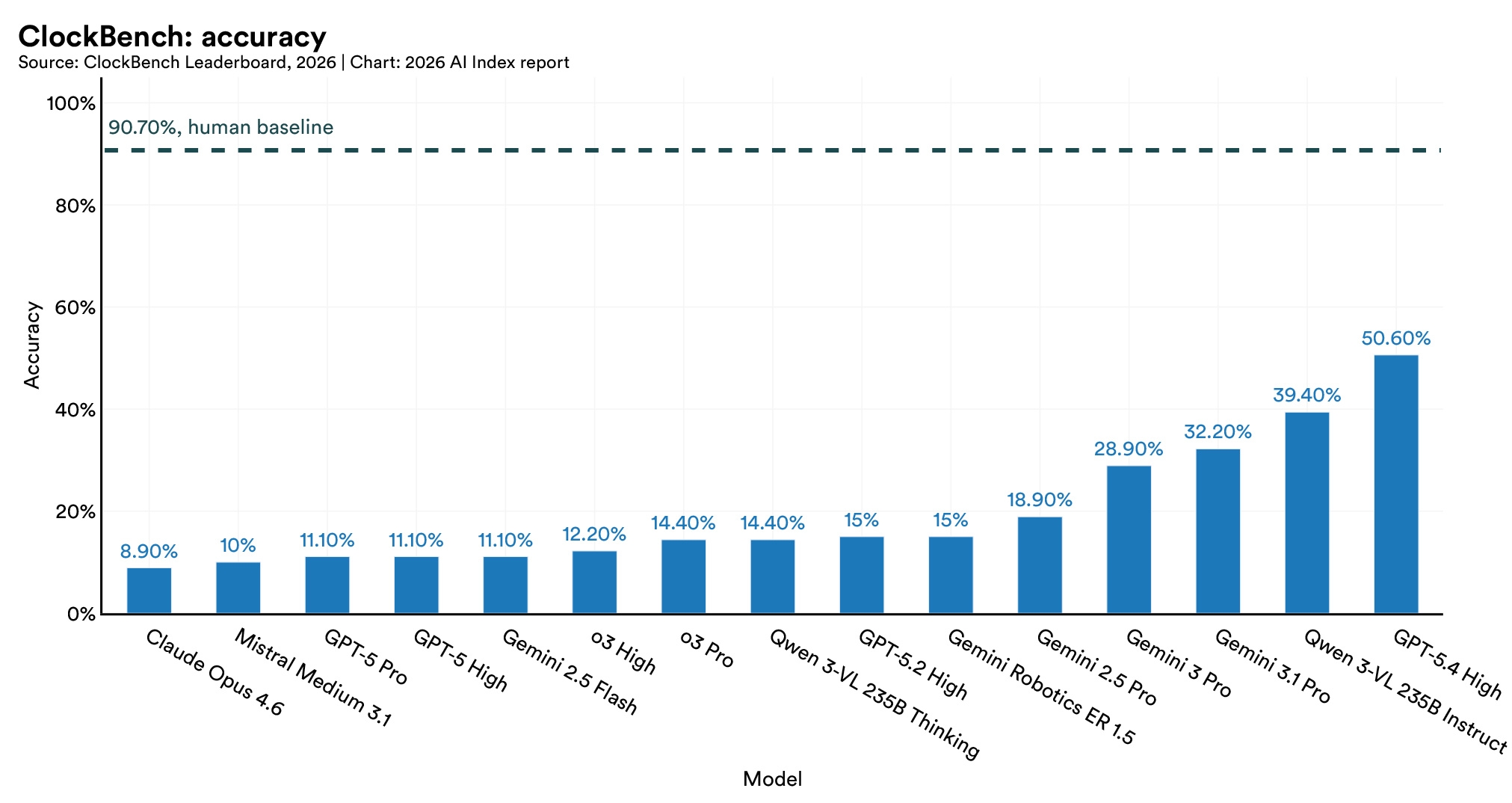
Gemini Deep Think scored 35 points (gold) at the 2025 IMO, working end to end in natural language within the 4.5-hour time limit, up from the 28-point silver achieved in 2024. On ClockBench, the top model read analog clocks correctly 50.6% of the time, compared with 90.1% for humans.
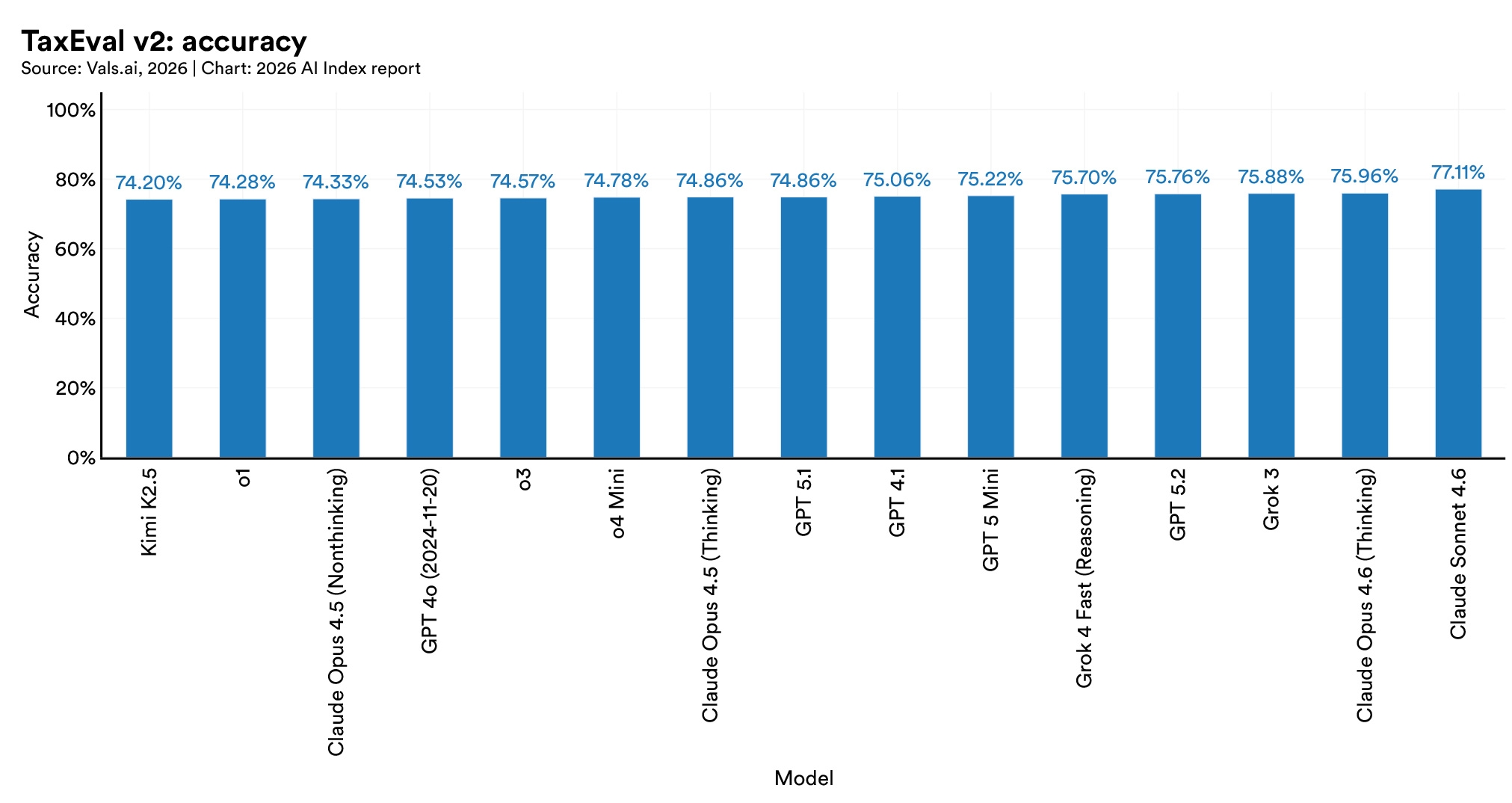
The performance of the top 15 models is separated by as little as 3 percentage points in each benchmark. These kinds of domains where high competency and reliability are required remain a great challenge for AI models.
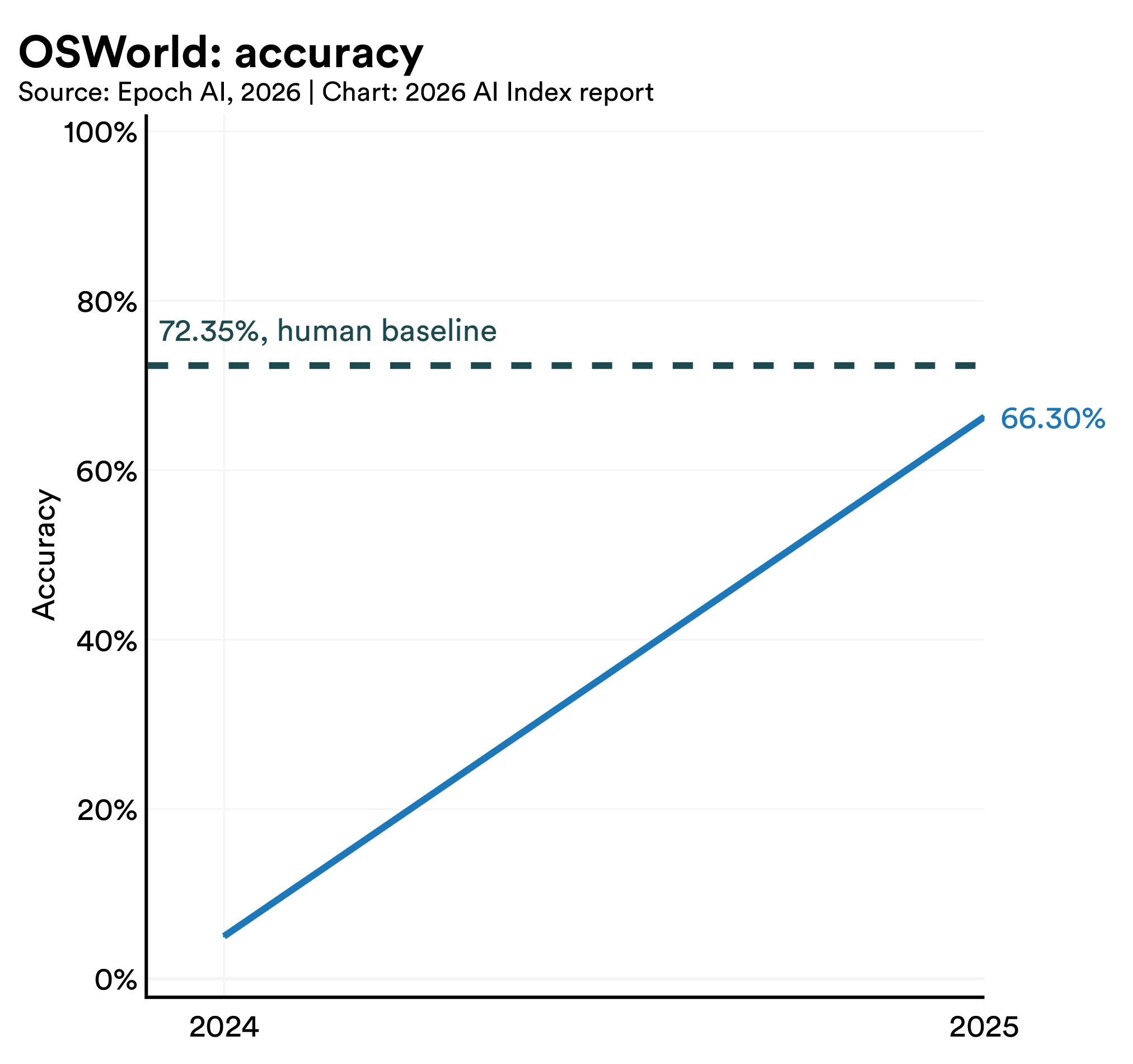
On OSWorld, which tests agents on computer tasks across operating systems, accuracy rose from roughly 12% to 66.3%, within 6 percentage points of human performance.
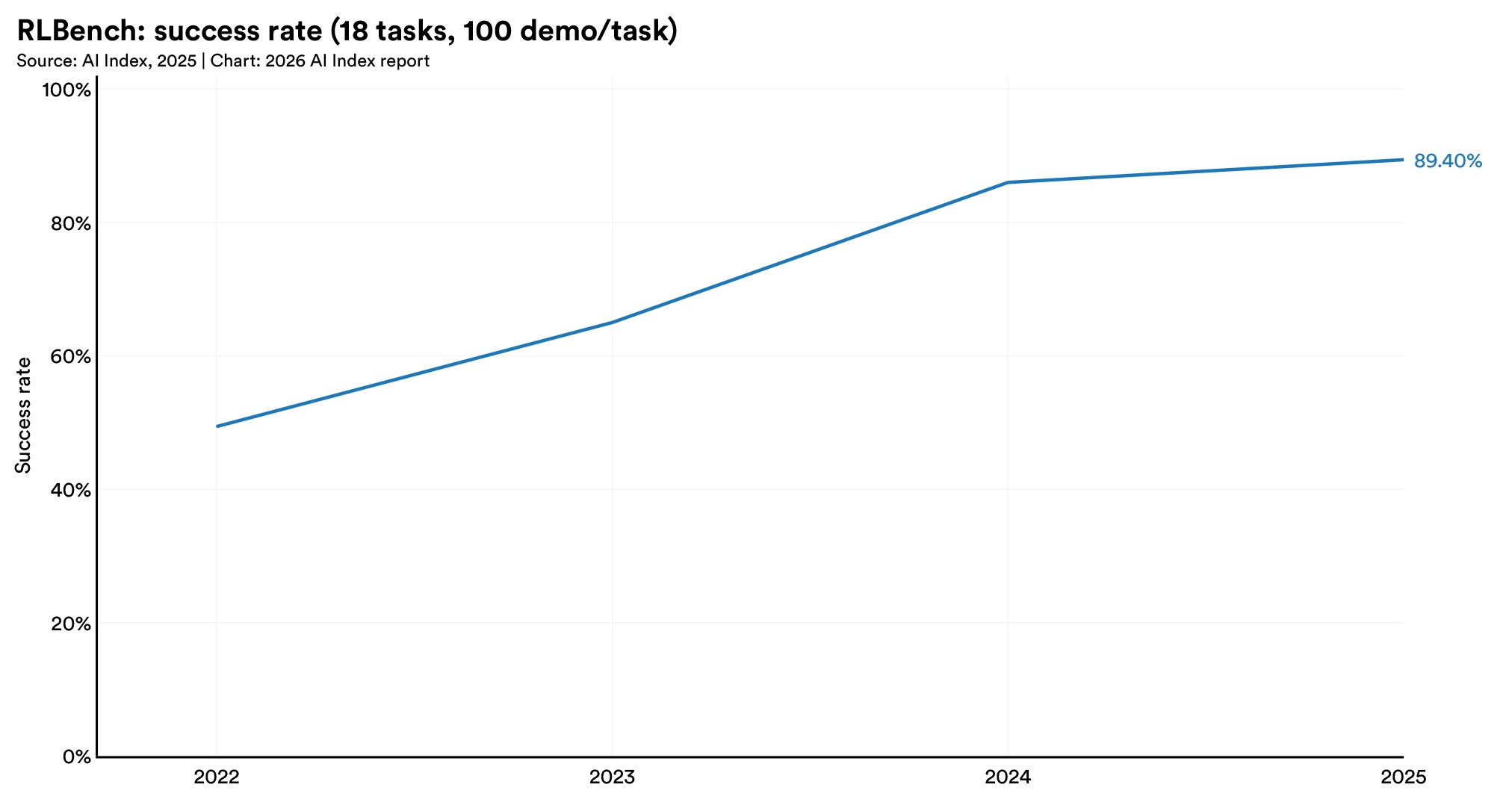
Robots succeed in only 12% of real household tasks, highlighting how far AI is from mastering the physical world. On RLBench, robotic manipulation in software-based simulations has reached 89.4% success, but the gap between predictable lab settings and unpredictable household environments is wide.
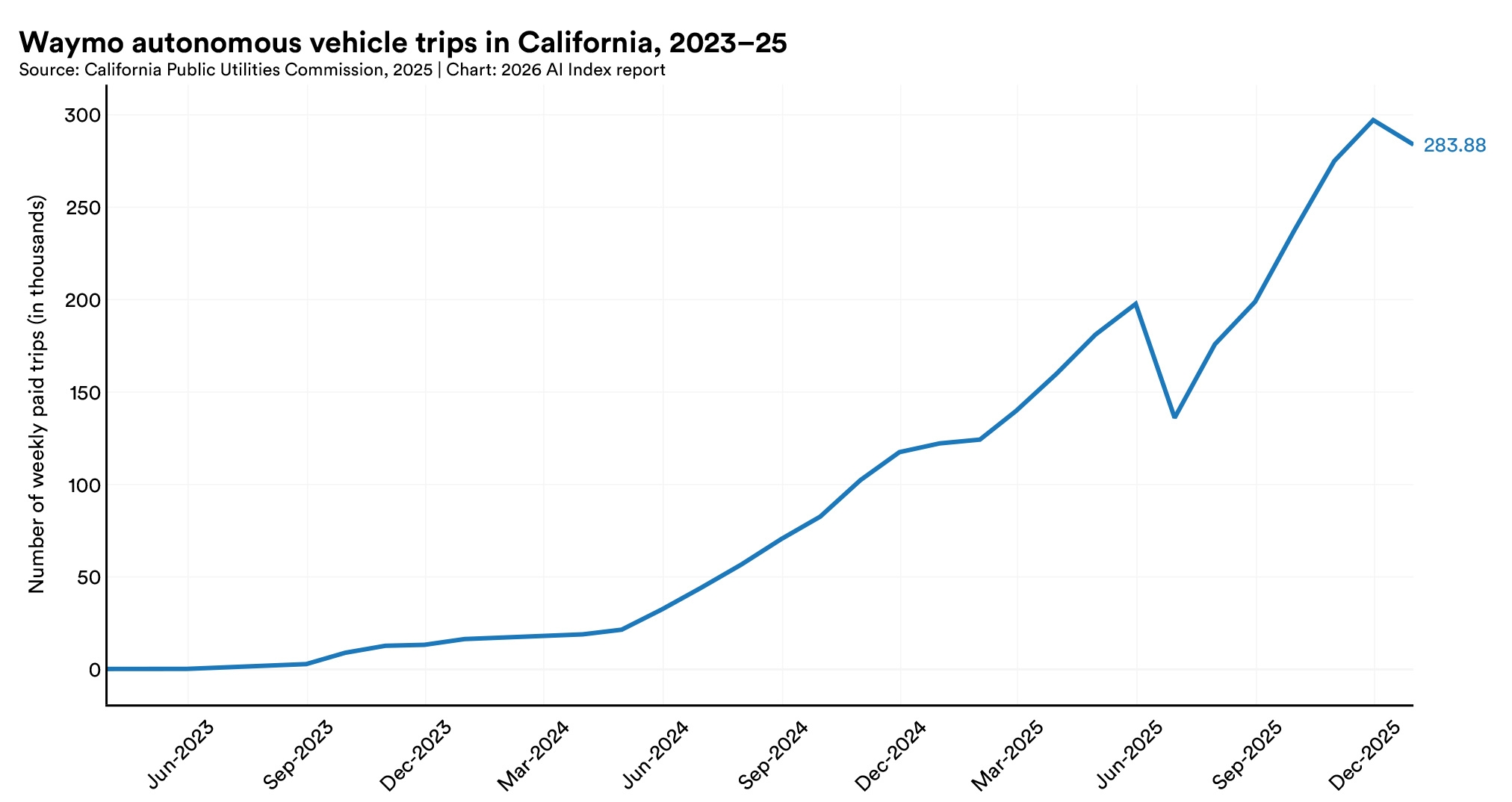
Waymo reached approximately 450,000 weekly trips across five U.S. cities. In China, Apollo Go completed 11 million fully driverless rides, a 175% year-over-year increase. European operators are active but comparable deployment data is not publicly available, limiting the global picture. Deployments so far are in areas with generally favorable weather and humans are available off-site to take over when necessary.
Support the AI Index in our mission to provide comprehensive, unbiased data on artificial intelligence worldwide. Your support sustains rigorous research, data collection, and analysis that informs policymakers, researchers, journalists, and business leaders—ensuring transparent AI metrics guide humanity toward a better future.
Make a Gift to AI Index