Stanford
University
  • Stanford Home
  • Maps & Directions
  • Search Stanford
  • Emergency Info
  • Terms of Use
  • Privacy
  • Copyright
  • Trademarks
  • Non-Discrimination
  • Accessibility
© Stanford University.  Stanford, California 94305.
Response to NSF’s Request for Information on Research Ethics | Stanford HAI

Stay Up To Date

Get the latest news, advances in research, policy work, and education program updates from HAI in your inbox weekly.

Sign Up For Latest News

Navigate
  • About
  • Events
  • Careers
  • Search
Participate
  • Get Involved
  • Support HAI
  • Contact Us
Skip to content
  • About

    • About
    • People
    • Get Involved with HAI
    • Support HAI
    • Subscribe to Email
  • Research

    • Research
    • Fellowship Programs
    • Grants
    • Student Affinity Groups
    • Centers & Labs
    • Research Publications
    • Research Partners
  • Education

    • Education
    • Executive and Professional Education
    • Government and Policymakers
    • K-12
    • Stanford Students
  • Policy

    • Policy
    • Policy Publications
    • Policymaker Education
    • Student Opportunities
  • AI Index

    • AI Index
    • AI Index Report
    • Global Vibrancy Tool
    • People
  • News
  • Events
  • Industry
  • Centers & Labs
policyResponse to Request

Response to NSF’s Request for Information on Research Ethics
Date
November 22, 2024
Topics
Ethics, Equity, Inclusion
Sciences (Social, Health, Biological, Physical)
Read Paper
abstract

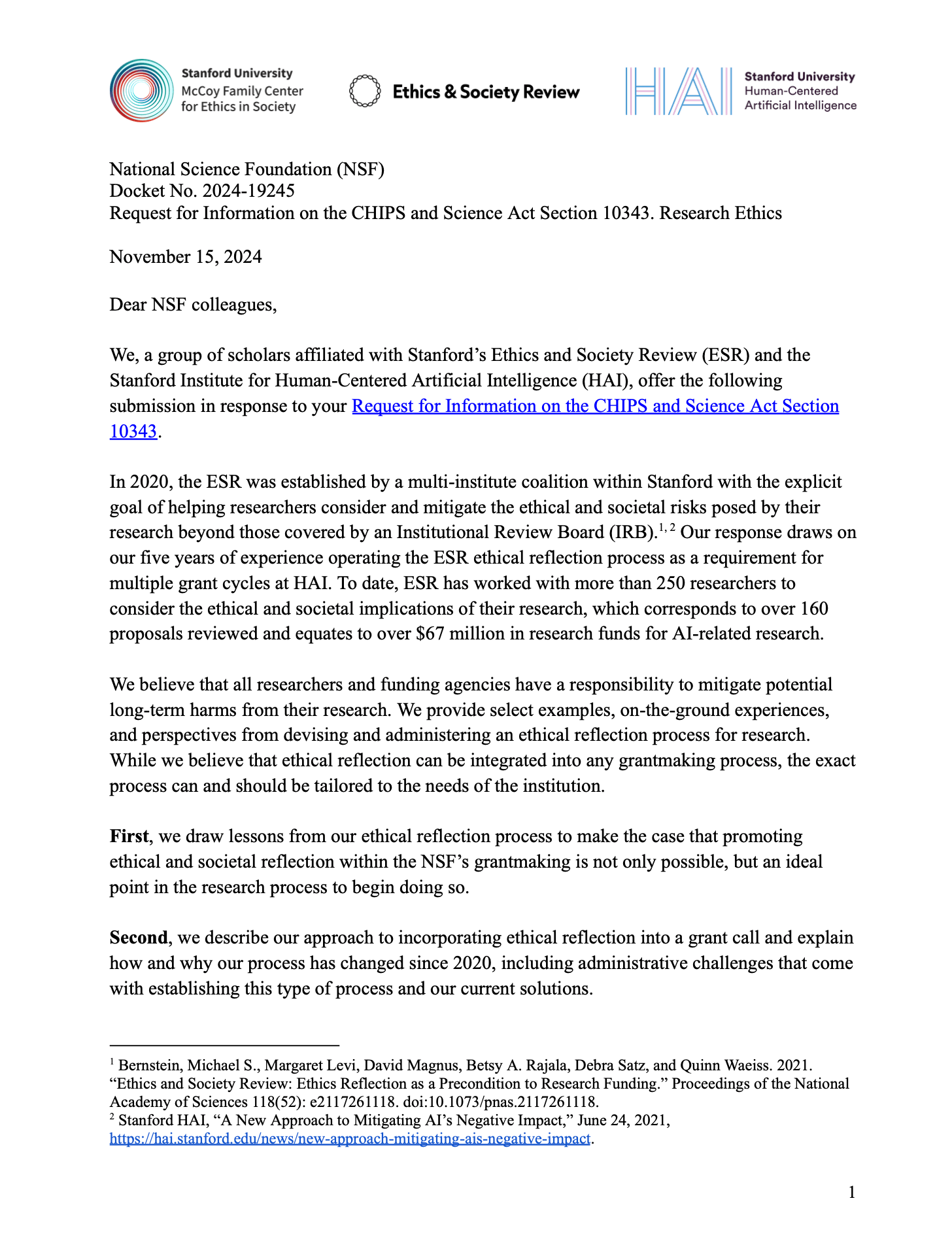
Stanford scholars respond to a federal RFI related to research ethics, sharing lessons from their experience operating an ethical reflection process for research grants.

In collaboration with

Executive Summary

In this response to the National Science Foundation’s (NSF) request for information related to research ethics, a group of scholars affiliated with Stanford HAI, Stanford’s McCoy Family Center for Ethics in Society, and Stanford’s Ethics and Society Review (ESR) share lessons drawn from their five years of experience operating the ESR ethical reflection process as a requirement for HAI research grants. They make the case for promoting ethical and societal reflection within NSF’s grantmaking and highlight the common ethical issues that arise as part of AI research reviews.

Read Paper
Share
Link copied to clipboard!
Authors
  • Quinn Waeiss
    Quinn Waeiss
  • Raio Huang
    Raio Huang
  • Betsy Arlene Rajala
    Betsy Arlene Rajala
  • Michael S. Bernstein
    Michael S. Bernstein
  • Margaret Levi
    Margaret Levi
  • David Magnus
    David Magnus
  • Debra Satz
    Debra Satz

Related Publications

Response to OSTP's Request for Information on Accelerating the American Scientific Enterprise
Rishi Bommasani, John Etchemendy, Surya Ganguli, Daniel E. Ho, Guido Imbens, James Landay, Fei-Fei Li, Russell Wald
Quick ReadDec 26, 2025
Response to Request

Stanford scholars respond to a federal RFI on scientific discovery, calling for the government to support a new “team science” academic research model for AI-enabled discovery.
Response to Request

Response to OSTP's Request for Information on Accelerating the American Scientific Enterprise

Rishi Bommasani, John Etchemendy, Surya Ganguli, Daniel E. Ho, Guido Imbens, James Landay, Fei-Fei Li, Russell Wald
Sciences (Social, Health, Biological, Physical)Regulation, Policy, GovernanceQuick ReadDec 26

Stanford scholars respond to a federal RFI on scientific discovery, calling for the government to support a new “team science” academic research model for AI-enabled discovery.

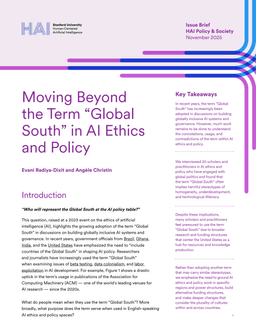
Moving Beyond the Term "Global South" in AI Ethics and Policy
Evani Radiya-Dixit, Angèle Christin
Quick ReadNov 19, 2025
Issue Brief

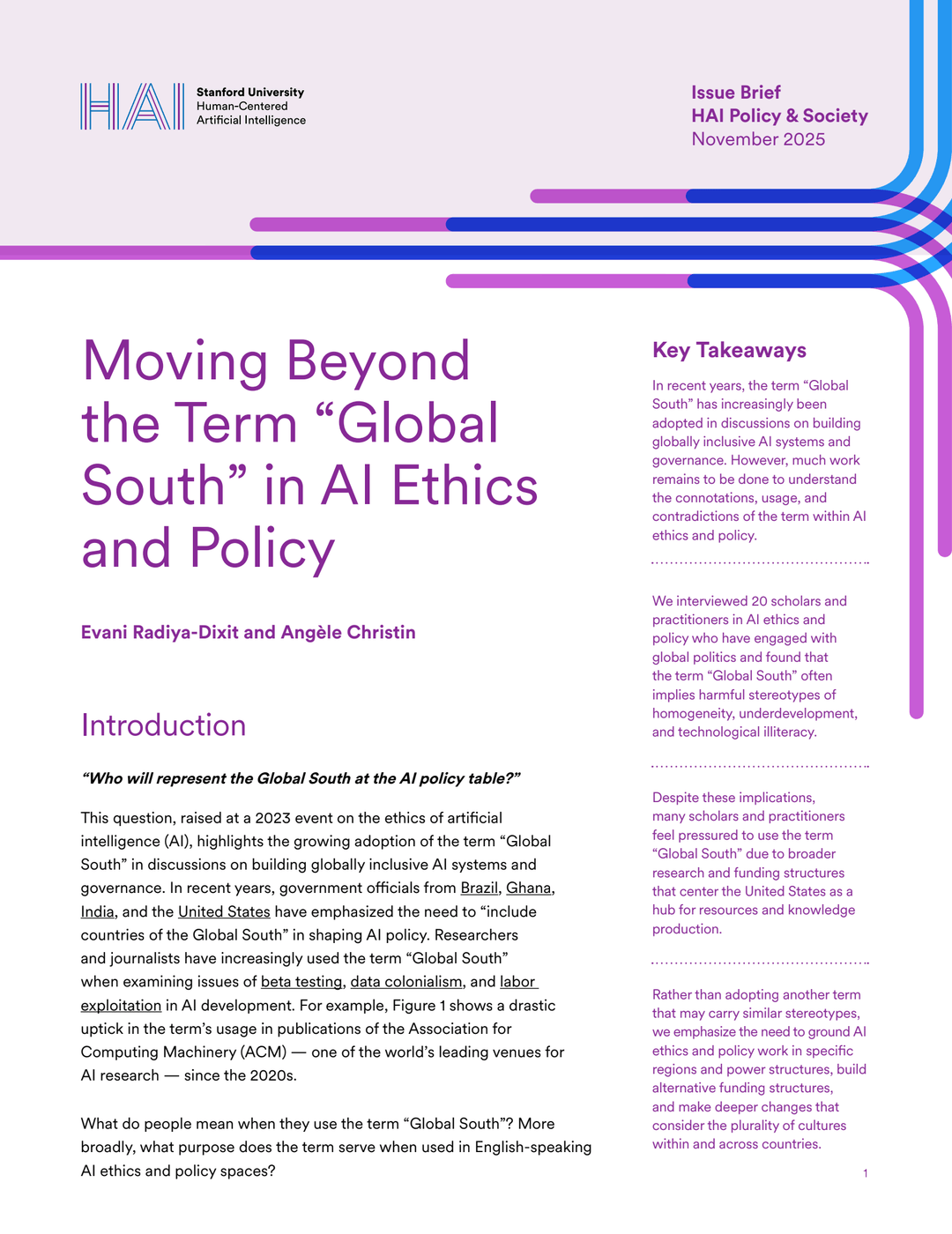
This brief examines the limitations of the term "Global South" in AI ethics and policy, and highlights the importance of grounding such work in specific regions and power structures.
Issue Brief

Moving Beyond the Term "Global South" in AI Ethics and Policy

Evani Radiya-Dixit, Angèle Christin
Ethics, Equity, InclusionInternational Affairs, International Security, International DevelopmentQuick ReadNov 19

This brief examines the limitations of the term "Global South" in AI ethics and policy, and highlights the importance of grounding such work in specific regions and power structures.

Russ Altman’s Testimony Before the U.S. Senate Committee on Health, Education, Labor, and Pensions
Russ Altman
Quick ReadOct 09, 2025
Testimony

In this testimony presented to the U.S. Senate Committee on Health, Education, Labor, and Pensions hearing titled “AI’s Potential to Support Patients, Workers, Children, and Families,” Russ Altman highlights opportunities for congressional support to make AI applications for patient care and drug discovery stronger, safer, and human-centered.

Testimony

Russ Altman’s Testimony Before the U.S. Senate Committee on Health, Education, Labor, and Pensions

Russ Altman
HealthcareRegulation, Policy, GovernanceSciences (Social, Health, Biological, Physical)Quick ReadOct 09

In this testimony presented to the U.S. Senate Committee on Health, Education, Labor, and Pensions hearing titled “AI’s Potential to Support Patients, Workers, Children, and Families,” Russ Altman highlights opportunities for congressional support to make AI applications for patient care and drug discovery stronger, safer, and human-centered.

Increasing Fairness in Medicare Payment Algorithms
Marissa Reitsma, Thomas G. McGuire, Sherri Rose
Quick ReadSep 01, 2025
Policy Brief

This brief introduces two algorithms that can promote fairer Medicare Advantage spending for minority populations.

Policy Brief

Increasing Fairness in Medicare Payment Algorithms

Marissa Reitsma, Thomas G. McGuire, Sherri Rose
Ethics, Equity, InclusionHealthcareQuick ReadSep 01

This brief introduces two algorithms that can promote fairer Medicare Advantage spending for minority populations.