All Work Published on Education, Skills

Scholars discover short-horizon data from edtech platforms can help predict student performance in the long term.
Scholars discover short-horizon data from edtech platforms can help predict student performance in the long term.

Language Models in the Classroom: Bridging the Gap Between Technology and Teaching

Instructors and students from Stanford class CS293/EDUC473 address the failures of current educational technologies and outline how to empower both teachers and learners through collaborative innovation.
Instructors and students from Stanford class CS293/EDUC473 address the failures of current educational technologies and outline how to empower both teachers and learners through collaborative innovation.


The new AI Index is out. See how well you know the state of the industry.
The new AI Index is out. See how well you know the state of the industry.


Education researchers have evaluated the ability of large language models (LLMs) to help middle school math teachers structure tiered lessons to reach diverse skill levels — a strategy called scaffolding.
Education researchers have evaluated the ability of large language models (LLMs) to help middle school math teachers structure tiered lessons to reach diverse skill levels — a strategy called scaffolding.

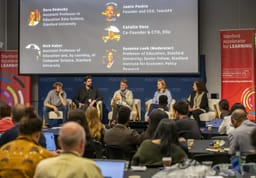
The third Stanford AI+Education Summit brought together researchers, K-12 leaders, educators, and technologists to explore how AI is shaping teaching and learning.
The third Stanford AI+Education Summit brought together researchers, K-12 leaders, educators, and technologists to explore how AI is shaping teaching and learning.
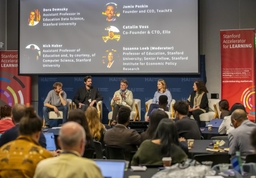

Thirty-two interdisciplinary teams will receive $2.37 million in Seed Research Grants to work toward initial results on ambitious proposals.
Thirty-two interdisciplinary teams will receive $2.37 million in Seed Research Grants to work toward initial results on ambitious proposals.