All Work Published on Healthcare
Ethical Obligations to Inform Patients About Use of AI Tools
Permeation of artificial intelligence (AI) tools into health care tests traditional understandings of what patients should be told about their care. Despite the general importance of informed consent, decision support tools (eg, automatic electrocardiogram readers, rule-based risk classifiers, and UpToDate summaries) are not usually discussed with patients even though they affect treatment decisions. Should AI tools be treated similarly? The legal doctrine of informed consent requires disclosing information that is material to a reasonable patient’s decision to accept a health care service, and evidence suggests that many patients would think differently about care if they knew it was guided by AI. In recent surveys, 60% of US adults said they would be uncomfortable with their physician relying on AI,1 70% to 80% had low expectations AI would improve important aspects of their care,2 only one-third trusted health care systems to use AI responsibly,3 and 63% said it was very true that they would want to be notified about use of AI in their care.
Permeation of artificial intelligence (AI) tools into health care tests traditional understandings of what patients should be told about their care. Despite the general importance of informed consent, decision support tools (eg, automatic electrocardiogram readers, rule-based risk classifiers, and UpToDate summaries) are not usually discussed with patients even though they affect treatment decisions. Should AI tools be treated similarly? The legal doctrine of informed consent requires disclosing information that is material to a reasonable patient’s decision to accept a health care service, and evidence suggests that many patients would think differently about care if they knew it was guided by AI. In recent surveys, 60% of US adults said they would be uncomfortable with their physician relying on AI,1 70% to 80% had low expectations AI would improve important aspects of their care,2 only one-third trusted health care systems to use AI responsibly,3 and 63% said it was very true that they would want to be notified about use of AI in their care.
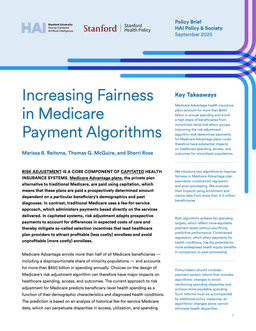
Increasing Fairness in Medicare Payment Algorithms

This brief introduces two algorithms that can promote fairer Medicare Advantage spending for minority populations.
This brief introduces two algorithms that can promote fairer Medicare Advantage spending for minority populations.

Practicing specific social skills with AI chatbots helps users build confidence and competence.
Practicing specific social skills with AI chatbots helps users build confidence and competence.

Current societal trends reflect an increased mistrust in science and a lowered civic engagement that threaten to impair research that is foundational for ensuring public health and advancing health equity. One effective countermeasure to these trends lies in community-facing citizen science applications to increase public participation in scientific research, making this field an important target for artificial intelligence (AI) exploration. We highlight potentially promising citizen science AI applications that extend beyond individual use to the community level, including conversational large language models, text-to-image generative AI tools, descriptive analytics for analyzing integrated macro- and micro-level data, and predictive analytics. The novel adaptations of AI technologies for community-engaged participatory research also bring an array of potential risks. We highlight possible negative externalities and mitigations for some of the potential ethical and societal challenges in this field.
Current societal trends reflect an increased mistrust in science and a lowered civic engagement that threaten to impair research that is foundational for ensuring public health and advancing health equity. One effective countermeasure to these trends lies in community-facing citizen science applications to increase public participation in scientific research, making this field an important target for artificial intelligence (AI) exploration. We highlight potentially promising citizen science AI applications that extend beyond individual use to the community level, including conversational large language models, text-to-image generative AI tools, descriptive analytics for analyzing integrated macro- and micro-level data, and predictive analytics. The novel adaptations of AI technologies for community-engaged participatory research also bring an array of potential risks. We highlight possible negative externalities and mitigations for some of the potential ethical and societal challenges in this field.
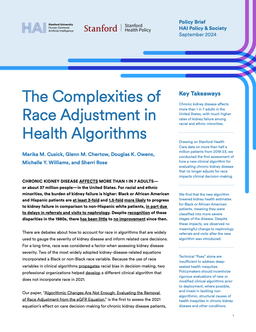
The Complexities of Race Adjustment in Health Algorithms

This policy brief explores the complexities of accounting for race in clinical algorithms for evaluating kidney disease and the implications for tackling deep-seated health inequities.
This policy brief explores the complexities of accounting for race in clinical algorithms for evaluating kidney disease and the implications for tackling deep-seated health inequities.

In a world where chatbots can stand in for friends, counselors, and even lovers, the mental health risks are a growing concern.
In a world where chatbots can stand in for friends, counselors, and even lovers, the mental health risks are a growing concern.