All Work Published on Healthcare
Conditional Generative Models for Synthetic Tabular Data: Applications for Precision Medicine and Diverse Representations
Tabular medical datasets, like electronic health records (EHRs), biobanks, and structured clinical trial data, are rich sources of information with the potential to advance precision medicine and optimize patient care. However, real-world medical datasets have limited patient diversity and cannot simulate hypothetical outcomes, both of which are necessary for equitable and effective medical research. Fueled by recent advancements in machine learning, generative models offer a promising solution to these data limitations by generating enhanced synthetic data. This review highlights the potential of conditional generative models (CGMs) to create patient-specific synthetic data for a variety of precision medicine applications. We survey CGM approaches that tackle two medical applications: correcting for data representation biases and simulating digital health twins. We additionally explore how the surveyed methods handle modeling tabular medical data and briefly discuss evaluation criteria. Finally, we summarize the technical, medical, and ethical challenges that must be addressed before CGMs can be effectively and safely deployed in the medical field.
Tabular medical datasets, like electronic health records (EHRs), biobanks, and structured clinical trial data, are rich sources of information with the potential to advance precision medicine and optimize patient care. However, real-world medical datasets have limited patient diversity and cannot simulate hypothetical outcomes, both of which are necessary for equitable and effective medical research. Fueled by recent advancements in machine learning, generative models offer a promising solution to these data limitations by generating enhanced synthetic data. This review highlights the potential of conditional generative models (CGMs) to create patient-specific synthetic data for a variety of precision medicine applications. We survey CGM approaches that tackle two medical applications: correcting for data representation biases and simulating digital health twins. We additionally explore how the surveyed methods handle modeling tabular medical data and briefly discuss evaluation criteria. Finally, we summarize the technical, medical, and ethical challenges that must be addressed before CGMs can be effectively and safely deployed in the medical field.
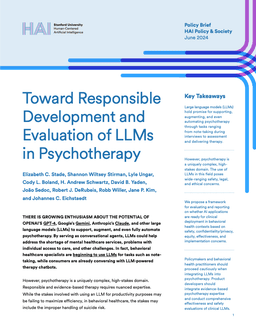
This brief reviews the current landscape of LLMs developed for psychotherapy and proposes a framework for evaluating the readiness of these AI tools for clinical deployment.
This brief reviews the current landscape of LLMs developed for psychotherapy and proposes a framework for evaluating the readiness of these AI tools for clinical deployment.
"The 2026 Stanford AI Index Report, released this month, highlights a sharp increase in AI adoption in medicine. It notes a significant rise in AI uses for clinical documentation, medical imaging, and diagnostic reasoning. That growth may improve efficiency. But it also expands the attack surface for public health if mis-deployed."
"The 2026 Stanford AI Index Report, released this month, highlights a sharp increase in AI adoption in medicine. It notes a significant rise in AI uses for clinical documentation, medical imaging, and diagnostic reasoning. That growth may improve efficiency. But it also expands the attack surface for public health if mis-deployed."
Few young people with type 1 diabetes (T1D) meet glucose targets. Continuous glucose monitoring improves glycemia, but access is not equitable. We prospectively assessed the impact of a systematic and equitable digital-health-team-based care program implementing tighter glucose targets (HbA1c < 7%), early technology use (continuous glucose monitoring starts <1 month after diagnosis) and remote patient monitoring on glycemia in young people with newly diagnosed T1D enrolled in the Teamwork, Targets, Technology, and Tight Control (4T Study 1). Primary outcome was HbA1c change from 4 to 12 months after diagnosis; the secondary outcome was achieving the HbA1c targets. The 4T Study 1 cohort (36.8% Hispanic and 35.3% publicly insured) had a mean HbA1c of 6.58%, 64% with HbA1c < 7% and mean time in the range (70-180 mg dl-1) of 68% at 1 year after diagnosis. Clinical implementation of the 4T Study 1 met the prespecified primary outcome and improved glycemia without unexpected serious adverse events. The strategies in the 4T Study 1 can be used to implement systematic and equitable care for individuals with T1D and translate to care for other chronic diseases.
Few young people with type 1 diabetes (T1D) meet glucose targets. Continuous glucose monitoring improves glycemia, but access is not equitable. We prospectively assessed the impact of a systematic and equitable digital-health-team-based care program implementing tighter glucose targets (HbA1c < 7%), early technology use (continuous glucose monitoring starts <1 month after diagnosis) and remote patient monitoring on glycemia in young people with newly diagnosed T1D enrolled in the Teamwork, Targets, Technology, and Tight Control (4T Study 1). Primary outcome was HbA1c change from 4 to 12 months after diagnosis; the secondary outcome was achieving the HbA1c targets. The 4T Study 1 cohort (36.8% Hispanic and 35.3% publicly insured) had a mean HbA1c of 6.58%, 64% with HbA1c < 7% and mean time in the range (70-180 mg dl-1) of 68% at 1 year after diagnosis. Clinical implementation of the 4T Study 1 met the prespecified primary outcome and improved glycemia without unexpected serious adverse events. The strategies in the 4T Study 1 can be used to implement systematic and equitable care for individuals with T1D and translate to care for other chronic diseases.
Michelle M. Mello's Testimony Before the U.S. Senate Committee on Finance

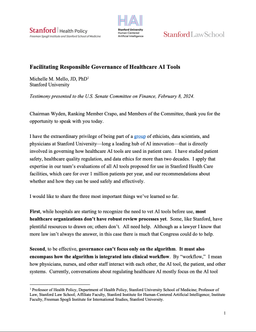
In this testimony presented to the U.S. Senate Committee on Finance, Michelle M. Mello provides recommendations on how Congress can support healthcare organizations and health insurers navigating the uncharted territory of AI tools by imposing some guardrails while allowing the rules to evolve with the technology.
In this testimony presented to the U.S. Senate Committee on Finance, Michelle M. Mello provides recommendations on how Congress can support healthcare organizations and health insurers navigating the uncharted territory of AI tools by imposing some guardrails while allowing the rules to evolve with the technology.

The annual report reveals a field hitting breakthrough capabilities while raising urgent questions about environmental costs, transparency, and who benefits from the technology.
The annual report reveals a field hitting breakthrough capabilities while raising urgent questions about environmental costs, transparency, and who benefits from the technology.