The 2026 AI Index Report | Stanford HAI
Stanford
University
  • Stanford Home
  • Maps & Directions
  • Search Stanford
  • Emergency Info
  • Terms of Use
  • Privacy
  • Copyright
  • Trademarks
  • Non-Discrimination
  • Accessibility
© Stanford University.  Stanford, California 94305.
Skip to content
  • About

    • About
    • People
    • Get Involved with HAI
    • Support HAI
    • Subscribe to Email
  • Research

    • Research
    • Fellowship Programs
    • Grants
    • Student Affinity Groups
    • Centers & Labs
    • Research Publications
    • Research Partners
  • Education

    • Education
    • Executive and Professional Education
    • Government and Policymakers
    • K-12
    • Stanford Students
  • Policy

    • Policy
    • Policy Publications
    • Policymaker Education
    • Student Opportunities
  • AI Index

    • AI Index
    • AI Index Report
    • Global Vibrancy Tool
    • People
  • News
  • Events
  • Industry
  • Centers & Labs
Navigate
  • About
  • Events
  • AI Glossary
  • Careers
  • Search
Participate
  • Get Involved
  • Support HAI
  • Contact Us

Stay Up To Date

Get the latest news, advances in research, policy work, and education program updates from HAI in your inbox weekly.

Sign Up For Latest News

Your browser does not support the video tag.

The 2026 AI Index Report

Read the 2026 AI Index Report

See Chapters by Topic

Top Takeaways

Chapter Lineup


Read the full report: 2026 AI Index Report

Measuring Trends in Intelligence

The AI Index report tracks, collates, distills, and visualizes data related to artificial intelligence (AI). Our mission is to provide unbiased, rigorously vetted, broadly sourced data in order for policymakers, researchers, executives, journalists, and the general public to develop a more thorough and nuanced understanding of the complex field of AI.

Access the Public Data

Support the AI Index

Past Reports

The 2025 AI Index Report

At Stanford HAI, we believe AI is poised to be the most transformative technology of the 21st century. But its benefits won’t be evenly distributed unless we guide its development thoughtfully.

The 2024 AI Index Report

Welcome to the seventh edition of the AI Index report. The 2024 Index is our most comprehensive to date and arrives at an important moment when AI’s influence on society has never been more pronounced.

The 2023 AI Index Report

The AI Index is an independent initiative at the Stanford Institute for Human-Centered Artificial Intelligence (HAI), led by the AI Index Steering Committee, an interdisciplinary group of experts from across academia and industry.

The 2022 AI Index Report

The AI Index is an independent initiative at the Stanford Institute for Human-Centered Artificial Intelligence (HAI), led by the AI Index Steering Committee, an interdisciplinary group of experts from across academia and industry.

The 2021 AI Index Report

This year we significantly expanded the amount of data available in the report, worked with a broader set of external organizations to calibrate our data, and deepened our connections with Stanford HAI.

artificial intelligence index 2019 Annual Report Cover art

The 2019 AI Index Report

The AI Index Report tracks, collates, distills, and visualizes data relating to artificial intelligence.

Its mission is to provide unbiased, rigorous, and comprehensive data for policymakers, researchers, journalists, executives, and the general public to develop a deeper understanding of the complex field of AI.

The 2018 AI Index Report

Artificial Intelligence has leapt to the forefront of global discourse, garnering increased attention from practitioners, industry leaders, policymakers, and the general public. The diversity of opinions and debates gathered from news articles this year illustrates just how broadly AI is being investigated, studied, and applied. However, the field of AI is still evolving rapidly and even experts have a hard time understanding and tracking progress across the field.

The 2017 AI Index Report

Artificial Intelligence has leapt to the forefront of global discourse, garnering increased attention from practitioners, industry leaders, policymakers, and the general public. The diversity of opinions and debates gathered from news articles this year illustrates just how broadly AI is being investigated, studied, and applied. However, the field of AI is still evolving rapidly and even experts have a hard time understanding and tracking progress across the field.
AI’s influence on society has never been more pronounced.

At Stanford HAI, we believe AI is poised to be the most transformative technology of the 21st century. But its benefits won’t be evenly distributed unless we guide its development thoughtfully. The AI Index offers one of the most comprehensive, data-driven views of artificial intelligence. Recognized as a trusted resource by global media, governments, and leading companies, the AI Index equips policymakers, business leaders, and the public with rigorous, objective insights into AI’s technical progress, economic influence, and societal impact.

Download the report

1. AI capability is not plateauing. It is accelerating and reaching more people than ever.

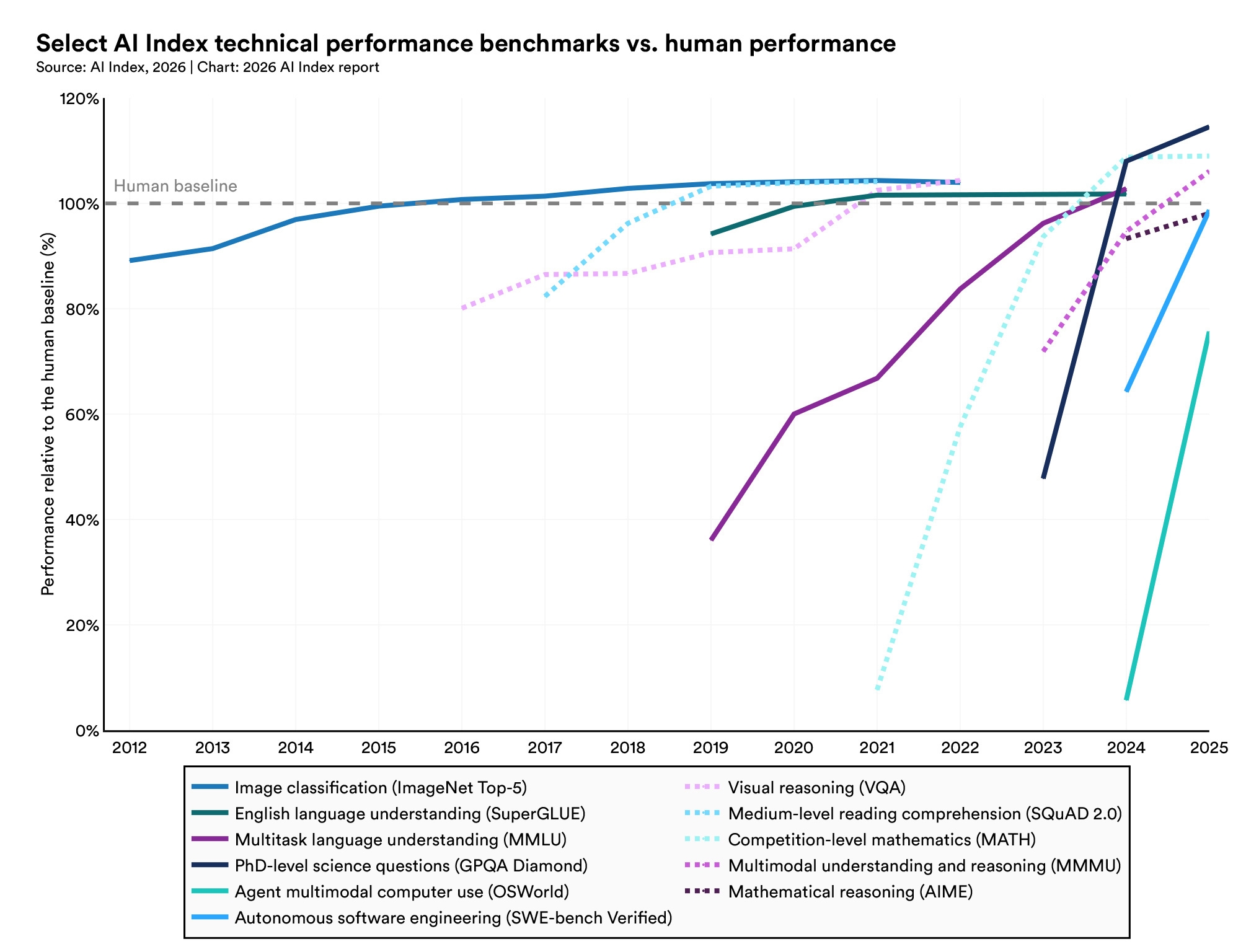
Industry produced over 90% of notable frontier models in 2025, and several of those models now meet or exceed human baselines on PhD-level science questions, multimodal reasoning, and competition mathematics. On a key coding benchmark—SWE-bench Verified—performance rose from 60% to near 100% in a single year. Organizational adoption reached 88%, and 4 in 5 university students now use generative AI.

See: Chapter 2: Technical Performance

2. The U.S.-China AI model performance gap has effectively closed.

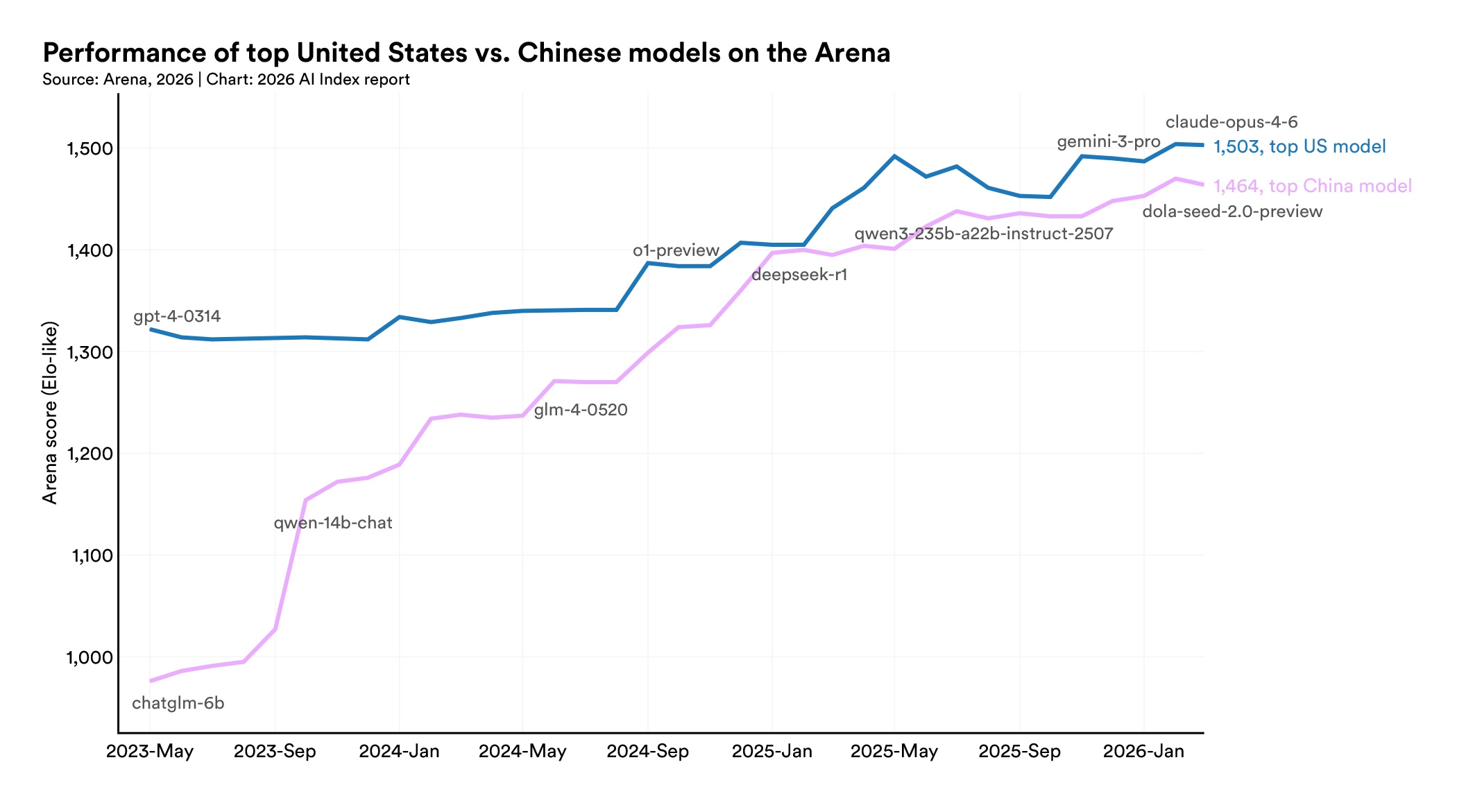
U.S. and Chinese models have traded the lead multiple times since early 2025. In February 2025, DeepSeek-R1 briefly matched the top U.S. model, and as of March 2026 Anthropic’s top model leads by just 2.7%. The U.S. still produces more top-tier AI models and higher-impact patents, while China leads in publication volume, citations, patent output, and industrial robot installations. South Korea stands out for its innovation density, leading the world in AI patents per capita.

See: Chapter 2: Technical Performance

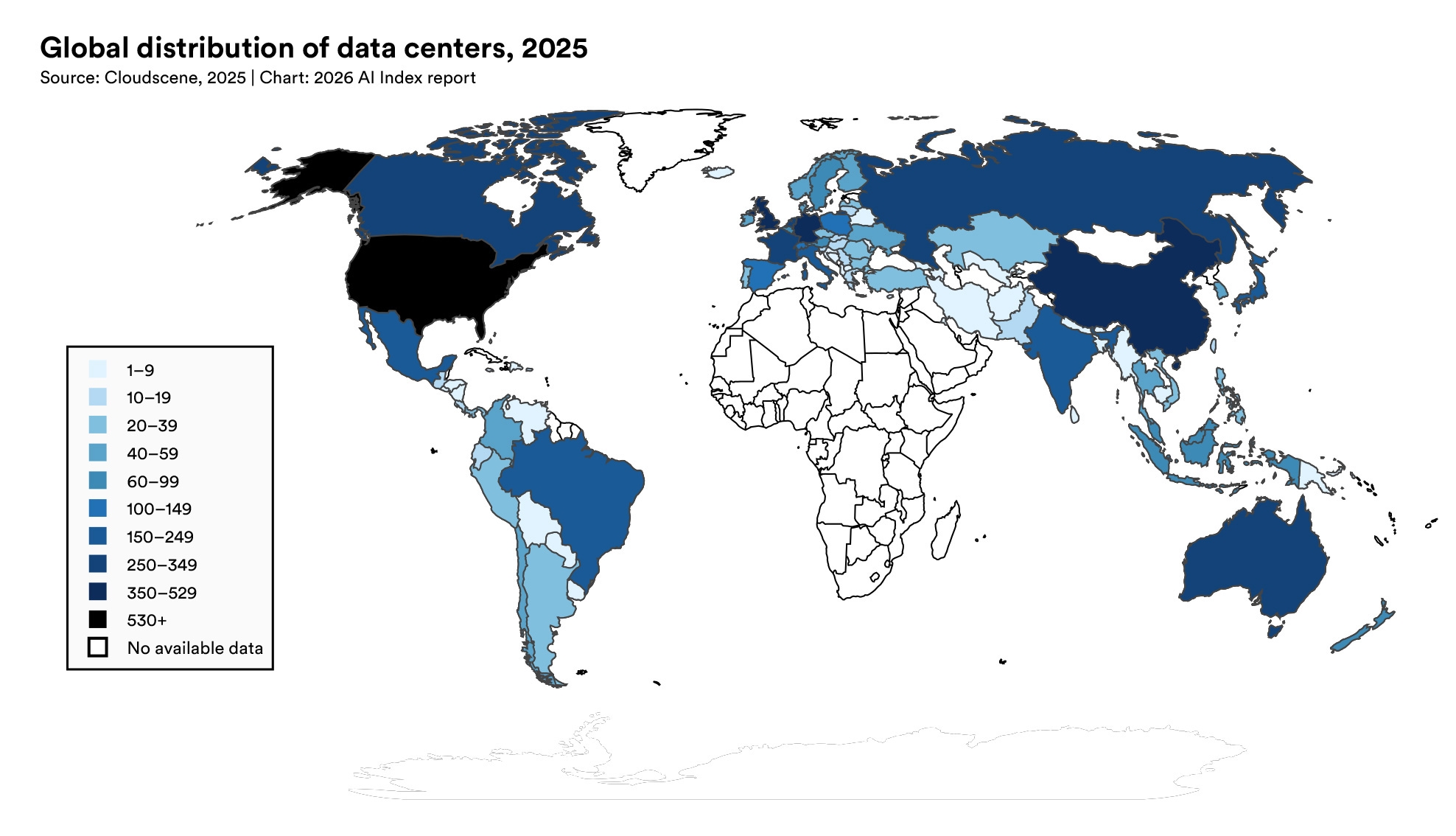
3. The United States hosts the most AI data centers, with the majority of their chips fabricated by one Taiwanese foundry.

The United States hosts 5,427 data centers, more than 10 times any other country, and it consumes more energy than any other country. A single company, TSMC, fabricates almost every leading AI chip, making the global AI hardware supply chain dependent on one foundry in Taiwan—though a TSMC-U.S. expansion began operations in 2025.

See: Chapter 1: Research and Development

4. AI models can win a gold medal at the International Mathematical Olympiad but cannot reliably tell time—an example of what researchers call the jagged frontier of AI.

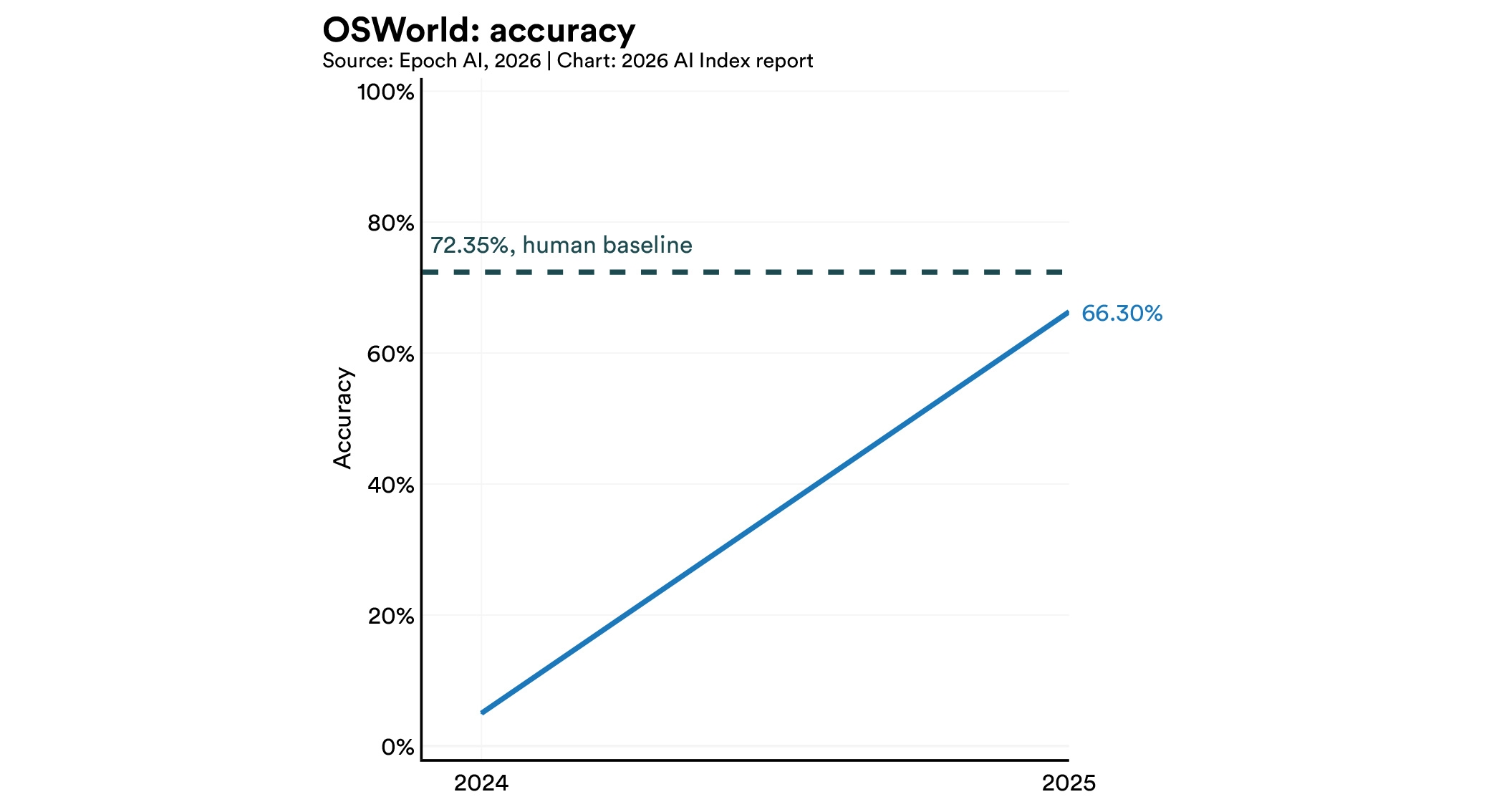
Gemini Deep Think earned a gold medal at IMO, yet the top model reads analog clocks correctly just 50.1% of the time. AI agents made a leap from 12% to ~66% task success on OSWorld, which tests agents on real computer tasks across operating systems, though they still fail roughly 1 in 3 attempts on structured benchmarks.

See: Chapter 2: Technical Performance

5. Responsible AI is not keeping pace with AI capability, with safety benchmarks lagging and incidents rising sharply.

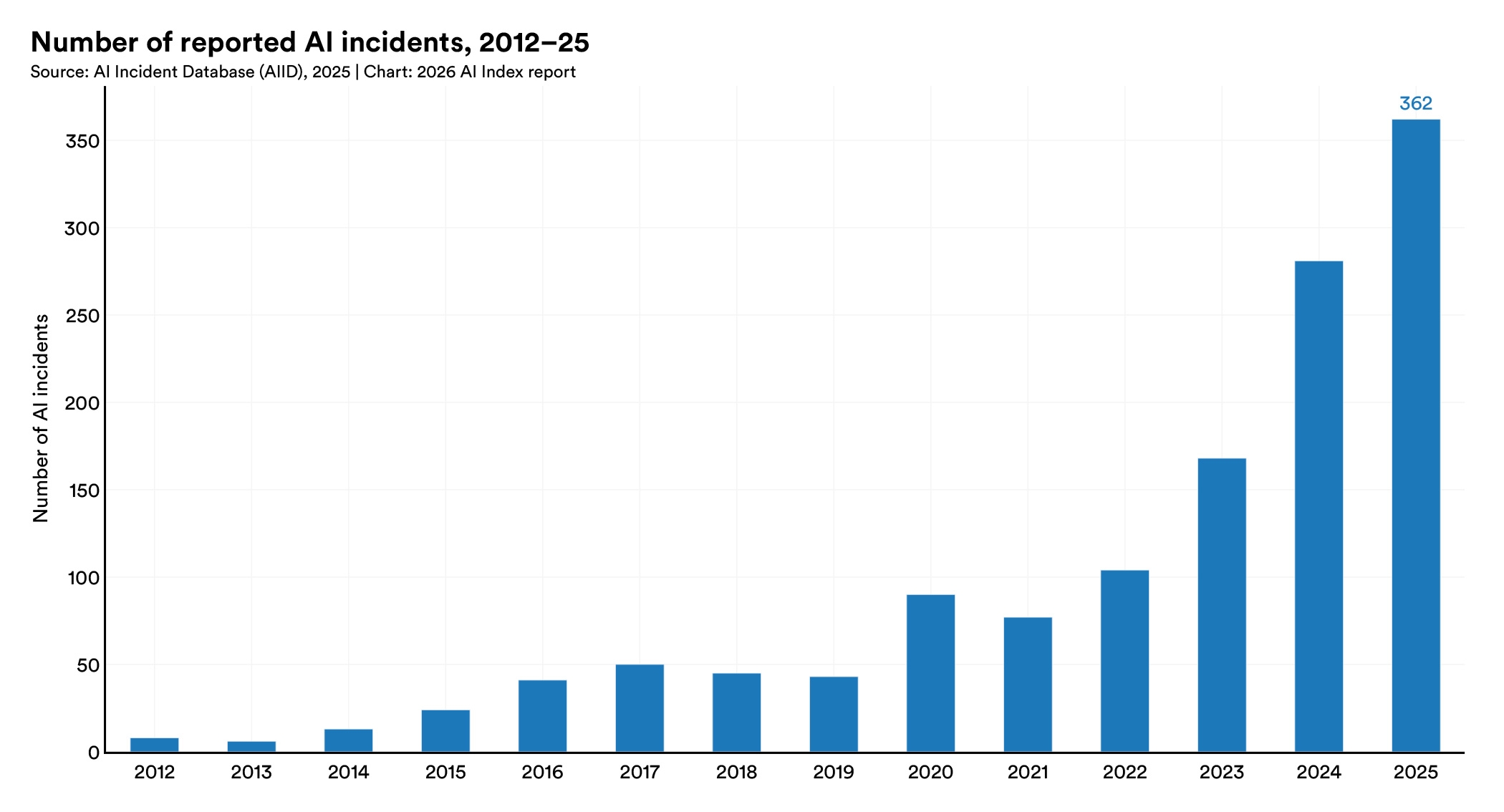
Almost all leading frontier AI model developers report results on capability benchmarks, but reporting on responsible AI benchmarks remains spotty. Documented AI incidents rose to 362, up from 233 in 2024. Adding to the challenge, recent research found that improving one responsible AI dimension, such as safety, can degrade another, such as accuracy.

See Chapter 3: Responsible AI

6. The United States leads in AI investment, but its ability to attract global talent is declining.

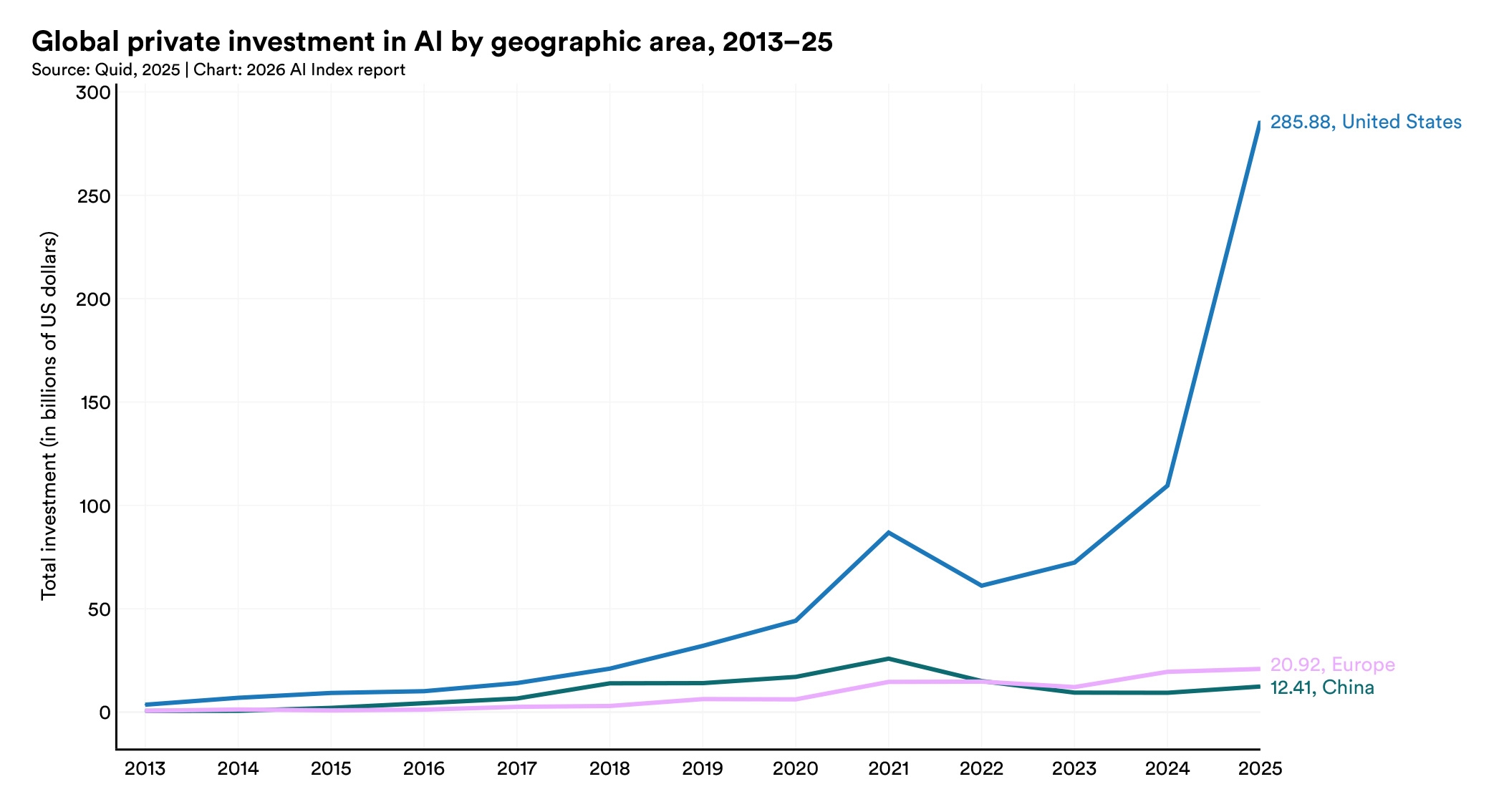
U.S. private AI investment reached $285.9 billion in 2025, more than 23 times the $12.4 billion invested in China—though looking at just private investment figures likely understates China’s total AI spending, given its government guidance funds. The U.S. also led in entrepreneurial activity with 1,953 newly funded AI companies in 2025, more than 10 times the next closest country. However, the number of AI researchers and developers moving to the U.S. has dropped 89% since 2017, with an 80% decline in the last year alone.

See Chapter 4: Economy

7. AI adoption is spreading at historic speed, and consumers are deriving substantial value from tools they often access for free.

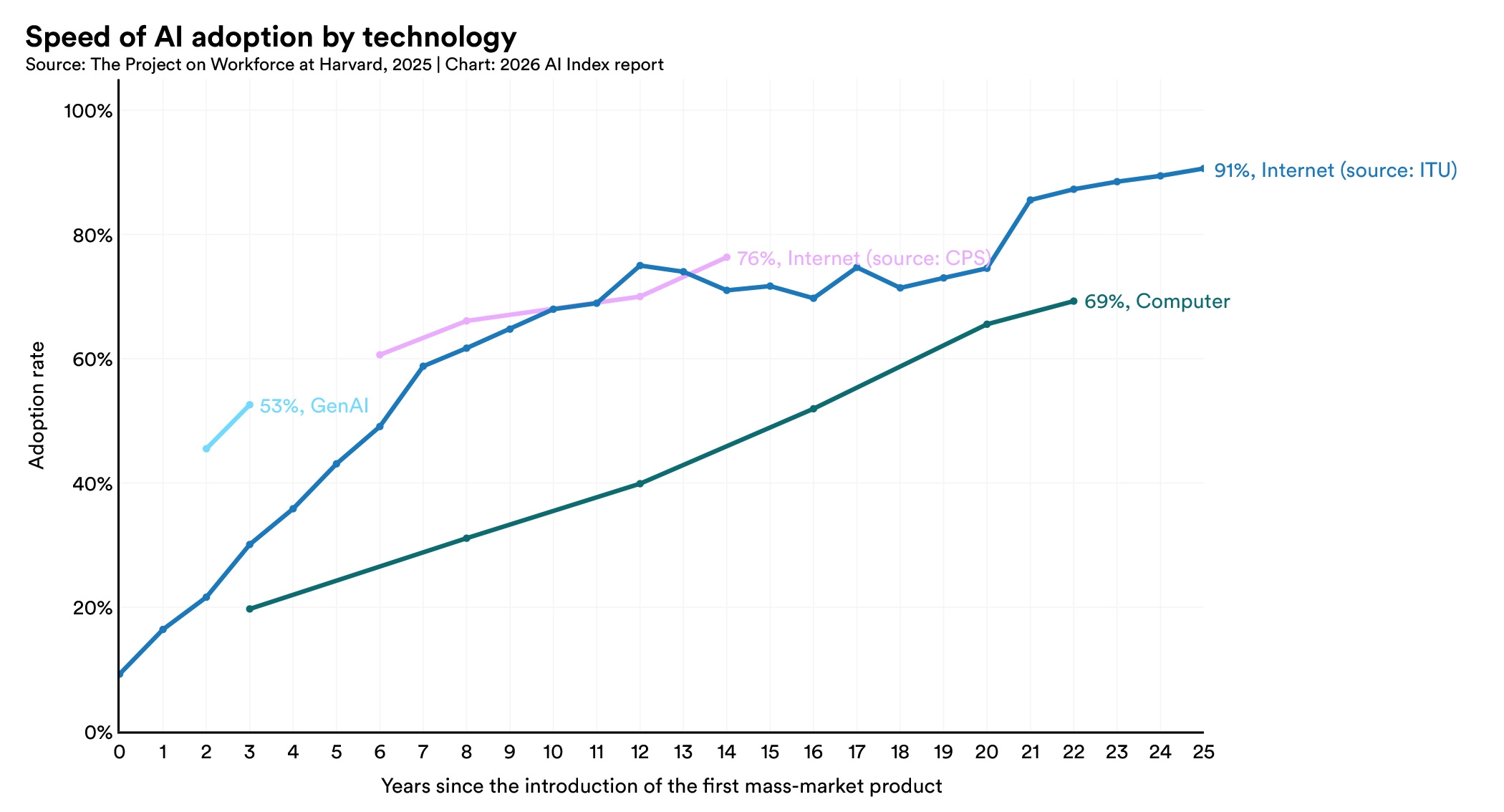
Generative AI reached 53% population adoption within three years, faster than the PC or the internet, though the pace varies by country and correlates strongly with GDP per capita. Some show higher-than-expected adoption, such as Singapore (61%) and the United Arab Emirates (54%), while the U.S. ranks 24th at 28.3%. The estimated value of generative AI tools to U.S. consumers reached $172 billion annually by early 2026, with the median value per user tripling between 2025 and 2026.

See Chapter 4: Economy

8. Formal education is lagging behind AI, but people are learning AI skills at every stage of life.

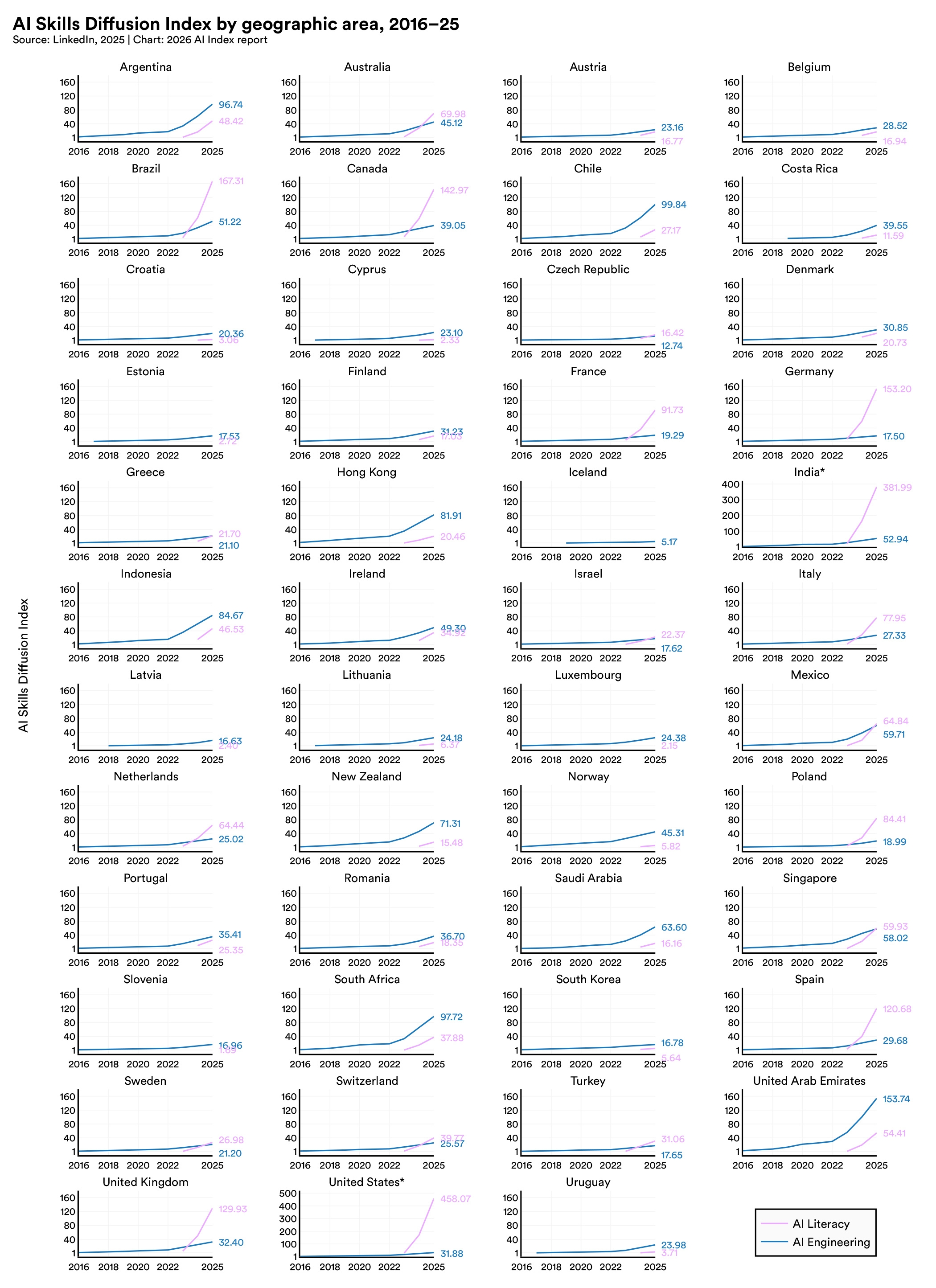
Over 80% of U.S. high school and college students now use AI for school-related tasks, but only half of middle and high schools have AI policies in place, and just 6% of teachers say those policies are clear. Outside the classroom, AI engineering skills are accelerating fastest in the United Arab Emirates, Chile, and South Africa. The number of new AI PhDs in the U.S. and Canada increased 22% from 2022 to 2024, the PhDs that make up that increase took jobs in academia, not in industry.

See Chapter 7: Education

9. AI sovereignty is becoming a defining feature of national policy, but capabilities remain uneven, even as open-source development helps to redistribute who participates.

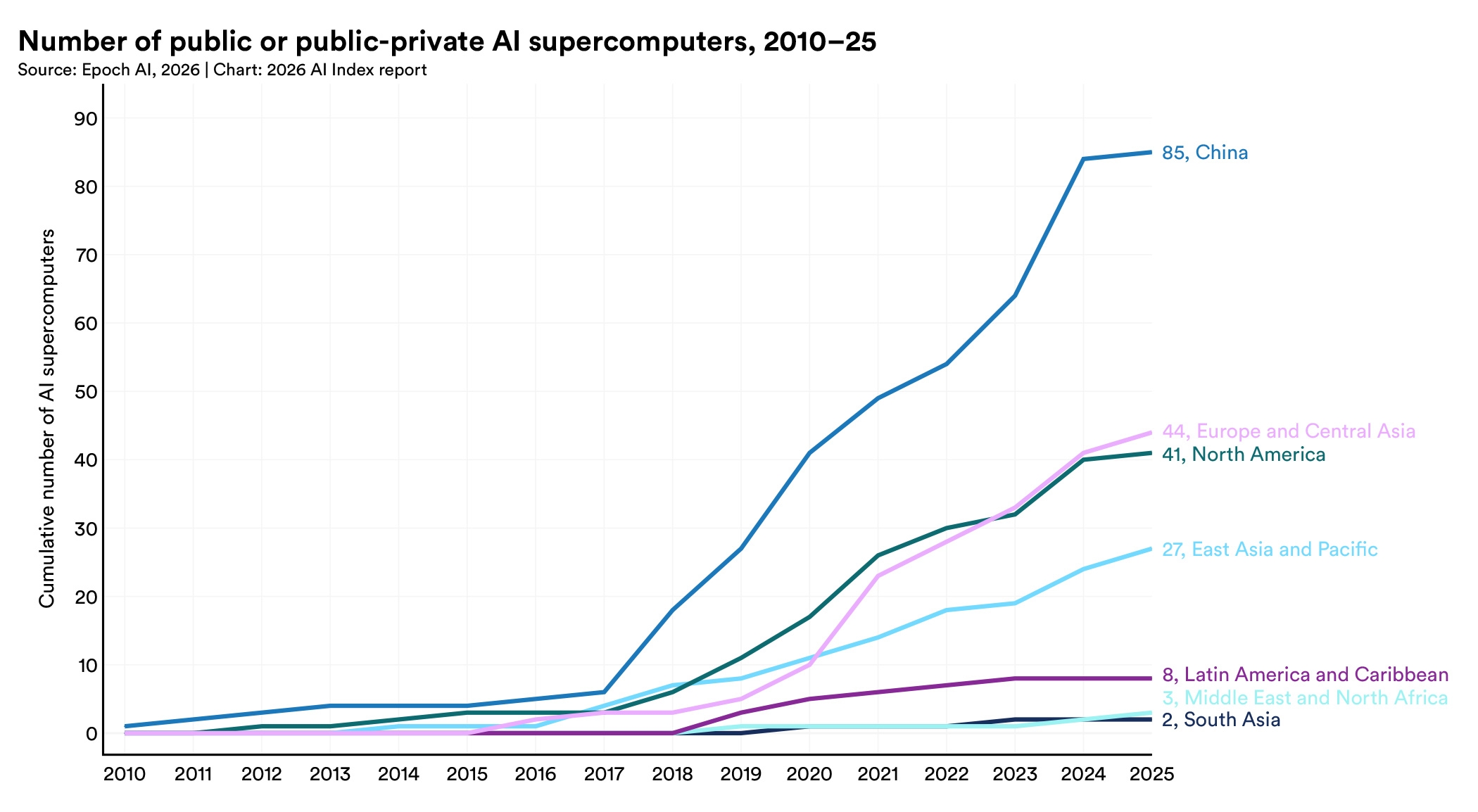
National AI strategies are expanding, particularly among developing economies, and state-backed investments in AI supercomputing are rising in parallel—a sign of growing ambitions for domestic control over AI ecosystems. Yet model production remains concentrated in the U.S. and China. Open-source development is starting to redistribute participation, with contributions from the rest of the world now outpacing Europe and approaching the United States on GitHub, fueling more linguistically diverse models and benchmarks.

See Chapter 8: Policy and Governance

10. AI experts and the public have very different perspectives on the technology’s future, and global trust in institutions to manage AI is fragmented.

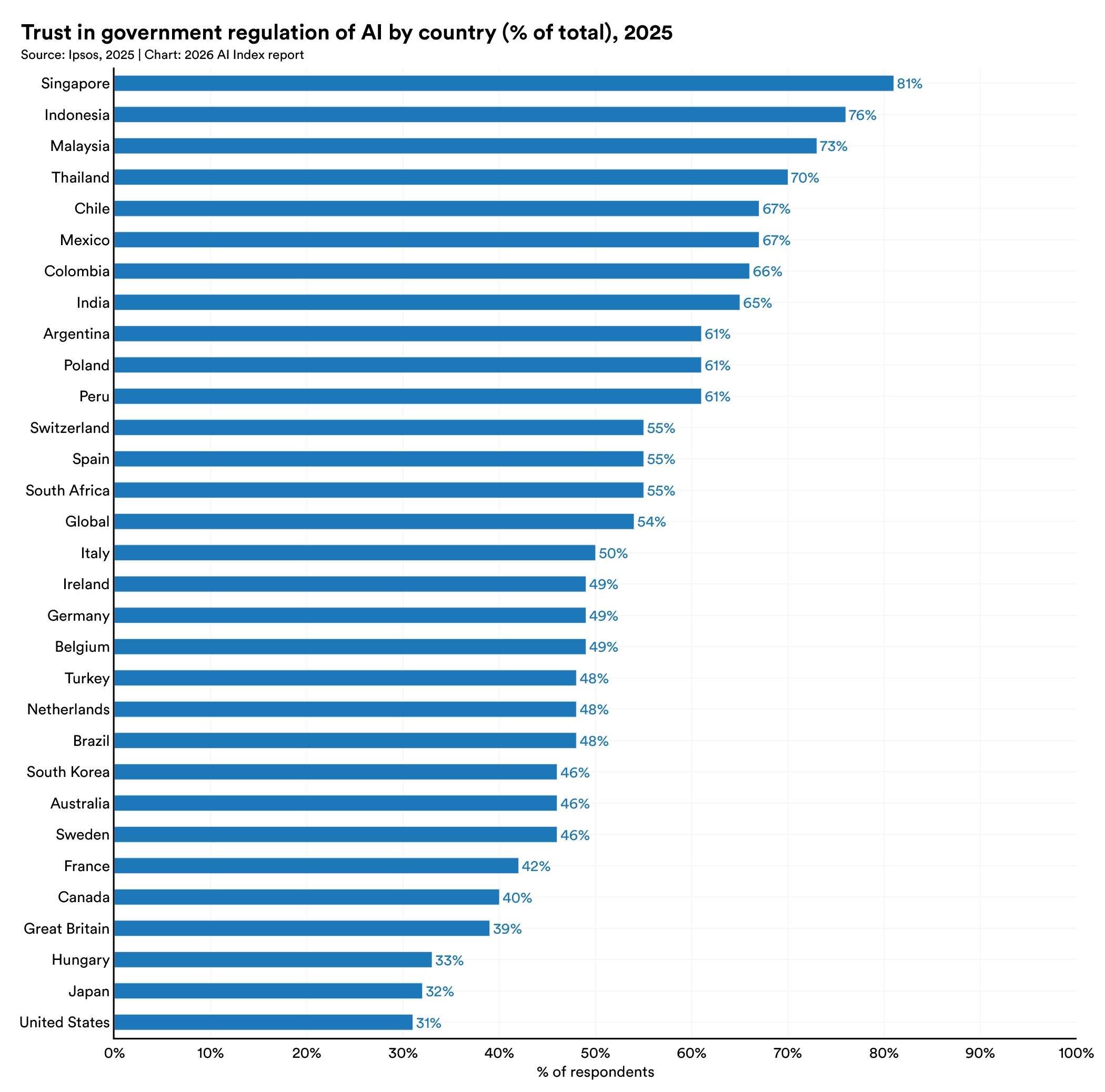
When it comes to how people do their jobs, 73% of experts expect a positive impact, compared with just 23% of the public, a 50-point gap. Similar divides appear for AI's impact on the economy and medical care. Globally, trust in governments to regulate AI varies. Among surveyed countries, the United States reported the lowest level of trust in its own government to regulate AI, at 31%. Globally, the EU is trusted more than the United States or China to regulate AI effectively.

See Chapter 9: Public Opinion

This chapter tracks AI research and development, covering the models and open-source ecosystems driving progress, the infrastructure and environmental footprint supporting it, and the publications, patents and investors shaping the field.

Read Chapter 1

A comprehensive overview of AI performance in 2025, spanning image, video, language, speech, reasoning, robotics, and agentic systems.

Read Chapter 2

This chapter examines responsible AI across the dimensions of safety, fairness, transparency, and governance, and the measurement gaps that persist.

Reach Chapter 3

This chapter analyzes the economic footprint  of AI across the private sector and its implications for labor markets, productivity, and the future of work.

Read Chapter 4

This chapter is a new addition in this year’s AI Index report, and looks into AI’s expanding role across scientific domains, such as Biology, Chemistry, Physics and Astronomy.

Read Chapter 5

An overview on AI advancements in medicine, including scientific discovery, clinical applications, patient engagement, and ethical considerations. 

Read Chapter 6

This chapter assesses how AI is reshaping education systems and what it means  for teaching, learning, and career readiness. 

Read Chapter 7

This chapter surveys the global policy landscape, highlighting policymaking and public investment in AI, and the rising  emphasis on AI sovereignty.

Read Chapter 8

Drawing on global survey data, this chapter captures public sentiment toward AI, from  trust levels, transparency, and regulation to employment and personal relationships.

Read Chapter 9

Support the AI Index in our mission to provide comprehensive, unbiased data on artificial intelligence worldwide. Your support sustains rigorous research, data collection, and analysis that informs policymakers, researchers, journalists, and business leaders—ensuring transparent AI metrics guide humanity toward a better future.

Make a Gift to AI Index