The 2026 US Talent Report: Benchmarking America’s STEM Pipeline Amid the Great Talent Competition
This report assesses America's ability to develop, attract, and retain STEM talent and warns that its advantages over China are narrowing rapidly.
In collaboration with

Read Paper
Executive Summary
The United States-China technology competition is usually measured in chips, data centers, satellites, supply chains, and weapons. But every technological breakthrough depends on a key input that is harder to develop, stockpile, or replace: people. Scientists, engineers, researchers, and founders determine which ideas become discoveries, which discoveries become products, and which countries lead. Yet national talent in STEM fields (Science, Technology, Engineering, and Mathematics) remains one of the most important—and least systematically measured—dimensions of the competition.
America’s STEM talent advantage has never rested on a single asset. It is a system: schools that develop talent at home, universities that attract it from abroad, laboratories and companies that put it to work, and immigration pathways that determine whether it stays and flourishes. Most assessments examine these pieces separately.
This report measures them together. It assembles decades of data from dozens of federal surveys, international databases, research rankings, publication and patent records, visa filings, and company histories. It analyzes evidence covering hundreds of thousands of students, graduates, researchers, workers, and founders across fields, countries, institutions, and stages of the talent pipeline. No dataset captures the whole picture, and important measurement gaps remain. But taken together, this evidence provides the most comprehensive assessment to date of how America develops, attracts, deploys, and retains the STEM talent that powers its economic and national security. The data reveal a powerful system whose advantages remain substantial—but whose vulnerabilities are becoming harder to ignore.
Key Findings
America’s STEM education system has grown dramatically, but its advanced levels have become heavily dependent on international students. International students earn more than half of STEM master’s degrees and more than a third of STEM research doctorates, with still higher shares in computer science, engineering, and mathematics. Only at the bachelor’s level is the share of international students in the single digits across most fields.
That international pipeline is increasingly concentrated by country and field. India and China together now supply 61 percent of all international graduate students, while South Korea, the third-largest source, accounts for just 3 percent. The concentration produces intellectual and financial benefits, but it also creates exposure to changes in a small number of countries and US visa policies. India now sends more students to study in the United States than any other country (surpassing China in 2023).
International talent powers American research and industry after graduation. International graduates constitute majorities of postdoctoral researchers in several STEM fields, work in STEM at higher rates than US-born graduates with comparable degrees, and have founded or co-founded a large share of the country’s leading AI firms.
America’s home-grown STEM talent system spends heavily but develops too little of its potential. The United States ranks 34th in the world in mathematics, behind not only the East Asian systems that lead across all subjects, but also Slovenia, Poland, and Vietnam. This is despite per-pupil spending 48 percent above the OECD average. And, of the students who enter college intending to major in STEM, only about four in ten finish a STEM degree.
America’s research magnet remains formidable, but its relative advantage is narrowing rapidly. In the past ten years, the US share of top-cited emerging technology publications has fallen from 14.2 percent to 8.4 percent, while China’s share has risen from 11.5 percent to 20.8 percent. China is quickly surpassing the United States in contributions to several leading artificial intelligence and machine learning conferences around the world. Chinese companies and researchers now file roughly three times as many computer technology patents as the United States and twice as many in biotechnology and in semiconductors.
International graduates increasingly want to stay, but retention falls short of intention—and the immigration system still operates under rules built for another era. 75.8 percent of new international PhDs report plans to remain in the United States, but only 67.8 percent of STEM PhDs are still in the country after ten years. The United States should not retain every graduate, and national-security screening, labor protections, and program integrity remain essential. But the system rations permanent residence through per-country ceilings enacted in 1965, making birthplace—not talent or employer demand—a major determinant of wait time.
These findings reveal a compounding risk. Weak domestic preparation increases reliance on international recruitment. Narrowing research advantages make international recruitment more competitive. Immigration bottlenecks and outdated policies make retention less certain. The United States still possesses enormous advantages, but none can safely be treated as permanent.
Read Paper
Related Publications
The Commercial Landscape of AI Sovereignty Offerings
This brief surveys the commercial AI sovereignty market and argues that policymakers should focus on calibrating interdependence rather than pursuing full self-sufficiency.
This brief surveys the commercial AI sovereignty market and argues that policymakers should focus on calibrating interdependence rather than pursuing full self-sufficiency.
How Can AI Support Language Digitization and Digital Inclusion?
This white paper analyzes the varying ways AI tools can advance language digitization work, and provides recommendations for responsibly realizing the potential of AI in supporting the digital inclusion of digitally disadvantaged languages.
This white paper analyzes the varying ways AI tools can advance language digitization work, and provides recommendations for responsibly realizing the potential of AI in supporting the digital inclusion of digitally disadvantaged languages.
Beyond DeepSeek: China's Diverse Open-Weight AI Ecosystem and Its Policy Implications
Almost one year after the “DeepSeek moment,” this brief analyzes China’s diverse open-model ecosystem and examines the policy implications of their widespread global diffusion.
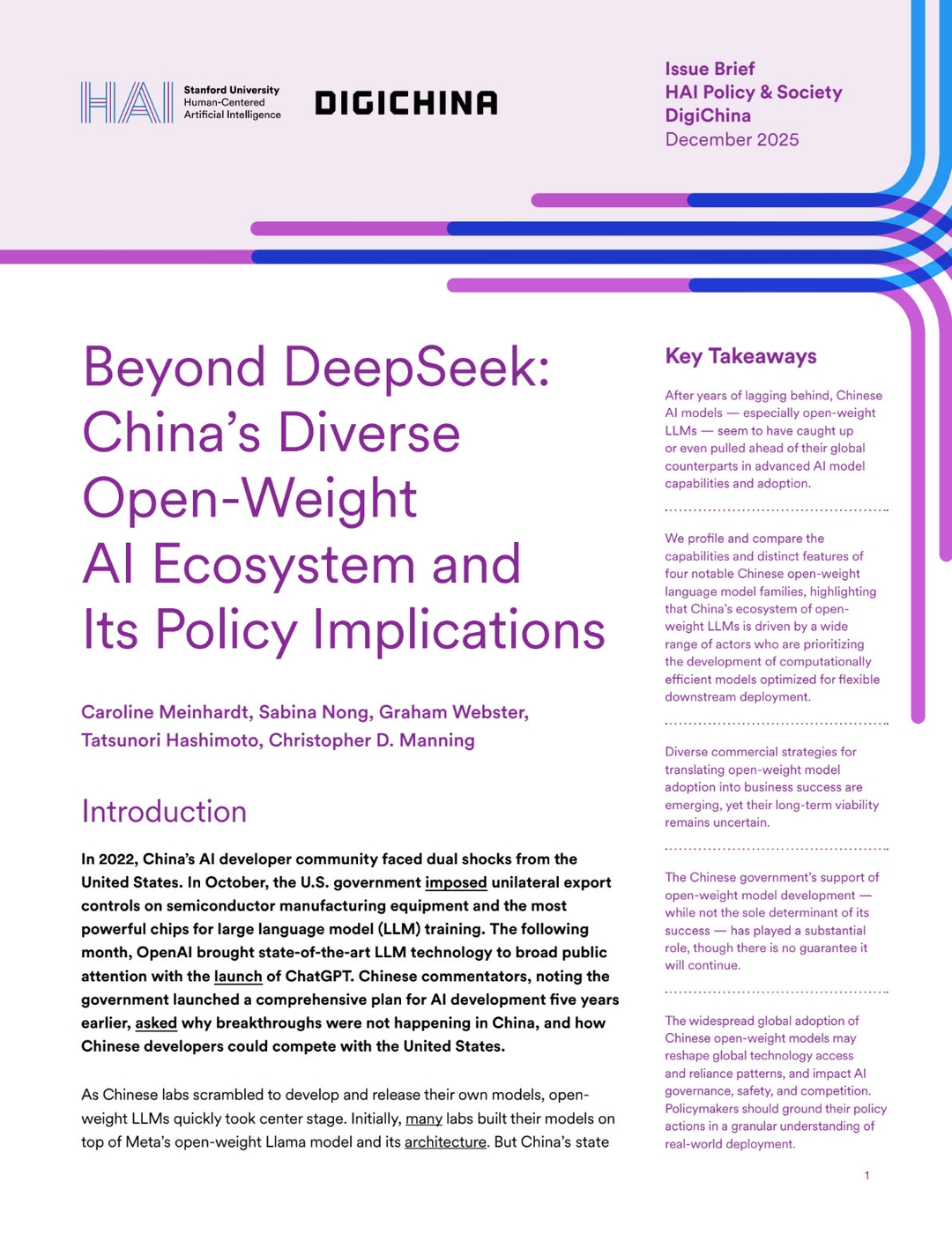
Almost one year after the “DeepSeek moment,” this brief analyzes China’s diverse open-model ecosystem and examines the policy implications of their widespread global diffusion.
Moving Beyond the Term "Global South" in AI Ethics and Policy
This brief examines the limitations of the term "Global South" in AI ethics and policy, and highlights the importance of grounding such work in specific regions and power structures.
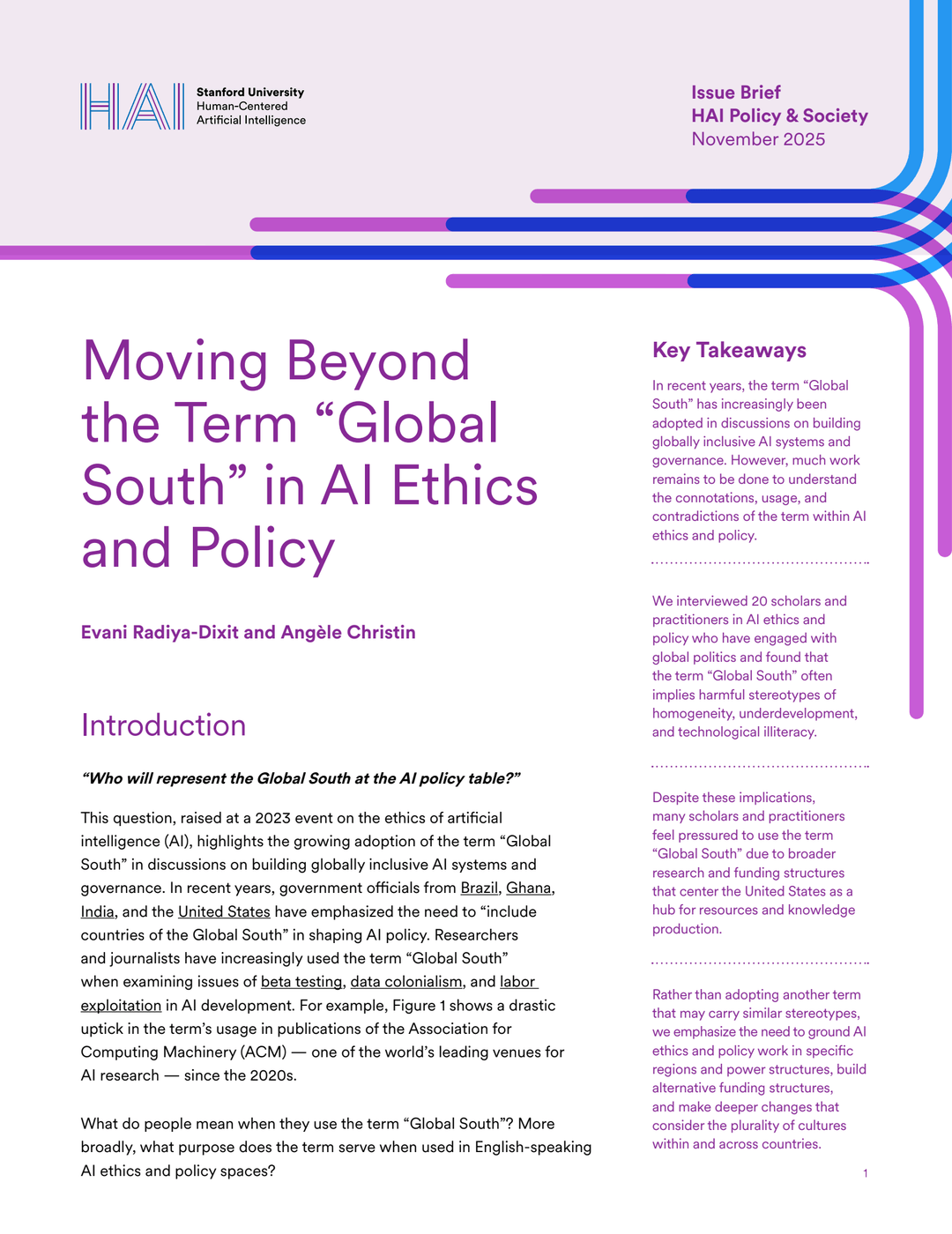
This brief examines the limitations of the term "Global South" in AI ethics and policy, and highlights the importance of grounding such work in specific regions and power structures.