The World Model and Spatial Intelligence Era: Governing AI Beyond Language
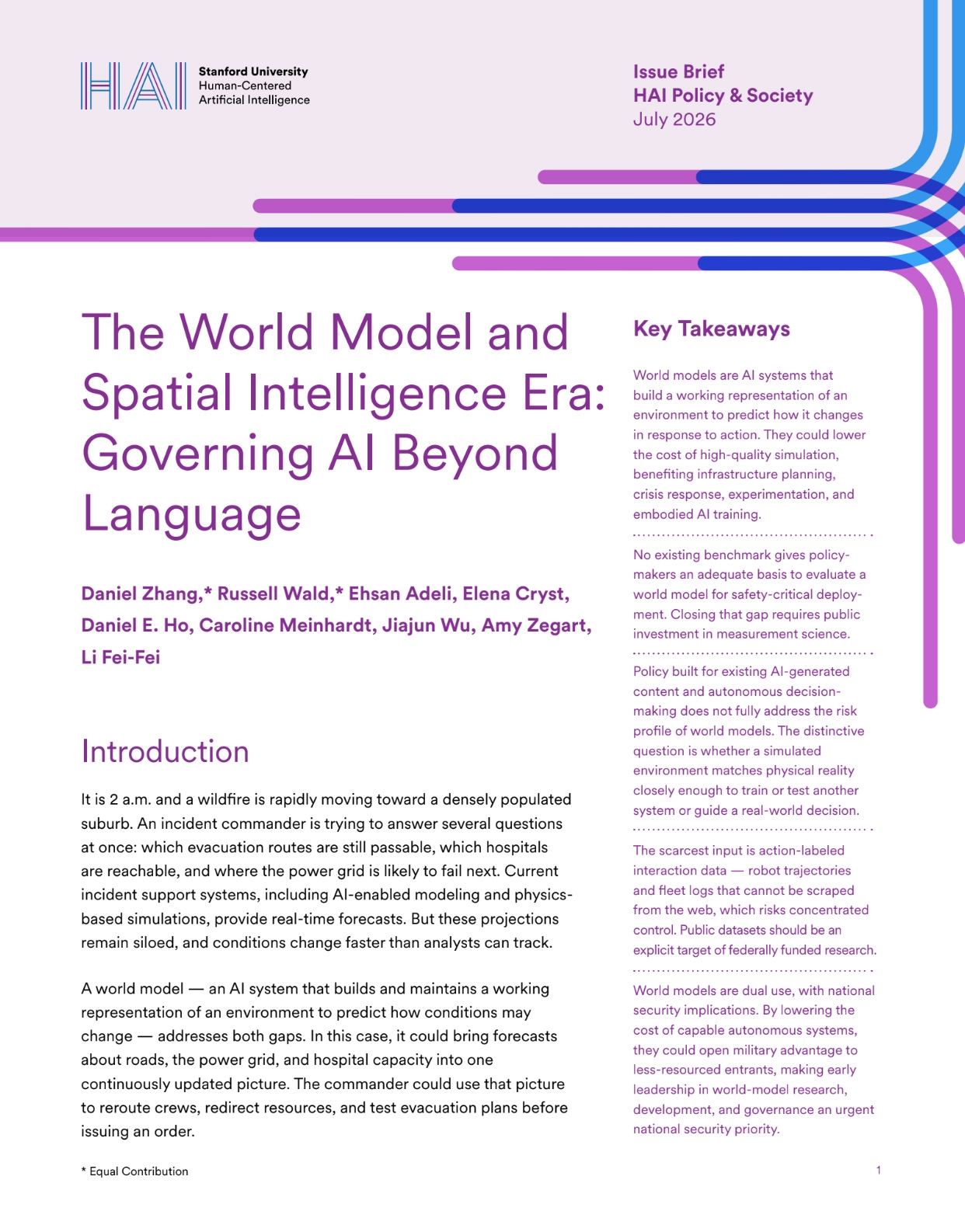
This brief highlights the emergence of world models and outlines a first-of-its-kind governance and policy agenda for the technology.
Key Takeaways
World models are AI systems that build a working representation of an environment to predict how it changes in response to action. They could lower the cost of high-quality simulation, benefiting infrastructure planning, crisis response, experimentation, and embodied AI training.
No existing benchmark gives policymakers an adequate basis to evaluate a world model for safety-critical deployment. Closing that gap requires public investment in measurement science.
Policy built for existing AI-generated content and autonomous decision-making does not fully address the risk profile of world models. The distinctive question is whether a simulated environment matches physical reality closely enough to train or test another system or guide a real-world decision.
The scarcest input is action-labeled interaction data — robot trajectories and fleet logs that cannot be scraped from the web, which risks concentrated control. Public datasets should be an explicit target of federally funded research.
World models are dual use, with national security implications. By lowering the cost of capable autonomous systems, they could open military advantage to less-resourced entrants, making early leadership in world-model research, development, and governance an urgent national security priority.
Introduction
It is 2 a.m. and a wildfire is rapidly moving toward a densely populated suburb. An incident commander is trying to answer several questions at once: which evacuation routes are still passable, which hospitals are reachable, and where the power grid is likely to fail next. Current incident support systems, including AI-enabled modeling and physics-based simulations, provide real-time forecasts. But these projections remain siloed, and conditions change faster than analysts can track.
A world model — an AI system that builds and maintains a working representation of an environment to predict how conditions may change — addresses both gaps. In this case, it could bring forecasts about roads, the power grid, and hospital capacity into one continuously updated picture. The commander could use that picture to reroute crews, redirect resources, and test evacuation plans before issuing an order.
The emergence of world models points to a broader shift in AI. The systems that define the current era operate primarily through language. Multimodal systems expand that capability to images, audio, and video, but most still cannot track a coherent environment over time. World models, by contrast, aim to maintain a coherent representation of an environment over time and predict how it may change in response to action. That capacity — to understand a physical environment and use that information to guide action — is spatial intelligence. World models are one technical pathway toward achieving that capability.
Beyond crisis response, world models can help manufacturers test designs before building them, engineers assess infrastructure under stress, and robots work in settings that are too dangerous for people. But moving AI closer to the physical world raises new policy concerns, such as flawed simulation, pervasive sensing and privacy erosion, questions of liability, concentrated control of spatial data and infrastructure, and dual-use risks in national security.
World models demand a broader policy agenda than the current wave of governance discussions around language-centered AI. While many applications will intersect with existing governance regimes — such as those for autonomous vehicles, medical devices, industrial robotics, infrastructure planning, and defense systems — world models add a capability layer that cuts across these sectors and demands attention across multiple domains. World models also raise a distinct governance challenge: They can serve as stand-ins for the physical world. Policymakers must therefore ask whether a learned environment matches reality closely enough to train a system on, test a system against, or guide a real-world decision.
For policymakers, the goal is twofold: to enable the socially valuable uses of world models while guarding against flawed simulation, concentrated control, and unsafe deployment. This brief sets out three governance priorities: broad access to the technology, safeguards matched to how and where a system is used, and the public capacity to evaluate these systems independently.
Related Publications
Implementing the Transparency in Frontier AI Act Report for the California Department of Technology Multistakeholder Workshops
In this paper, HAI Associate Director and Senior Fellow Rob Reich and UC Berkeley School of Information Professor Deirdre K. Mulligan provide concrete recommendations to the California Department of Technology on the implementation of its frontier AI transparency requirements.
In this paper, HAI Associate Director and Senior Fellow Rob Reich and UC Berkeley School of Information Professor Deirdre K. Mulligan provide concrete recommendations to the California Department of Technology on the implementation of its frontier AI transparency requirements.
Designing Loyalty: AI Agents and Conflicts of Interest
This brief examines the conflict-of-interest risks posed by AI agents and calls for imposing a duty of loyalty on developers and deployers.
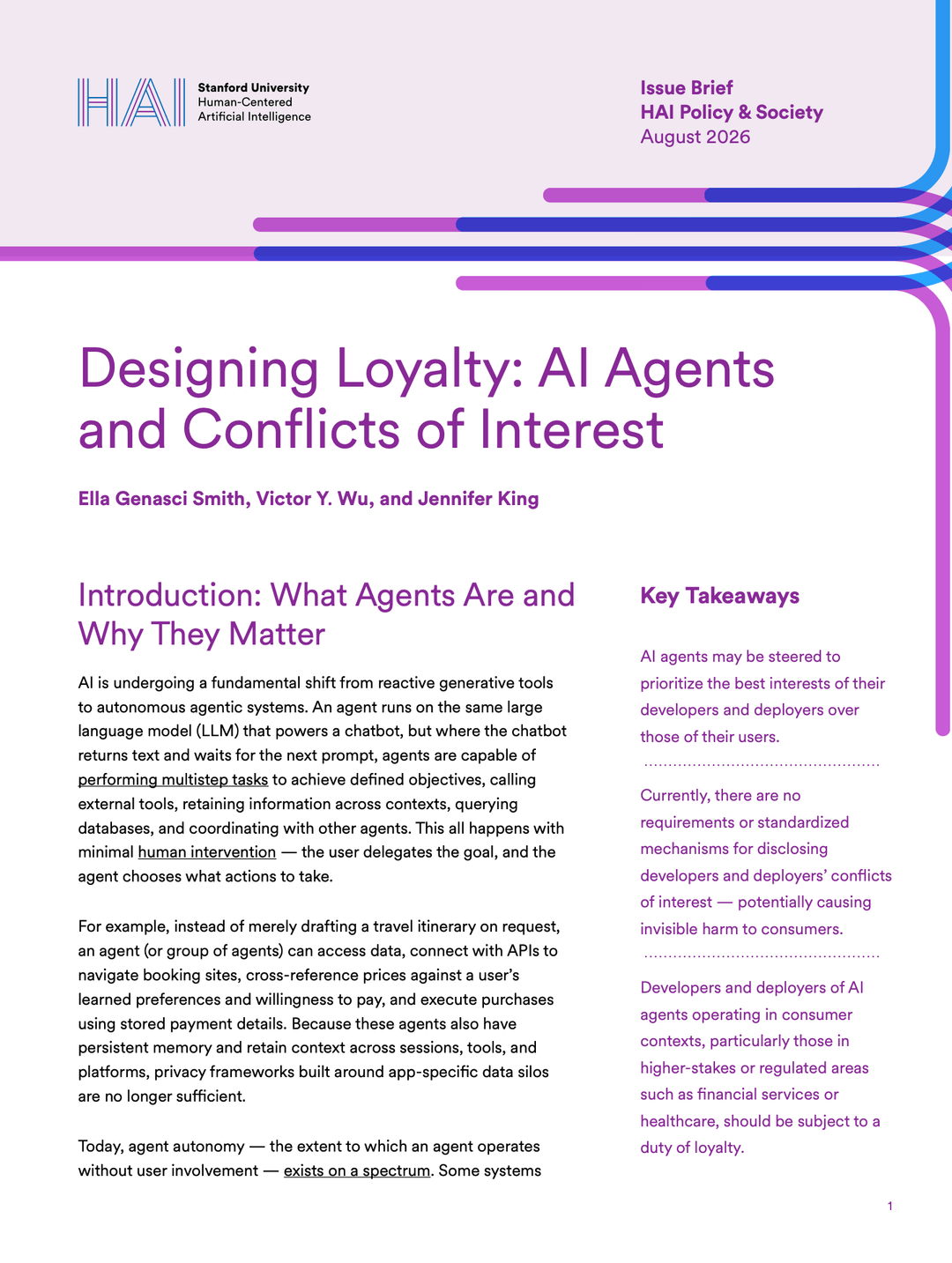
This brief examines the conflict-of-interest risks posed by AI agents and calls for imposing a duty of loyalty on developers and deployers.
Regulating Data Brokers in the Age of AI: A California Case Study
This brief assesses data broker compliance with California privacy laws and calls for more stringent consumer protections.
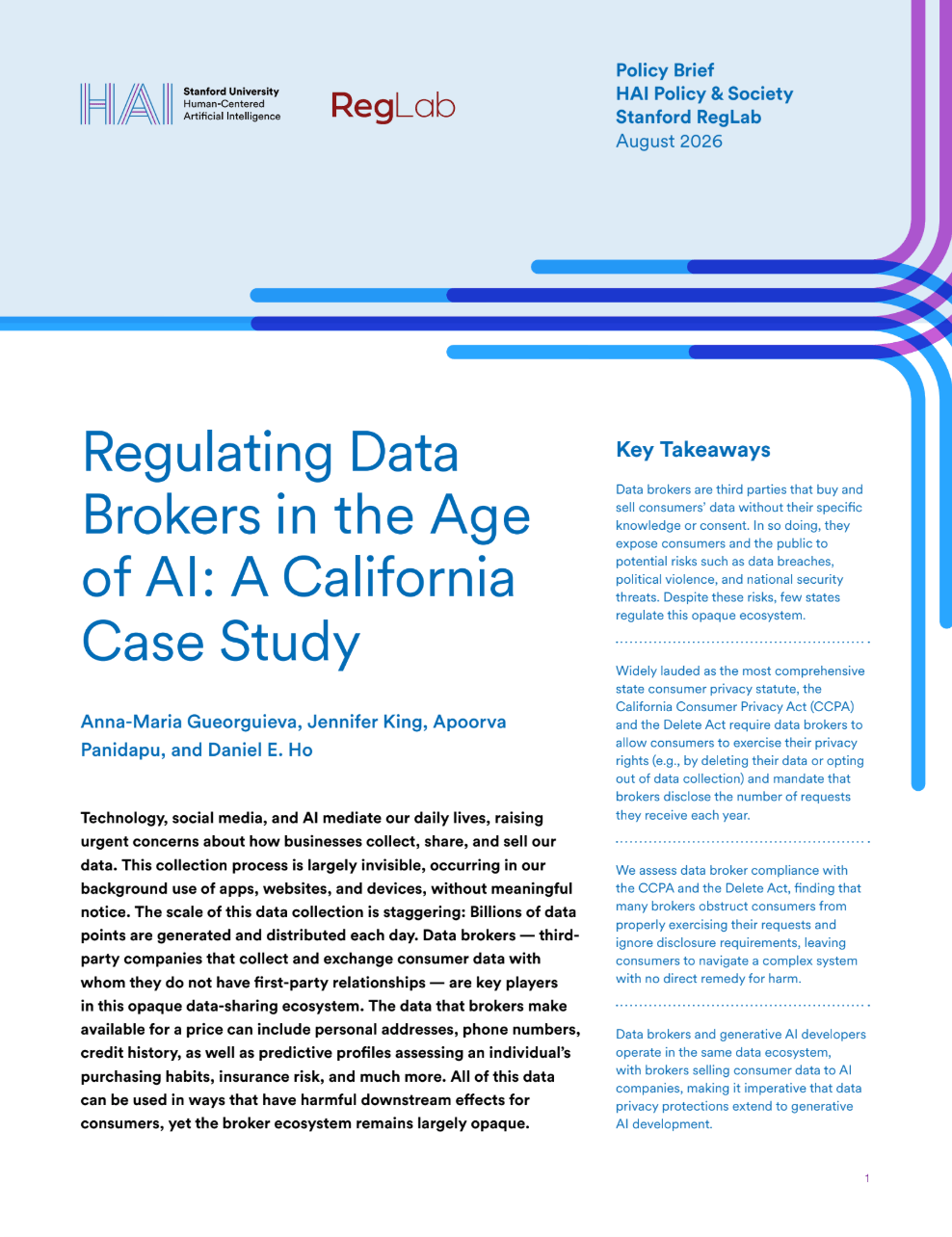
This brief assesses data broker compliance with California privacy laws and calls for more stringent consumer protections.
The Commercial Landscape of AI Sovereignty Offerings
This brief surveys the commercial AI sovereignty market and argues that policymakers should focus on calibrating interdependence rather than pursuing full self-sufficiency.
This brief surveys the commercial AI sovereignty market and argues that policymakers should focus on calibrating interdependence rather than pursuing full self-sufficiency.