All Work Published on Foundation Models

By having AI study a user’s context offline, researchers dramatically reduce the memory and cost required to make AI contextually aware.
By having AI study a user’s context offline, researchers dramatically reduce the memory and cost required to make AI contextually aware.

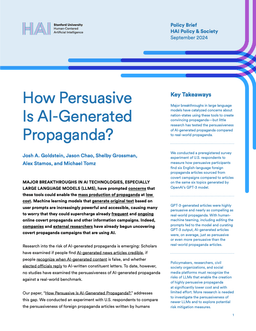
How Persuasive Is AI-generated Propaganda?

Can large language models, a form of artificial intelligence (AI), generate persuasive propaganda? We conducted a preregistered survey experiment of US respondents to investigate the persuasiveness of news articles written by foreign propagandists compared to content generated by GPT-3 davinci (a large language model). We found that GPT-3 can create highly persuasive text as measured by participants’ agreement with propaganda theses. We further investigated whether a person fluent in English could improve propaganda persuasiveness. Editing the prompt fed to GPT-3 and/or curating GPT-3’s output made GPT-3 even more persuasive, and, under certain conditions, as persuasive as the original propaganda. Our findings suggest that propagandists could use AI to create convincing content with limited effort.
Can large language models, a form of artificial intelligence (AI), generate persuasive propaganda? We conducted a preregistered survey experiment of US respondents to investigate the persuasiveness of news articles written by foreign propagandists compared to content generated by GPT-3 davinci (a large language model). We found that GPT-3 can create highly persuasive text as measured by participants’ agreement with propaganda theses. We further investigated whether a person fluent in English could improve propaganda persuasiveness. Editing the prompt fed to GPT-3 and/or curating GPT-3’s output made GPT-3 even more persuasive, and, under certain conditions, as persuasive as the original propaganda. Our findings suggest that propagandists could use AI to create convincing content with limited effort.

How Persuasive is AI-Generated Propaganda?

This brief presents the findings of an experiment that measures how persuasive AI-generated propaganda is compared to foreign propaganda articles written by humans.
This brief presents the findings of an experiment that measures how persuasive AI-generated propaganda is compared to foreign propaganda articles written by humans.
Stanford AI Scholars Find Support for Innovation in a Time of Uncertainty

Stanford HAI offers critical resources for faculty and students to continue groundbreaking research across the vast AI landscape.
Stanford HAI offers critical resources for faculty and students to continue groundbreaking research across the vast AI landscape.

The ML community is rapidly exploring techniques for prompting language models (LMs) and for stacking them into pipelines that solve complex tasks. Unfortunately, existing LM pipelines are typically implemented using hard-coded “prompt templates”, i.e. lengthy strings discovered via trial and error. Toward a more systematic approach for developing and optimizing LM pipelines, we introduce DSPy, a programming model that abstracts LM pipelines as text transformation graphs, or imperative computational graphs where LMs are invoked through declarative modules. DSPy modules are parameterized, meaning they can learn how to apply compositions of prompting, finetuning, augmentation, and reasoning techniques. We design a compiler that will optimize any DSPy pipeline to maximize a given metric, by creating and collecting demonstrations. We conduct two case studies, showing that succinct DSPy programs can express and optimize pipelines that reason about math word problems, tackle multi-hop retrieval, answer complex questions, and control agent loops. Within minutes of compiling, DSPy can automatically produce pipelines that outperform out-of-the-box few-shot prompting as well as expert-created demonstrations for GPT-3.5 and Llama2-13b-chat. On top of that, DSPy programs compiled for relatively small LMs like 770M parameter T5 and Llama2-13b-chat are competitive with many approaches that rely on large and proprietary LMs like GPT-3.5 and on expert-written prompt chains. DSPy is available at https://github.com/stanfordnlp/dspy
The ML community is rapidly exploring techniques for prompting language models (LMs) and for stacking them into pipelines that solve complex tasks. Unfortunately, existing LM pipelines are typically implemented using hard-coded “prompt templates”, i.e. lengthy strings discovered via trial and error. Toward a more systematic approach for developing and optimizing LM pipelines, we introduce DSPy, a programming model that abstracts LM pipelines as text transformation graphs, or imperative computational graphs where LMs are invoked through declarative modules. DSPy modules are parameterized, meaning they can learn how to apply compositions of prompting, finetuning, augmentation, and reasoning techniques. We design a compiler that will optimize any DSPy pipeline to maximize a given metric, by creating and collecting demonstrations. We conduct two case studies, showing that succinct DSPy programs can express and optimize pipelines that reason about math word problems, tackle multi-hop retrieval, answer complex questions, and control agent loops. Within minutes of compiling, DSPy can automatically produce pipelines that outperform out-of-the-box few-shot prompting as well as expert-created demonstrations for GPT-3.5 and Llama2-13b-chat. On top of that, DSPy programs compiled for relatively small LMs like 770M parameter T5 and Llama2-13b-chat are competitive with many approaches that rely on large and proprietary LMs like GPT-3.5 and on expert-written prompt chains. DSPy is available at https://github.com/stanfordnlp/dspy
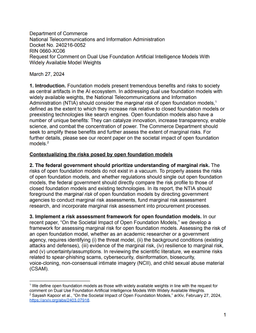
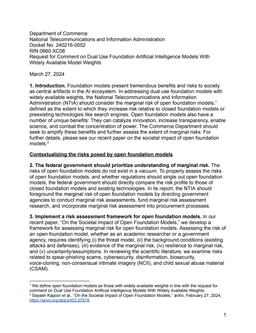
Stanford scholars respond to a federal RFC on dual use foundation models with widely available model weights, urging policymakers to consider their marginal risks.
Stanford scholars respond to a federal RFC on dual use foundation models with widely available model weights, urging policymakers to consider their marginal risks.