All Work Published on Foundation Models

In evaluating thousands of benchmarks that AI developers use to assess the quality of their new models, a team of Stanford researchers says 5% could have serious flaws that can lead to major ramifications.
In evaluating thousands of benchmarks that AI developers use to assess the quality of their new models, a team of Stanford researchers says 5% could have serious flaws that can lead to major ramifications.

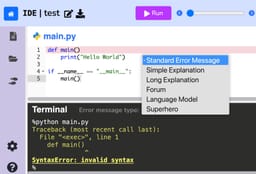
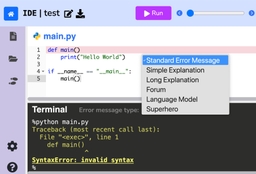
In this paper, we evaluate the most effective error message types through a large-scale randomized controlled trial conducted in an open-access, online introductory computer science course with 8,762 students from 146 countries. We assess existing error message enhancement strategies, as well as two novel approaches of our own: (1) generating error messages using OpenAI's GPT in real time and (2) constructing error messages that incorporate the course discussion forum. By examining students' direct responses to error messages, and their behavior throughout the course, we quantitatively evaluate the immediate and longer term efficacy of different error message types. We find that students using GPT generated error messages repeat an error 23.1% less often in the subsequent attempt, and resolve an error in 34.8% fewer additional attempts, compared to students using standard error messages. We also perform an analysis across various demographics to understand any disparities in the impact of different error message types. Our results find no significant difference in the effectiveness of GPT generated error messages for students from varying socioeconomic and demographic backgrounds. Our findings underscore GPT generated error messages as the most helpful error message type, especially as a universally effective intervention across demographics.
In this paper, we evaluate the most effective error message types through a large-scale randomized controlled trial conducted in an open-access, online introductory computer science course with 8,762 students from 146 countries. We assess existing error message enhancement strategies, as well as two novel approaches of our own: (1) generating error messages using OpenAI's GPT in real time and (2) constructing error messages that incorporate the course discussion forum. By examining students' direct responses to error messages, and their behavior throughout the course, we quantitatively evaluate the immediate and longer term efficacy of different error message types. We find that students using GPT generated error messages repeat an error 23.1% less often in the subsequent attempt, and resolve an error in 34.8% fewer additional attempts, compared to students using standard error messages. We also perform an analysis across various demographics to understand any disparities in the impact of different error message types. Our results find no significant difference in the effectiveness of GPT generated error messages for students from varying socioeconomic and demographic backgrounds. Our findings underscore GPT generated error messages as the most helpful error message type, especially as a universally effective intervention across demographics.
What Makes a Good AI Benchmark?

This brief presents a novel assessment framework for evaluating the quality of AI benchmarks and scores 24 benchmarks against the framework.
This brief presents a novel assessment framework for evaluating the quality of AI benchmarks and scores 24 benchmarks against the framework.

HAI Faculty Affiliate Diyi Yang studies the foundations of AI, ensuring these tools are designed with people in mind.
HAI Faculty Affiliate Diyi Yang studies the foundations of AI, ensuring these tools are designed with people in mind.
Silent Speech Interfaces (SSIs) offer a nonin- vasive alternative to brain-computer interfaces for soundless verbal communication. We in- troduce Multimodal Orofacial Neural Audio (MONA), a system that leverages cross-modal alignment through novel loss functions—cross- contrast (crossCon) and supervised temporal con- trast (supTcon)—to train a multimodal model with a shared latent representation. This archi- tecture enables the use of audio-only datasets like LibriSpeech to improve silent speech recog- nition. Additionally, our introduction of Large Language Model (LLM) Integrated Scoring Ad- justment (LISA) significantly improves recogni- tion accuracy. Together, MONA LISA reduces the state-of-the-art word error rate (WER) from 28.8% to 12.2% in the Gaddy (2020) benchmark dataset for silent speech on an open vocabulary. For vocal EMG recordings, our method improves the state-of-the-art from 23.3% to 3.7% WER. In the Brain-to-Text 2024 competition, LISA per- forms best, improving the top WER from 9.8% to 8.9%. To the best of our knowledge, this work represents the first instance where noninvasive silent speech recognition on an open vocabulary has cleared the threshold of 15% WER, demon- strating that SSIs can be a viable alternative to au- tomatic speech recognition (ASR). Our work not only narrows the performance gap between silent and vocalized speech but also opens new possi- bilities in human-computer interaction, demon- strating the potential of cross-modal approaches in noisy and data-limited regimes.
Silent Speech Interfaces (SSIs) offer a nonin- vasive alternative to brain-computer interfaces for soundless verbal communication. We in- troduce Multimodal Orofacial Neural Audio (MONA), a system that leverages cross-modal alignment through novel loss functions—cross- contrast (crossCon) and supervised temporal con- trast (supTcon)—to train a multimodal model with a shared latent representation. This archi- tecture enables the use of audio-only datasets like LibriSpeech to improve silent speech recog- nition. Additionally, our introduction of Large Language Model (LLM) Integrated Scoring Ad- justment (LISA) significantly improves recogni- tion accuracy. Together, MONA LISA reduces the state-of-the-art word error rate (WER) from 28.8% to 12.2% in the Gaddy (2020) benchmark dataset for silent speech on an open vocabulary. For vocal EMG recordings, our method improves the state-of-the-art from 23.3% to 3.7% WER. In the Brain-to-Text 2024 competition, LISA per- forms best, improving the top WER from 9.8% to 8.9%. To the best of our knowledge, this work represents the first instance where noninvasive silent speech recognition on an open vocabulary has cleared the threshold of 15% WER, demon- strating that SSIs can be a viable alternative to au- tomatic speech recognition (ASR). Our work not only narrows the performance gap between silent and vocalized speech but also opens new possi- bilities in human-computer interaction, demon- strating the potential of cross-modal approaches in noisy and data-limited regimes.

Stanford scholars respond to a federal RFC on the U.S. AI Safety Institute’s draft guidelines for managing the misuse risk for dual-use foundation models.
Stanford scholars respond to a federal RFC on the U.S. AI Safety Institute’s draft guidelines for managing the misuse risk for dual-use foundation models.
