All Work Published on Foundation Models
Transparency in AI is on the Decline
A new study shows the AI industry is withholding key information.
A new study shows the AI industry is withholding key information.
A Multi-Center Study on the Adaptability of a Shared Foundation Model for Electronic Health Records
Foundation models are transforming artificial intelligence (AI) in healthcare by providing modular components adaptable for various downstream tasks, making AI development more scalable and cost-effective. Foundation models for structured electronic health records (EHR), trained on coded medical records from millions of patients, demonstrated benefits including increased performance with fewer training labels, and improved robustness to distribution shifts. However, questions remain on the feasibility of sharing these models across hospitals and their performance in local tasks. This multi-center study examined the adaptability of a publicly accessible structured EHR foundation model (FMSM), trained on 2.57 M patient records from Stanford Medicine. Experiments used EHR data from The Hospital for Sick Children (SickKids) and Medical Information Mart for Intensive Care (MIMIC-IV). We assessed both adaptability via continued pretraining on local data, and task adaptability compared to baselines of locally training models from scratch, including a local foundation model. Evaluations on 8 clinical prediction tasks showed that adapting the off-the-shelf FMSMmatched the performance of gradient boosting machines (GBM) locally trained on all data while providing a 13% improvement in settings with few task-specific training labels. Continued pretraining on local data showed FMSM required fewer than 1% of training examples to match the fully trained GBM’s performance, and was 60 to 90% more sample-efficient than training local foundation models from scratch. Our findings demonstrate that adapting EHR foundation models across hospitals provides improved prediction performance at less cost, underscoring the utility of base foundation models as modular components to streamline the development of healthcare AI.
Foundation models are transforming artificial intelligence (AI) in healthcare by providing modular components adaptable for various downstream tasks, making AI development more scalable and cost-effective. Foundation models for structured electronic health records (EHR), trained on coded medical records from millions of patients, demonstrated benefits including increased performance with fewer training labels, and improved robustness to distribution shifts. However, questions remain on the feasibility of sharing these models across hospitals and their performance in local tasks. This multi-center study examined the adaptability of a publicly accessible structured EHR foundation model (FMSM), trained on 2.57 M patient records from Stanford Medicine. Experiments used EHR data from The Hospital for Sick Children (SickKids) and Medical Information Mart for Intensive Care (MIMIC-IV). We assessed both adaptability via continued pretraining on local data, and task adaptability compared to baselines of locally training models from scratch, including a local foundation model. Evaluations on 8 clinical prediction tasks showed that adapting the off-the-shelf FMSMmatched the performance of gradient boosting machines (GBM) locally trained on all data while providing a 13% improvement in settings with few task-specific training labels. Continued pretraining on local data showed FMSM required fewer than 1% of training examples to match the fully trained GBM’s performance, and was 60 to 90% more sample-efficient than training local foundation models from scratch. Our findings demonstrate that adapting EHR foundation models across hospitals provides improved prediction performance at less cost, underscoring the utility of base foundation models as modular components to streamline the development of healthcare AI.
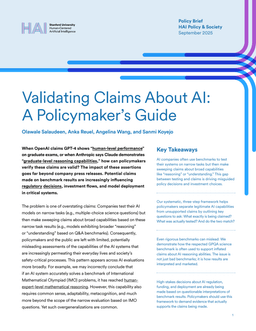
Validating Claims About AI: A Policymaker’s Guide

This brief proposes a practical validation framework to help policymakers separate legitimate claims about AI systems from unsupported claims.
This brief proposes a practical validation framework to help policymakers separate legitimate claims about AI systems from unsupported claims.

Five teams will use the funding to advance their work in biology, generative AI and creativity, policing, and more.
Five teams will use the funding to advance their work in biology, generative AI and creativity, policing, and more.

Interventions on model-internal states are fundamental operations in many areas of AI, including model editing, steering, robustness, and interpretability. To facilitate such research, we introduce pyvene, an open-source Python library that supports customizable interventions on a range of different PyTorch modules. pyvene supports complex intervention schemes with an intuitive configuration format, and its interventions can be static or include trainable parameters. We show how pyvene provides a unified and extensible framework for performing interventions on neural models and sharing the intervened upon models with others. We illustrate the power of the library via interpretability analyses using causal abstraction and knowledge localization. We publish our library through Python Package Index (PyPI) and provide code, documentation, and tutorials at ‘https://github.com/stanfordnlp/pyvene‘.
Interventions on model-internal states are fundamental operations in many areas of AI, including model editing, steering, robustness, and interpretability. To facilitate such research, we introduce pyvene, an open-source Python library that supports customizable interventions on a range of different PyTorch modules. pyvene supports complex intervention schemes with an intuitive configuration format, and its interventions can be static or include trainable parameters. We show how pyvene provides a unified and extensible framework for performing interventions on neural models and sharing the intervened upon models with others. We illustrate the power of the library via interpretability analyses using causal abstraction and knowledge localization. We publish our library through Python Package Index (PyPI) and provide code, documentation, and tutorials at ‘https://github.com/stanfordnlp/pyvene‘.

This brief presents an analysis of Chinese AI startup DeepSeek’s talent base and calls for U.S. policymakers to reinvest in competing to attract and retain global AI talent.
This brief presents an analysis of Chinese AI startup DeepSeek’s talent base and calls for U.S. policymakers to reinvest in competing to attract and retain global AI talent.
