All Work Published on Foundation Models

Small models get better, regulation moves to the states, and more.
Small models get better, regulation moves to the states, and more.

Although data visualizations are a relatively recent invention, most people are expected to know how to read them. How do current machine learning systems compare with people when performing tasks involving data visualizations? Prior work evaluating machine data visualization understanding has relied upon weak benchmarks that do not resemble the tests used to assess these abilities in humans. We evaluated several state-of-the-art algorithms on data visualization literacy assessments designed for humans, and compared their responses to multiple cohorts of human participants with varying levels of experience with high school-level math. We found that these models systematically underperform all human cohorts and are highly sensitive to small changes in how they are prompted. Among the models we tested, GPT-4V most closely approximates human error patterns, but gaps remain between all models and humans. Our findings highlight the need for stronger benchmarks for data visualization understanding to advance artificial systems towards human-like reasoning about data visualizations.
Although data visualizations are a relatively recent invention, most people are expected to know how to read them. How do current machine learning systems compare with people when performing tasks involving data visualizations? Prior work evaluating machine data visualization understanding has relied upon weak benchmarks that do not resemble the tests used to assess these abilities in humans. We evaluated several state-of-the-art algorithms on data visualization literacy assessments designed for humans, and compared their responses to multiple cohorts of human participants with varying levels of experience with high school-level math. We found that these models systematically underperform all human cohorts and are highly sensitive to small changes in how they are prompted. Among the models we tested, GPT-4V most closely approximates human error patterns, but gaps remain between all models and humans. Our findings highlight the need for stronger benchmarks for data visualization understanding to advance artificial systems towards human-like reasoning about data visualizations.
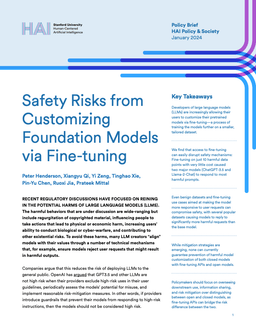
Safety Risks from Customizing Foundation Models via Fine-Tuning
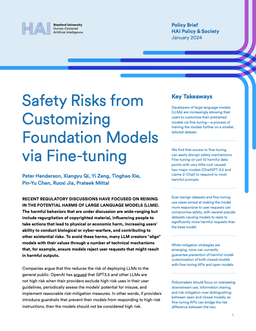
This brief underscores the safety risks inherent in custom fine-tuning of large language models.
This brief underscores the safety risks inherent in custom fine-tuning of large language models.

The new AI Index is out. See how well you know the state of the industry.
The new AI Index is out. See how well you know the state of the industry.

WikiChat: Stopping the Hallucination of Large Language Model Chatbots by Few-Shot Grounding on Wikipedia
This paper presents the first few-shot LLM-based chatbot that almost never hallucinates and has high conversationality and low latency. WikiChat is grounded on the English Wikipedia, the largest curated free-text corpus. WikiChat generates a response from an LLM, retains only the grounded facts, and combines them with additional information it retrieves from the corpus to form factual and engaging responses. We distill WikiChat based on GPT-4 into a 7B-parameter LLaMA model with minimal loss of quality, to significantly improve its latency, cost and privacy, and facilitate research and deployment. Using a novel hybrid human-and-LLM evaluation methodology, we show that our best system achieves 97.3% factual accuracy in simulated conversations. It significantly outperforms all retrieval-based and LLM-based baselines, and by 3.9%, 38.6% and 51.0% on head, tail and recent knowledge compared to GPT-4. Compared to previous state-of-the-art retrieval-based chatbots, WikiChat is also significantly more informative and engaging, just like an LLM. WikiChat achieves 97.9% factual accuracy in conversations with human users about recent topics, 55.0% better than GPT-4, while receiving significantly higher user ratings and more favorable comments.
This paper presents the first few-shot LLM-based chatbot that almost never hallucinates and has high conversationality and low latency. WikiChat is grounded on the English Wikipedia, the largest curated free-text corpus. WikiChat generates a response from an LLM, retains only the grounded facts, and combines them with additional information it retrieves from the corpus to form factual and engaging responses. We distill WikiChat based on GPT-4 into a 7B-parameter LLaMA model with minimal loss of quality, to significantly improve its latency, cost and privacy, and facilitate research and deployment. Using a novel hybrid human-and-LLM evaluation methodology, we show that our best system achieves 97.3% factual accuracy in simulated conversations. It significantly outperforms all retrieval-based and LLM-based baselines, and by 3.9%, 38.6% and 51.0% on head, tail and recent knowledge compared to GPT-4. Compared to previous state-of-the-art retrieval-based chatbots, WikiChat is also significantly more informative and engaging, just like an LLM. WikiChat achieves 97.9% factual accuracy in conversations with human users about recent topics, 55.0% better than GPT-4, while receiving significantly higher user ratings and more favorable comments.

This brief highlights the benefits of open foundation models and calls for greater focus on their marginal risks.
This brief highlights the benefits of open foundation models and calls for greater focus on their marginal risks.
