All Work Published on Machine Learning
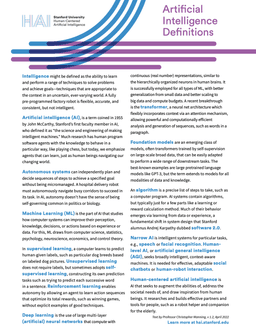
This explainer provides brief definitions for key terms associated with artificial intelligence, ranging from autonomous systems to deep learning and foundation models.
This explainer provides brief definitions for key terms associated with artificial intelligence, ranging from autonomous systems to deep learning and foundation models.
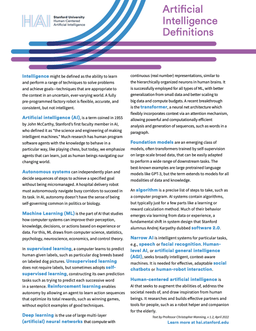
Want To Understand The Current State Of AI? Check Out These Charts.
"If you’re following AI news, you’re probably getting whiplash. AI is a gold rush. AI is a bubble. AI is taking your job. AI can’t even read a clock. The 2026 AI Index from Stanford University’s Institute for Human-Centered Artificial Intelligence, AI’s annual report card, comes out today and cuts through some of that noise."
"If you’re following AI news, you’re probably getting whiplash. AI is a gold rush. AI is a bubble. AI is taking your job. AI can’t even read a clock. The 2026 AI Index from Stanford University’s Institute for Human-Centered Artificial Intelligence, AI’s annual report card, comes out today and cuts through some of that noise."
AI driven by deep learning is transforming many aspects of science and technology. The enormous success of deep learning stems from its unique capability of extracting essential features from Big Data for decision-making. However, the feature extraction and hidden representations in deep neural networks (DNNs) remain inexplicable, primarily because of lack of technical tools to comprehend and interrogate the feature space data. The main hurdle here is that the feature data are often noisy in nature, complex in structure, and huge in size and dimensionality, making it intractable for existing techniques to analyze the data reliably. In this work, we develop a computational framework named contrastive feature analysis (CFA) to facilitate the exploration of the DNN feature space and improve the performance of AI. By utilizing the interaction relations among the features and incorporating a novel data-driven kernel formation strategy into the feature analysis pipeline, CFA mitigates the limitations of traditional approaches and provides an urgently needed solution for the analysis of feature space data. The technique allows feature data exploration in unsupervised, semi-supervised and supervised formats to address different needs of downstream applications. The potential of CFA and its applications for pruning of neural network architectures are demonstrated using several state-of-the-art networks and well-annotated datasets across different disciplines.
AI driven by deep learning is transforming many aspects of science and technology. The enormous success of deep learning stems from its unique capability of extracting essential features from Big Data for decision-making. However, the feature extraction and hidden representations in deep neural networks (DNNs) remain inexplicable, primarily because of lack of technical tools to comprehend and interrogate the feature space data. The main hurdle here is that the feature data are often noisy in nature, complex in structure, and huge in size and dimensionality, making it intractable for existing techniques to analyze the data reliably. In this work, we develop a computational framework named contrastive feature analysis (CFA) to facilitate the exploration of the DNN feature space and improve the performance of AI. By utilizing the interaction relations among the features and incorporating a novel data-driven kernel formation strategy into the feature analysis pipeline, CFA mitigates the limitations of traditional approaches and provides an urgently needed solution for the analysis of feature space data. The technique allows feature data exploration in unsupervised, semi-supervised and supervised formats to address different needs of downstream applications. The potential of CFA and its applications for pruning of neural network architectures are demonstrated using several state-of-the-art networks and well-annotated datasets across different disciplines.
A New Direction for Machine Learning in Criminal Law
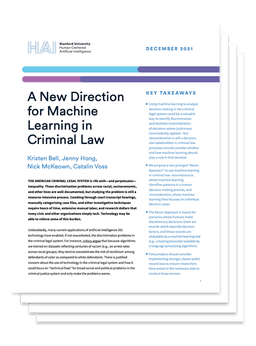
This brief proposes a machine learning approach to studying decision-making in the criminal legal system as a way to identify and reduce systemic inequalities.
This brief proposes a machine learning approach to studying decision-making in the criminal legal system as a way to identify and reduce systemic inequalities.
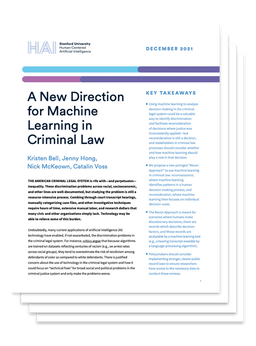
Interventions on model-internal states are fundamental operations in many areas of AI, including model editing, steering, robustness, and interpretability. To facilitate such research, we introduce pyvene, an open-source Python library that supports customizable interventions on a range of different PyTorch modules. pyvene supports complex intervention schemes with an intuitive configuration format, and its interventions can be static or include trainable parameters. We show how pyvene provides a unified and extensible framework for performing interventions on neural models and sharing the intervened upon models with others. We illustrate the power of the library via interpretability analyses using causal abstraction and knowledge localization. We publish our library through Python Package Index (PyPI) and provide code, documentation, and tutorials at ‘https://github.com/stanfordnlp/pyvene‘.
Interventions on model-internal states are fundamental operations in many areas of AI, including model editing, steering, robustness, and interpretability. To facilitate such research, we introduce pyvene, an open-source Python library that supports customizable interventions on a range of different PyTorch modules. pyvene supports complex intervention schemes with an intuitive configuration format, and its interventions can be static or include trainable parameters. We show how pyvene provides a unified and extensible framework for performing interventions on neural models and sharing the intervened upon models with others. We illustrate the power of the library via interpretability analyses using causal abstraction and knowledge localization. We publish our library through Python Package Index (PyPI) and provide code, documentation, and tutorials at ‘https://github.com/stanfordnlp/pyvene‘.