Machine Learning
Learn about the latest advances in machine learning that allow systems to learn and improve over time.

Two models working together perform worse than one alone, exposing a critical gap in artificial intelligence capabilities.

Two models working together perform worse than one alone, exposing a critical gap in artificial intelligence capabilities.
Human-Centered Large Language Models
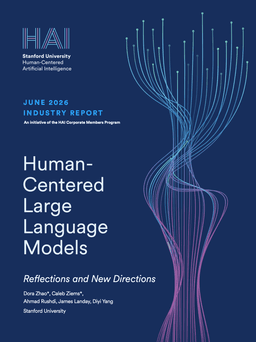
Large language models (LLM) have moved from research laboratories into the infrastructure of everyday life. They power everything from developer tools to educational tutors, healthcare assistants to enterprise agents. Yet the frameworks guiding LLM development remain anchored in technical performance metrics that tell us little about whether these systems actually benefit the people who use them.
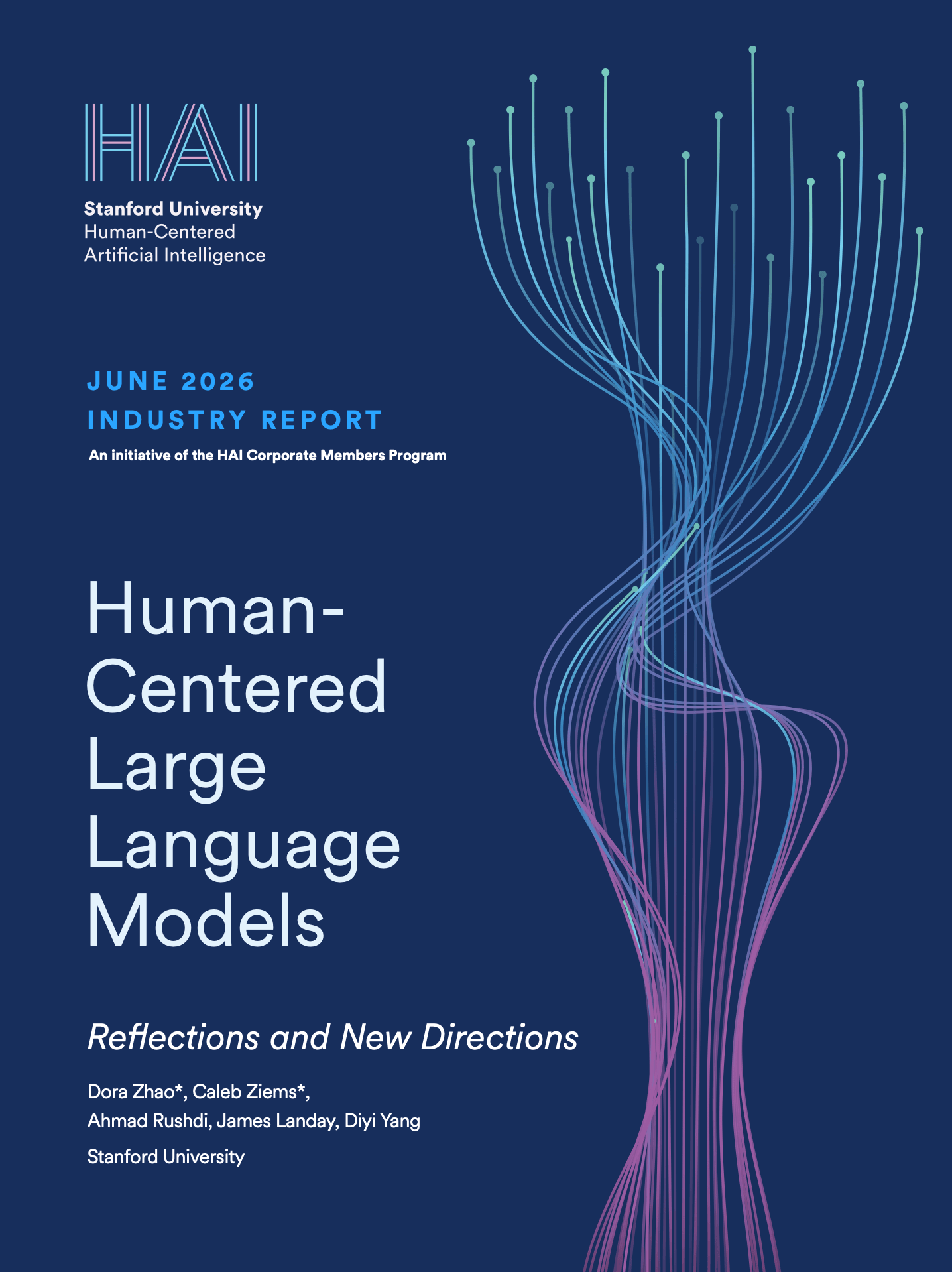
Large language models (LLM) have moved from research laboratories into the infrastructure of everyday life. They power everything from developer tools to educational tutors, healthcare assistants to enterprise agents. Yet the frameworks guiding LLM development remain anchored in technical performance metrics that tell us little about whether these systems actually benefit the people who use them.

We invited 11 sci-fi filmmakers and AI researchers to Stanford for Stories for the Future, a day-and-a-half experiment in fostering new narratives about AI. Researchers shared perspectives on AI and filmmakers reflected on the challenges of writing AI narratives. Together researcher-writer pairs transformed a research paper into a written scene. The challenge? Each scene had to include an AI manifestation, but could not be about the personhood of AI or AI as a threat. Read the results of this project.

We invited 11 sci-fi filmmakers and AI researchers to Stanford for Stories for the Future, a day-and-a-half experiment in fostering new narratives about AI. Researchers shared perspectives on AI and filmmakers reflected on the challenges of writing AI narratives. Together researcher-writer pairs transformed a research paper into a written scene. The challenge? Each scene had to include an AI manifestation, but could not be about the personhood of AI or AI as a threat. Read the results of this project.
Improving Transparency in AI Language Models: A Holistic Evaluation

This brief introduces Holistic Evaluation of Language Models (HELM) as a framework to evaluate commercial application of AI use cases.
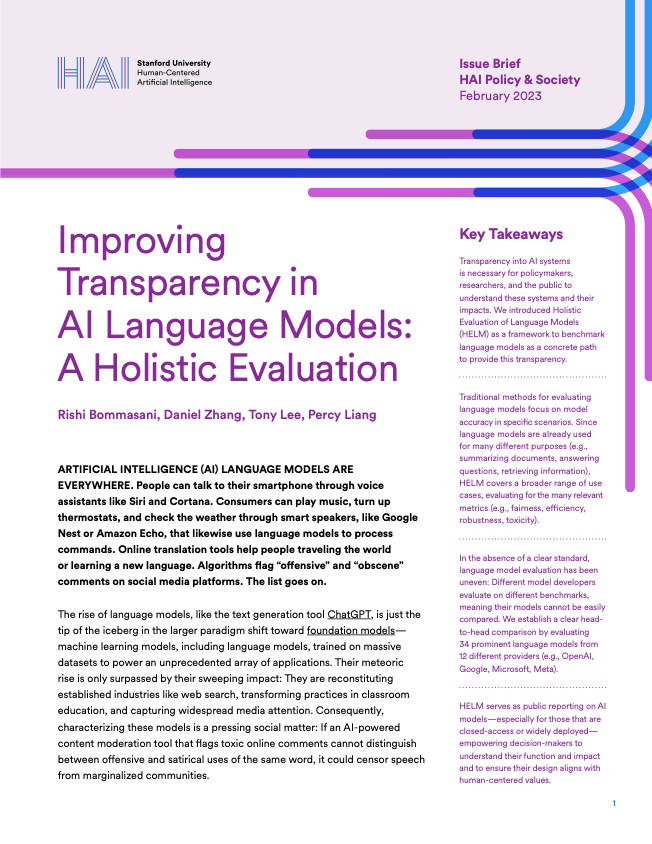
This brief introduces Holistic Evaluation of Language Models (HELM) as a framework to evaluate commercial application of AI use cases.
.png&w=256&q=80)
.png&w=1920&q=100)
AI Hiring Tools Can Yield Racial Bias and Systemic Rejection

The first large-scale study of hiring algorithms in the wild finds concerning patterns to how systems reject candidates.

The first large-scale study of hiring algorithms in the wild finds concerning patterns to how systems reject candidates.
All Work Published on Machine Learning
From Benchmarks to Real-World Impact: Causal Science Conference Explores Modern Challenges in AI Evaluation

On April 24, 2026, the Stanford Causal Science Conference: Frontiers in AI Evaluation brought together leading researchers from academia and industry to examine how causal reasoning, evaluation, and measurement are reshaping the future of AI systems.
On April 24, 2026, the Stanford Causal Science Conference: Frontiers in AI Evaluation brought together leading researchers from academia and industry to examine how causal reasoning, evaluation, and measurement are reshaping the future of AI systems.
Current societal trends reflect an increased mistrust in science and a lowered civic engagement that threaten to impair research that is foundational for ensuring public health and advancing health equity. One effective countermeasure to these trends lies in community-facing citizen science applications to increase public participation in scientific research, making this field an important target for artificial intelligence (AI) exploration. We highlight potentially promising citizen science AI applications that extend beyond individual use to the community level, including conversational large language models, text-to-image generative AI tools, descriptive analytics for analyzing integrated macro- and micro-level data, and predictive analytics. The novel adaptations of AI technologies for community-engaged participatory research also bring an array of potential risks. We highlight possible negative externalities and mitigations for some of the potential ethical and societal challenges in this field.
Current societal trends reflect an increased mistrust in science and a lowered civic engagement that threaten to impair research that is foundational for ensuring public health and advancing health equity. One effective countermeasure to these trends lies in community-facing citizen science applications to increase public participation in scientific research, making this field an important target for artificial intelligence (AI) exploration. We highlight potentially promising citizen science AI applications that extend beyond individual use to the community level, including conversational large language models, text-to-image generative AI tools, descriptive analytics for analyzing integrated macro- and micro-level data, and predictive analytics. The novel adaptations of AI technologies for community-engaged participatory research also bring an array of potential risks. We highlight possible negative externalities and mitigations for some of the potential ethical and societal challenges in this field.
Promoting Algorithmic Fairness in Clinical Risk Prediction
-1.png&w=256&q=80)
This brief examines the debate on algorithmic fairness in clinical predictive algorithms and recommends paths to safer, more equitable healthcare AI.
This brief examines the debate on algorithmic fairness in clinical predictive algorithms and recommends paths to safer, more equitable healthcare AI.
-1.png&w=256&q=100)
Ramesh Johari


HAI Executive Director Russell Wald talks about the AI competition between the U.S. and China, and the advent of “world models” that predict what might happen in real-world environments.
HAI Executive Director Russell Wald talks about the AI competition between the U.S. and China, and the advent of “world models” that predict what might happen in real-world environments.
Model-based reinforcement learning (MBRL) is a promising route to sampleefficient policy optimization. However, a known vulnerability of reconstructionbased MBRL consists of scenarios in which detailed aspects of the world are highly predictable, but irrelevant to learning a good policy. Such scenarios can lead the model to exhaust its capacity on meaningless content, at the cost of neglecting important environment dynamics. While existing approaches attempt to solve this problem, we highlight its continuing impact on leading MBRL methods —including DreamerV3 and DreamerPro — with a novel environment where background distractions are intricate, predictable, and useless for planning future actions. To address this challenge we develop a method for focusing the capacity of the world model through synergy of a pretrained segmentation model, a task-aware reconstruction loss, and adversarial learning. Our method outperforms a variety of other approaches designed to reduce the impact of distractors, and is an advance towards robust model-based reinforcement learning.
Model-based reinforcement learning (MBRL) is a promising route to sampleefficient policy optimization. However, a known vulnerability of reconstructionbased MBRL consists of scenarios in which detailed aspects of the world are highly predictable, but irrelevant to learning a good policy. Such scenarios can lead the model to exhaust its capacity on meaningless content, at the cost of neglecting important environment dynamics. While existing approaches attempt to solve this problem, we highlight its continuing impact on leading MBRL methods —including DreamerV3 and DreamerPro — with a novel environment where background distractions are intricate, predictable, and useless for planning future actions. To address this challenge we develop a method for focusing the capacity of the world model through synergy of a pretrained segmentation model, a task-aware reconstruction loss, and adversarial learning. Our method outperforms a variety of other approaches designed to reduce the impact of distractors, and is an advance towards robust model-based reinforcement learning.