All Work Published on Regulation, Policy, Governance
Conditional Generative Models for Synthetic Tabular Data: Applications for Precision Medicine and Diverse Representations
Tabular medical datasets, like electronic health records (EHRs), biobanks, and structured clinical trial data, are rich sources of information with the potential to advance precision medicine and optimize patient care. However, real-world medical datasets have limited patient diversity and cannot simulate hypothetical outcomes, both of which are necessary for equitable and effective medical research. Fueled by recent advancements in machine learning, generative models offer a promising solution to these data limitations by generating enhanced synthetic data. This review highlights the potential of conditional generative models (CGMs) to create patient-specific synthetic data for a variety of precision medicine applications. We survey CGM approaches that tackle two medical applications: correcting for data representation biases and simulating digital health twins. We additionally explore how the surveyed methods handle modeling tabular medical data and briefly discuss evaluation criteria. Finally, we summarize the technical, medical, and ethical challenges that must be addressed before CGMs can be effectively and safely deployed in the medical field.
Tabular medical datasets, like electronic health records (EHRs), biobanks, and structured clinical trial data, are rich sources of information with the potential to advance precision medicine and optimize patient care. However, real-world medical datasets have limited patient diversity and cannot simulate hypothetical outcomes, both of which are necessary for equitable and effective medical research. Fueled by recent advancements in machine learning, generative models offer a promising solution to these data limitations by generating enhanced synthetic data. This review highlights the potential of conditional generative models (CGMs) to create patient-specific synthetic data for a variety of precision medicine applications. We survey CGM approaches that tackle two medical applications: correcting for data representation biases and simulating digital health twins. We additionally explore how the surveyed methods handle modeling tabular medical data and briefly discuss evaluation criteria. Finally, we summarize the technical, medical, and ethical challenges that must be addressed before CGMs can be effectively and safely deployed in the medical field.
Response to OSTP's Request for Information on Accelerating the American Scientific Enterprise
Stanford scholars respond to a federal RFI on scientific discovery, calling for the government to support a new “team science” academic research model for AI-enabled discovery.
Stanford scholars respond to a federal RFI on scientific discovery, calling for the government to support a new “team science” academic research model for AI-enabled discovery.

As artificial intelligence moves beyond language into the physical world through "world models," Stanford researchers warn that policymakers face an even steeper governance challenge than with large language models—and the window to get ahead of the technology is closing fast.
As artificial intelligence moves beyond language into the physical world through "world models," Stanford researchers warn that policymakers face an even steeper governance challenge than with large language models—and the window to get ahead of the technology is closing fast.

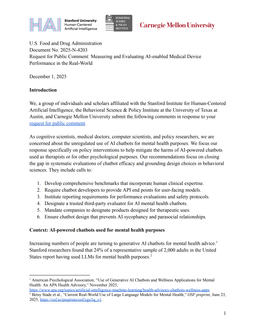
Response to FDA's Request for Comment on AI-Enabled Medical Devices
Stanford scholars respond to a federal RFC on evaluating AI-enabled medical devices, recommending policy interventions to help mitigate the harms of AI-powered chatbots used as therapists.
Stanford scholars respond to a federal RFC on evaluating AI-enabled medical devices, recommending policy interventions to help mitigate the harms of AI-powered chatbots used as therapists.
The Complexities of Governing Mental Health AI

Policymakers, academics, healthcare providers, AI developers, and patient advocates convened by Stanford HAI identify critical gaps in how we regulate AI tools used for therapy and emotional support.
Policymakers, academics, healthcare providers, AI developers, and patient advocates convened by Stanford HAI identify critical gaps in how we regulate AI tools used for therapy and emotional support.

Russ Altman’s Testimony Before the U.S. Senate Committee on Health, Education, Labor, and Pensions

In this testimony presented to the U.S. Senate Committee on Health, Education, Labor, and Pensions hearing titled “AI’s Potential to Support Patients, Workers, Children, and Families,” Russ Altman highlights opportunities for congressional support to make AI applications for patient care and drug discovery stronger, safer, and human-centered.
In this testimony presented to the U.S. Senate Committee on Health, Education, Labor, and Pensions hearing titled “AI’s Potential to Support Patients, Workers, Children, and Families,” Russ Altman highlights opportunities for congressional support to make AI applications for patient care and drug discovery stronger, safer, and human-centered.