All Work Published on Regulation, Policy, Governance
HAI Executive Director Russell Wald talks about the AI competition between the U.S. and China, and the advent of “world models” that predict what might happen in real-world environments.
HAI Executive Director Russell Wald talks about the AI competition between the U.S. and China, and the advent of “world models” that predict what might happen in real-world environments.
Adverse Event Reporting for AI: Developing the Information Infrastructure Government Needs to Learn and Act

This brief assesses the benefits of and provides policy recommendations for adverse event reporting systems for AI that report failures and harms post deployment.
This brief assesses the benefits of and provides policy recommendations for adverse event reporting systems for AI that report failures and harms post deployment.

"Countries pursue AI sovereignty with four main objectives in mind: cultural autonomy, national security, economic competitiveness, and regulatory oversight," says Juan N. Pava, Stanford HAI Research Fellow.
"Countries pursue AI sovereignty with four main objectives in mind: cultural autonomy, national security, economic competitiveness, and regulatory oversight," says Juan N. Pava, Stanford HAI Research Fellow.

Stanford scholars respond to a federal RFI on the development of an AI Action Plan, urging policymakers to promote open and scientific innovation, craft evidence-based AI policy, and empower government leaders.
Stanford scholars respond to a federal RFI on the development of an AI Action Plan, urging policymakers to promote open and scientific innovation, craft evidence-based AI policy, and empower government leaders.

Stanford HAI Executive Director Russell Wald discusses world models, saying many policymakers or government officials need to better understand the technologies and their implications.
Stanford HAI Executive Director Russell Wald discusses world models, saying many policymakers or government officials need to better understand the technologies and their implications.
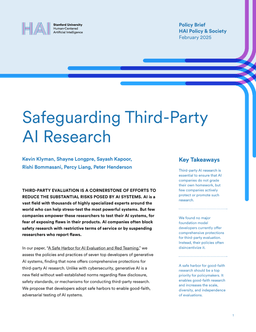
Safeguarding Third-Party AI Research

This brief examines the barriers to independent AI evaluation and proposes safe harbors to protect good-faith third-party research.
This brief examines the barriers to independent AI evaluation and proposes safe harbors to protect good-faith third-party research.