All Work Published on Regulation, Policy, Governance
Developing mental health AI tools that improve care across different groups and contexts
In order to realize the potential of mental health AI applications to deliver improved care, a multipronged approach is needed, including representative AI datasets, research practices that reflect and anticipate potential sources of bias, stakeholder engagement, and equitable design practices.
In order to realize the potential of mental health AI applications to deliver improved care, a multipronged approach is needed, including representative AI datasets, research practices that reflect and anticipate potential sources of bias, stakeholder engagement, and equitable design practices.
Data Privacy and Foundation Models: Can We Have Both?

This brief examines the privacy risks foundation models pose to individuals and society, and governance mechanisms needed to address them.
This brief examines the privacy risks foundation models pose to individuals and society, and governance mechanisms needed to address them.

This conversation spans the evolution of AI, exploring the opportunities for AI to augment human capabilities, particularly in healthcare, education, and scientific discovery. Fei-Fei discusses the limits of today’s AI, the importance of preserving human agency, and why society, not just the technology industry, needs to play a role in shaping its future.
This conversation spans the evolution of AI, exploring the opportunities for AI to augment human capabilities, particularly in healthcare, education, and scientific discovery. Fei-Fei discusses the limits of today’s AI, the importance of preserving human agency, and why society, not just the technology industry, needs to play a role in shaping its future.
Ethical Obligations to Inform Patients About Use of AI Tools
Permeation of artificial intelligence (AI) tools into health care tests traditional understandings of what patients should be told about their care. Despite the general importance of informed consent, decision support tools (eg, automatic electrocardiogram readers, rule-based risk classifiers, and UpToDate summaries) are not usually discussed with patients even though they affect treatment decisions. Should AI tools be treated similarly? The legal doctrine of informed consent requires disclosing information that is material to a reasonable patient’s decision to accept a health care service, and evidence suggests that many patients would think differently about care if they knew it was guided by AI. In recent surveys, 60% of US adults said they would be uncomfortable with their physician relying on AI,1 70% to 80% had low expectations AI would improve important aspects of their care,2 only one-third trusted health care systems to use AI responsibly,3 and 63% said it was very true that they would want to be notified about use of AI in their care.
Permeation of artificial intelligence (AI) tools into health care tests traditional understandings of what patients should be told about their care. Despite the general importance of informed consent, decision support tools (eg, automatic electrocardiogram readers, rule-based risk classifiers, and UpToDate summaries) are not usually discussed with patients even though they affect treatment decisions. Should AI tools be treated similarly? The legal doctrine of informed consent requires disclosing information that is material to a reasonable patient’s decision to accept a health care service, and evidence suggests that many patients would think differently about care if they knew it was guided by AI. In recent surveys, 60% of US adults said they would be uncomfortable with their physician relying on AI,1 70% to 80% had low expectations AI would improve important aspects of their care,2 only one-third trusted health care systems to use AI responsibly,3 and 63% said it was very true that they would want to be notified about use of AI in their care.
Toward Responsible AI in Health Insurance Decision-Making
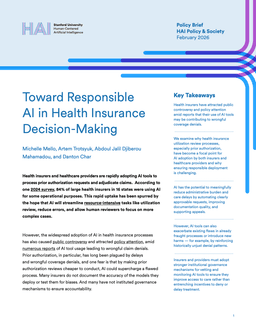
This brief proposes governance mechanisms for the growing use of AI in health insurance utilization review.
This brief proposes governance mechanisms for the growing use of AI in health insurance utilization review.
Open-Weight Models Aren’t Enough. We Need Truly Open Source AI Models for Science and Society.

As Chinese AI closes the capability gap, Washington and Silicon Valley debate open-weight models. Stanford HAI's James Landay says it's the right conversation framed the wrong way.
As Chinese AI closes the capability gap, Washington and Silicon Valley debate open-weight models. Stanford HAI's James Landay says it's the right conversation framed the wrong way.