All Work Published on Regulation, Policy, Governance
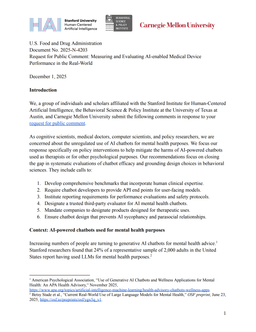
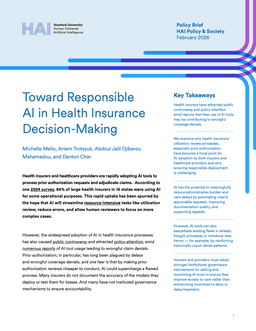
Toward Responsible AI in Health Insurance Decision-Making
This brief proposes governance mechanisms for the growing use of AI in health insurance utilization review.
This brief proposes governance mechanisms for the growing use of AI in health insurance utilization review.
This conversation spans the evolution of AI, exploring the opportunities for AI to augment human capabilities, particularly in healthcare, education, and scientific discovery. Fei-Fei discusses the limits of today’s AI, the importance of preserving human agency, and why society, not just the technology industry, needs to play a role in shaping its future.
This conversation spans the evolution of AI, exploring the opportunities for AI to augment human capabilities, particularly in healthcare, education, and scientific discovery. Fei-Fei discusses the limits of today’s AI, the importance of preserving human agency, and why society, not just the technology industry, needs to play a role in shaping its future.
Conditional Generative Models for Synthetic Tabular Data: Applications for Precision Medicine and Diverse Representations
Tabular medical datasets, like electronic health records (EHRs), biobanks, and structured clinical trial data, are rich sources of information with the potential to advance precision medicine and optimize patient care. However, real-world medical datasets have limited patient diversity and cannot simulate hypothetical outcomes, both of which are necessary for equitable and effective medical research. Fueled by recent advancements in machine learning, generative models offer a promising solution to these data limitations by generating enhanced synthetic data. This review highlights the potential of conditional generative models (CGMs) to create patient-specific synthetic data for a variety of precision medicine applications. We survey CGM approaches that tackle two medical applications: correcting for data representation biases and simulating digital health twins. We additionally explore how the surveyed methods handle modeling tabular medical data and briefly discuss evaluation criteria. Finally, we summarize the technical, medical, and ethical challenges that must be addressed before CGMs can be effectively and safely deployed in the medical field.
Tabular medical datasets, like electronic health records (EHRs), biobanks, and structured clinical trial data, are rich sources of information with the potential to advance precision medicine and optimize patient care. However, real-world medical datasets have limited patient diversity and cannot simulate hypothetical outcomes, both of which are necessary for equitable and effective medical research. Fueled by recent advancements in machine learning, generative models offer a promising solution to these data limitations by generating enhanced synthetic data. This review highlights the potential of conditional generative models (CGMs) to create patient-specific synthetic data for a variety of precision medicine applications. We survey CGM approaches that tackle two medical applications: correcting for data representation biases and simulating digital health twins. We additionally explore how the surveyed methods handle modeling tabular medical data and briefly discuss evaluation criteria. Finally, we summarize the technical, medical, and ethical challenges that must be addressed before CGMs can be effectively and safely deployed in the medical field.
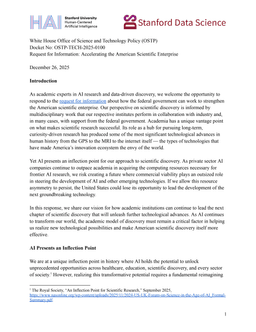
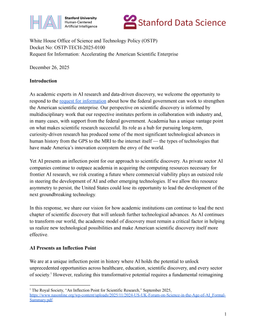
Response to OSTP's Request for Information on Accelerating the American Scientific Enterprise
Stanford scholars respond to a federal RFI on scientific discovery, calling for the government to support a new “team science” academic research model for AI-enabled discovery.
Stanford scholars respond to a federal RFI on scientific discovery, calling for the government to support a new “team science” academic research model for AI-enabled discovery.
Open-Weight Models Aren’t Enough. We Need Truly Open Source AI Models for Science and Society.

As Chinese AI closes the capability gap, Washington and Silicon Valley debate open-weight models. Stanford HAI's James Landay says it's the right conversation framed the wrong way.
As Chinese AI closes the capability gap, Washington and Silicon Valley debate open-weight models. Stanford HAI's James Landay says it's the right conversation framed the wrong way.

Response to FDA's Request for Comment on AI-Enabled Medical Devices
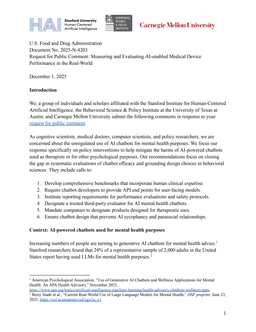
Stanford scholars respond to a federal RFC on evaluating AI-enabled medical devices, recommending policy interventions to help mitigate the harms of AI-powered chatbots used as therapists.
Stanford scholars respond to a federal RFC on evaluating AI-enabled medical devices, recommending policy interventions to help mitigate the harms of AI-powered chatbots used as therapists.