All Work Published on Regulation, Policy, Governance
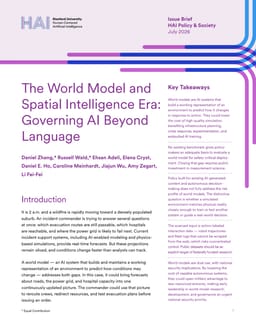
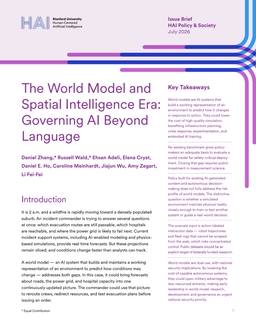
This brief highlights the emergence of world models and outlines a first-of-its-kind governance and policy agenda for the technology.
This brief highlights the emergence of world models and outlines a first-of-its-kind governance and policy agenda for the technology.
Daniel E. Ho


The state's Delete Act was supposed to give Californians a one-stop-shop to request their online information be deleted. But only a minority of registered data brokers are abiding by those laws, says Jennifer King, privacy and data policy fellow at the Stanford University Institute for Human-Centered AI.
The state's Delete Act was supposed to give Californians a one-stop-shop to request their online information be deleted. But only a minority of registered data brokers are abiding by those laws, says Jennifer King, privacy and data policy fellow at the Stanford University Institute for Human-Centered AI.
Automated real-time assessment of intracranial hemorrhage detection AI using an ensembled monitoring model (EMM)
Artificial intelligence (AI) tools for radiology are commonly unmonitored once deployed. The lack of real-time case-by-case assessments of AI prediction confidence requires users to independently distinguish between trustworthy and unreliable AI predictions, which increases cognitive burden, reduces productivity, and potentially leads to misdiagnoses. To address these challenges, we introduce Ensembled Monitoring Model (EMM), a framework inspired by clinical consensus practices using multiple expert reviews. Designed specifically for black-box commercial AI products, EMM operates independently without requiring access to internal AI components or intermediate outputs, while still providing robust confidence measurements. Using intracranial hemorrhage detection as our test case on a large, diverse dataset of 2919 studies, we demonstrate that EMM can successfully categorize confidence in the AI-generated prediction, suggest appropriate actions, and help physicians recognize low confidence scenarios, ultimately reducing cognitive burden. Importantly, we provide key technical considerations and best practices for successfully translating EMM into clinical settings.
Artificial intelligence (AI) tools for radiology are commonly unmonitored once deployed. The lack of real-time case-by-case assessments of AI prediction confidence requires users to independently distinguish between trustworthy and unreliable AI predictions, which increases cognitive burden, reduces productivity, and potentially leads to misdiagnoses. To address these challenges, we introduce Ensembled Monitoring Model (EMM), a framework inspired by clinical consensus practices using multiple expert reviews. Designed specifically for black-box commercial AI products, EMM operates independently without requiring access to internal AI components or intermediate outputs, while still providing robust confidence measurements. Using intracranial hemorrhage detection as our test case on a large, diverse dataset of 2919 studies, we demonstrate that EMM can successfully categorize confidence in the AI-generated prediction, suggest appropriate actions, and help physicians recognize low confidence scenarios, ultimately reducing cognitive burden. Importantly, we provide key technical considerations and best practices for successfully translating EMM into clinical settings.
Operationalizing Real-Time Monitoring of Clinical AI
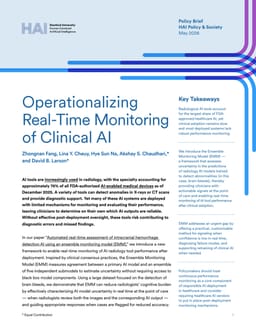
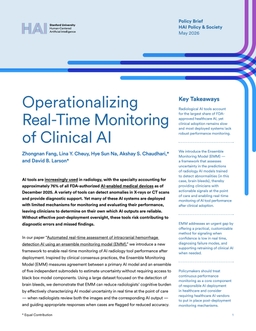
This brief demonstrates how real-time monitoring can address critical gaps in the oversight of radiological AI tools.
This brief demonstrates how real-time monitoring can address critical gaps in the oversight of radiological AI tools.
New Stanford Grants Tackle AI's Impact on Global Security and Geopolitics

Stanford HAI and the Hoover Institution’s Technology Policy Accelerator back projects examining AI's role in detecting nuclear proliferation, U.S.-China competition, and political influence.
Stanford HAI and the Hoover Institution’s Technology Policy Accelerator back projects examining AI's role in detecting nuclear proliferation, U.S.-China competition, and political influence.