Over three years, we’ve built progressively harder, more realistic benchmarks for medical AI. Here’s what we learned.
Over three years, we’ve built progressively harder, more realistic benchmarks for medical AI. Here’s what we learned.

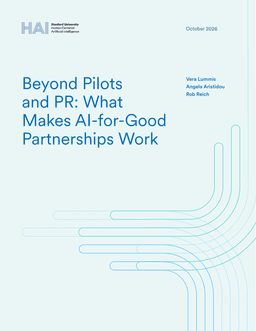
This paper examines how nonprofits and frontier AI labs partner to deploy AI for social good and offers recommendations for structuring these partnerships for greater impact.
This paper examines how nonprofits and frontier AI labs partner to deploy AI for social good and offers recommendations for structuring these partnerships for greater impact.

It's one of AI policy's hardest unsolved problems. Expert Deb Raji joins Stanford HAI to find answers that move beyond principles and into practice.
It's one of AI policy's hardest unsolved problems. Expert Deb Raji joins Stanford HAI to find answers that move beyond principles and into practice.

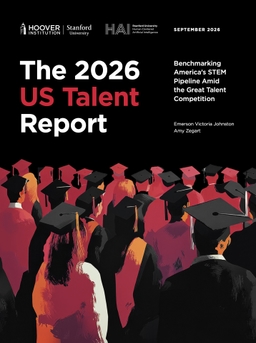
The 2026 US Talent Report: Benchmarking America’s STEM Pipeline Amid the Great Talent Competition
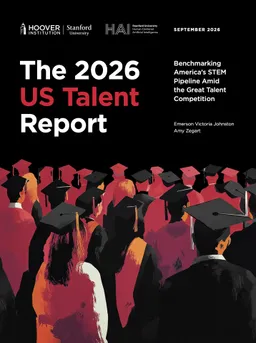
This report assesses America's ability to develop, attract, and retain STEM talent and warns that its advantages over China are narrowing rapidly.
This report assesses America's ability to develop, attract, and retain STEM talent and warns that its advantages over China are narrowing rapidly.

Analyzing thousands of human-AI conversations, a new study shows that people are turning to chatbots for increasingly critical tasks – and that productive outcomes depend on how the collaboration unfolds.
Analyzing thousands of human-AI conversations, a new study shows that people are turning to chatbots for increasingly critical tasks – and that productive outcomes depend on how the collaboration unfolds.

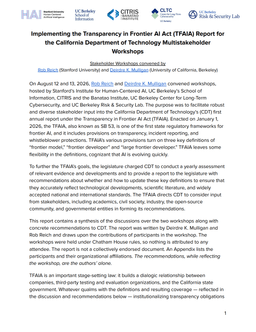
Implementing the Transparency in Frontier AI Act Report for the California Department of Technology Multistakeholder Workshops
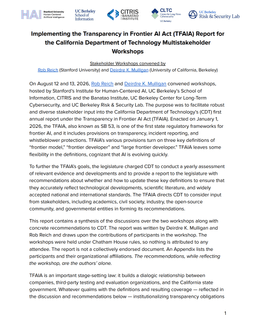
In this paper, HAI Associate Director and Senior Fellow Rob Reich and UC Berkeley School of Information Professor Deirdre K. Mulligan provide concrete recommendations to the California Department of Technology on the implementation of its frontier AI transparency requirements.
In this paper, HAI Associate Director and Senior Fellow Rob Reich and UC Berkeley School of Information Professor Deirdre K. Mulligan provide concrete recommendations to the California Department of Technology on the implementation of its frontier AI transparency requirements.