Beyond Pilots and PR: What Makes AI-for-Good Partnerships Work
This paper examines how nonprofits and frontier AI labs partner to deploy AI for social good and offers recommendations for structuring these partnerships for greater impact.
Executive Summary
Frontier AI labs and nonprofit organizations are increasingly partnering to deploy frontier AI in support of nonprofits’ missions to improve global health, climate, humanitarian, and development outcomes. Individual and institutional funders have invested hundreds of millions of dollars to support nonprofits in deploying AI for good, occasionally in formal partnership with AI labs. However, the rapidly growing AI for Social Good (AI4SG) ecosystem lacks a clear understanding of what these partnerships provide, how they form, and what drives or compromises their success.
Drawing on interviews with 36 individuals across 24 organizations (frontier AI labs, nonprofits, philanthropic funders, and independent experts) and four in-depth case studies, this report offers insights into how nonprofits and frontier AI labs partner to deploy AI to produce social impact and provides recommendations for how partnership and funding arrangements can be structured for success.
Key findings:
Nonprofits and AI labs partner by bridging overlapping yet, in successful collaborations, complementary goals. Nonprofits primarily seek technical expertise to deploy and evaluate AI, insight into how AI can advance their mission and impact, and financial resources. AI labs primarily seek to demonstrate social impact, learn from real-world deployment in low-resource settings, improve their models, and drive scaled adoption of their technologies.
AI labs tend to form their most substantive partnerships with high-capacity nonprofits that stand to benefit from specialized support. Brokered largely through existing relationships and funder introductions, these partnerships favor well-connected organizations that possess strong in-house product, engineering, and data capacity and a large geographic footprint. Because these attributes are relatively uncommon, this pattern widens the AI capacity and opportunity gap for the majority of nonprofits.
Contrary to the narrative that benefits flow primarily to nonprofits, AI labs also gain significant value from these partnerships. Key benefits include access to users and real-world use cases, evaluations and benchmarks in last-mile settings, opportunities to advance the research frontier, and increased public and government trust. The presence of multi-directional benefits, rather than a one-directional donor-beneficiary structure, has important implications for how partnerships are governed.
Success factors and sources of friction cluster at the nonprofit, AI lab, and partnership levels. On the nonprofit side, success is driven by in-house technical capacity and data readiness; a clearly owned problem definition and product vision; measurement and iteration; localization and participatory design; and the ability to advocate for needed support. On the lab side, success is driven by effective scoping of nonprofit needs, and right-fit technical support on evaluations, cost, and model customization. Aligned or complementary values and designing for handoff of the AI solution from the outset further enable success. Leading sources of friction in these partnerships include fiscal uncertainty as subsidized support winds down; unclear or informal partnership terms and governance structures; technosolutionist pressure; misaligned commercial and reputational incentives; differing ways of working and time horizons; and reliance on individual “champions” over institutional processes.
Partnerships have significant room to strengthen AI governance, formalize expectations, and support nonprofits’ capacity to maintain solutions after the partnership ends. Many partnerships operate on trust-based or nonbinding agreements that understate the actual scope of the collaboration. Organizations infrequently formalize strong governance practices — such as external audits, public consultation, and transparency around data and AI use — that would help nonprofits adopt AI responsibly. In addition, nonprofits often bear the burden of ensuring partnerships include design features that support long-term sustainability of AI solutions.
Philanthropic funders play a vital role by convening partnerships, coordinating to reduce duplication and fund shared public goods, and investing directly. However, major foundations can in some cases concentrate resources on a smaller set of high-capacity organizations, invest in innovative tools rather than the enabling infrastructure and capabilities required for impact, and create funding strategies that can influence nonprofits’ choices, such as tying grants to specific AI lab partnerships.
Key recommendations:
This report aims to inform how AI labs, nonprofits, philanthropic funders, and intermediary organizations can more effectively design partnerships that support nonprofits in accessing, integrating, and evaluating AI for social good.
For AI labs and other organizations providing AI-related support
Conduct in-depth scoping to understand organizational needs and technical capacity, reassessing as the partnership evolves.
Prioritize nonprofit capacity-building over short-term deployments, devoting engineering time to durable tooling, data pipelines, and evaluation capabilities nonprofits can maintain independently.
Establish plans from the outset to taper support and sustain solutions as partnerships conclude.
Standardize partnership terms, including expected contributions and governance requirements.
For nonprofit and mission-driven organizations
Build basic in-house technical capability before entering a bespoke partnership.
Approach labs with a clearly defined problem, retaining control of the product vision and decision-making.
Define success metrics, invest in context-specific evaluation datasets validated by domain experts, and monitor performance after deployment.
Articulate vendor selection and performance criteria aligned with organizational objectives.
Plan for the long-term costs of scaling, including commitments from institutional payers such as public-sector partners.
For institutional funders
Direct capital toward data systems, internal engineering staff, and measurement expertise, rather than tools alone.
Coordinate capital through funding coalitions, shared public goods, and databases of grant-funded use cases.
Avoid arrangements that tie grant eligibility to specific proprietary solutions.
Broaden resource allocation beyond exemplar organizations, while helping nonprofits leverage existing products and models.
Mandate third-party evaluations and public reporting as standard conditions of grant funding tied to large commercial providers.
For ecosystem intermediaries and advisers
Create space for candid exchange between deployers, lab teams, and researchers.
Develop transparent pathways to donor-supported partnerships, including with academic and open-source model providers.
Align incentives across the ecosystem around governance frameworks, public goods, and the use of evidence.
Related Publications
The 2026 US Talent Report: Benchmarking America’s STEM Pipeline Amid the Great Talent Competition
This report assesses America's ability to develop, attract, and retain STEM talent and warns that its advantages over China are narrowing rapidly.
This report assesses America's ability to develop, attract, and retain STEM talent and warns that its advantages over China are narrowing rapidly.
Implementing the Transparency in Frontier AI Act Report for the California Department of Technology Multistakeholder Workshops
In this paper, HAI Associate Director and Senior Fellow Rob Reich and UC Berkeley School of Information Professor Deirdre K. Mulligan provide concrete recommendations to the California Department of Technology on the implementation of its frontier AI transparency requirements.
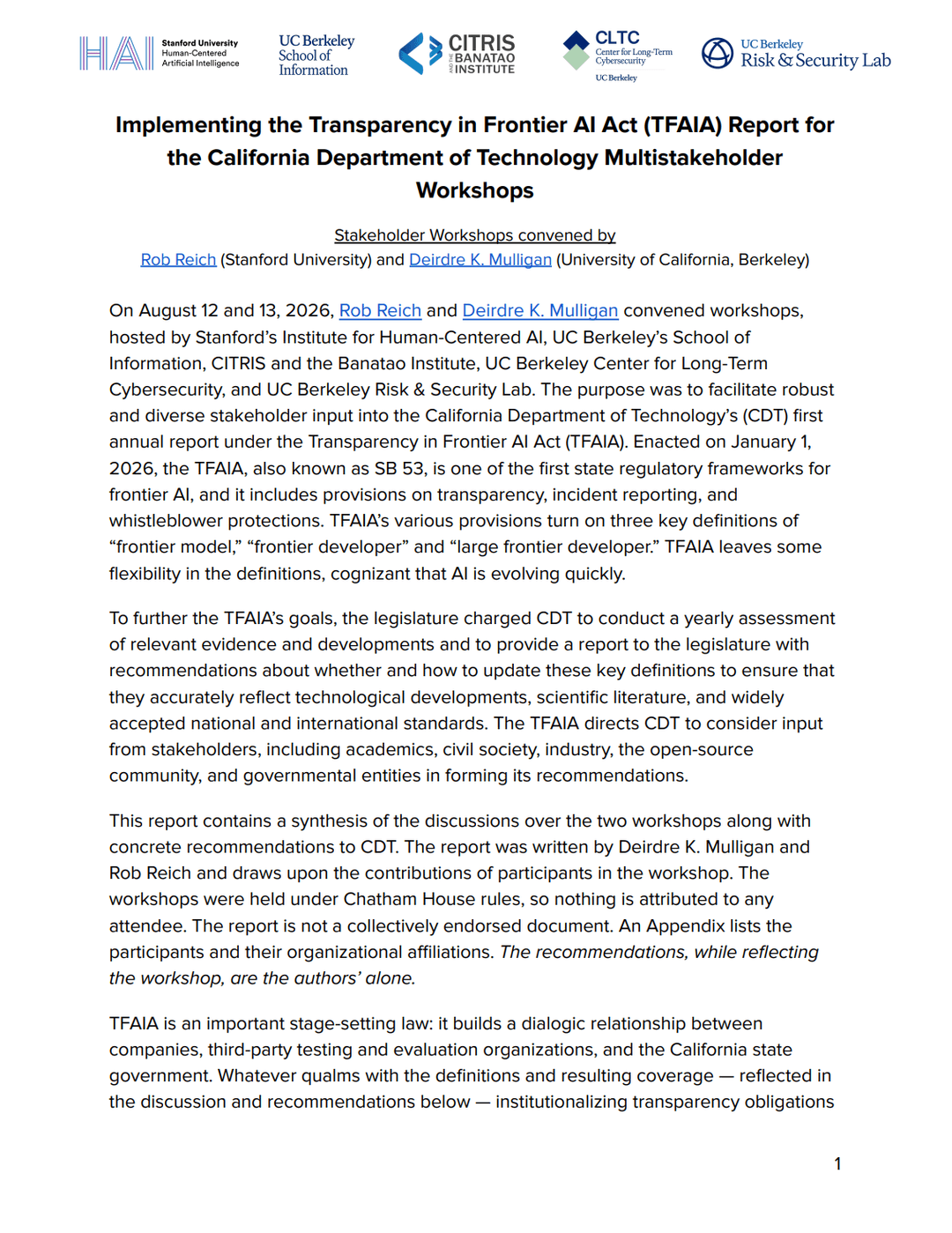
In this paper, HAI Associate Director and Senior Fellow Rob Reich and UC Berkeley School of Information Professor Deirdre K. Mulligan provide concrete recommendations to the California Department of Technology on the implementation of its frontier AI transparency requirements.
Making Local Law Legible: LLM-Assisted Detection of Discrimination
This brief demonstrates the potential of LLM-assisted review to accelerate legal reform.
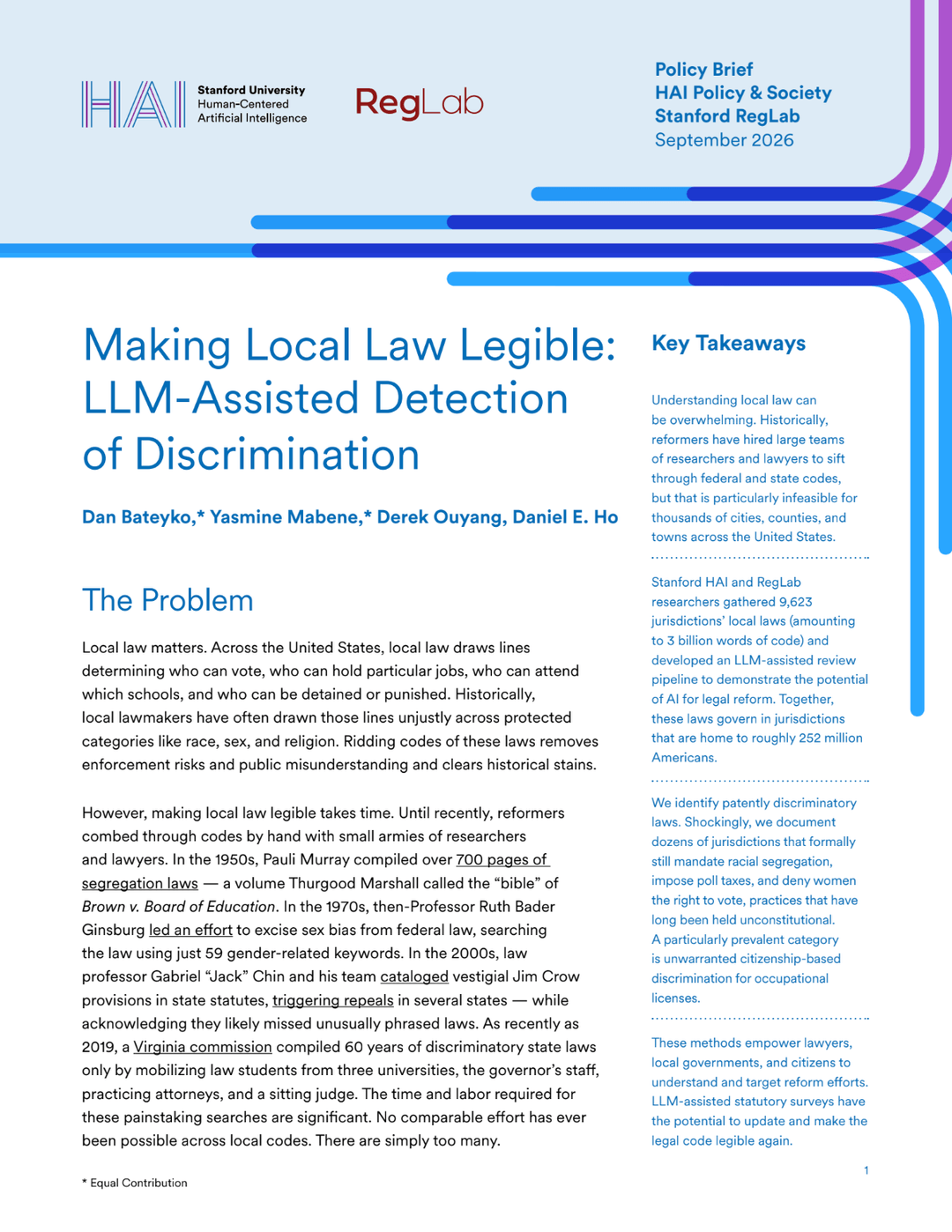
This brief demonstrates the potential of LLM-assisted review to accelerate legal reform.
Designing Loyalty: AI Agents and Conflicts of Interest
This brief examines the conflict-of-interest risks posed by AI agents and calls for imposing a duty of loyalty on developers and deployers.
This brief examines the conflict-of-interest risks posed by AI agents and calls for imposing a duty of loyalty on developers and deployers.